

“Stakeholder” can mean everyone with an interest in a property sale, or, in a specific legal context, someone holding a deposit. That distinction explains why asking what is a stakeholder in a property transaction can lead to more than one answer. Understanding the context helps you work out who makes decisions, who gives advice and who handles administration.
Buyers and sellers make the main decisions. Solicitors, lenders, surveyors and other participants may contribute legal advice, finance or information that affects progress. In an auction, the auction house facilitates the sale and its administration, but doesn’t replace either party’s legal adviser.
This guide explains the main roles, how their interests and responsibilities differ, and where to direct questions. It also clarifies the two uses of “stakeholder” and outlines how participants work together in a typical transaction, including an auction sale. Use this overview to identify who is responsible for the next step and follow up with the right person if progress stalls.
Key Takeaways
- Understand what is a stakeholder in a property transaction and why the term can describe different people and organisations.
- Identify the roles of buyers and sellers, professional advisers, finance providers and transaction facilitators.
- Distinguish having an interest in a sale from having formal responsibility or authority to make decisions.
- Follow the main stages of a transaction while recognising that procedures can vary across the UK.
- See how buyers, sellers, legal representatives and an auction house may work together in an auction sale.
What is a stakeholder in a property transaction?
A stakeholder in a property transaction is a person or organisation affected by, involved in, or able to influence the sale or purchase. It describes a connection to the transaction, not one universal legal job title. Its meaning depends on the person’s role and, in some cases, on how a contract uses the word.
Property transactions involve decisions, advice, funding and administration. The real estate transaction process varies with the property, how the buyer funds the purchase and whether it is a private sale or an auction. A cash buyer, for example, won’t have a mortgage lender involved. An auction sale may include an auction house to manage marketing and bidding.
A stakeholder has a direct interest, role or influence in the transaction. Someone who merely receives general information about it isn’t automatically a stakeholder. This distinction separates people with a practical connection to the sale from those who are simply kept informed.
Who counts as a stakeholder when property changes hands?
The buyer and seller are the principal stakeholders. Their decisions drive the transaction: the seller decides whether to proceed with a sale, and the buyer decides whether to purchase on the proposed terms. Other participants may support, advise or facilitate those decisions without taking them over.
- Professional advisers, such as solicitors or conveyancers, handle legal work for their own clients.
- Lenders may provide purchase finance and have an interest in the property securing the loan.
- Transaction facilitators, such as estate agents or an auction house, can help market the property and manage parts of the sales process.
These participants have a direct role because their work or decisions can affect progress. A neighbour might be indirectly affected by a proposed development, for instance, but that doesn’t automatically make them a party to the sale or give them authority over the buyer’s and seller’s choices. The stakeholders involved depend on the transaction. Not every sale includes every type of participant.
Does stakeholder have a specific legal meaning?
Context matters. In everyday discussion, “stakeholder” can refer broadly to anyone with an interest in the transaction. In a contract or legal discussion, it may describe a specific role. Don’t assume the broad meaning applies: read the wording and identify the person, funds and responsibilities it refers to.
One specific use concerns money held as a stakeholder under contractual terms. This describes an arrangement for holding funds, not a label for everyone involved in a property sale. The agreement sets out the terms for holding and releasing the money. If the wording or responsibilities are unclear, seek advice from a qualified legal professional. Procedures and legal requirements can differ across the UK, so don’t assume the arrangement in one transaction applies to all others.
Key Stakeholders in Property Transactions and Their Roles
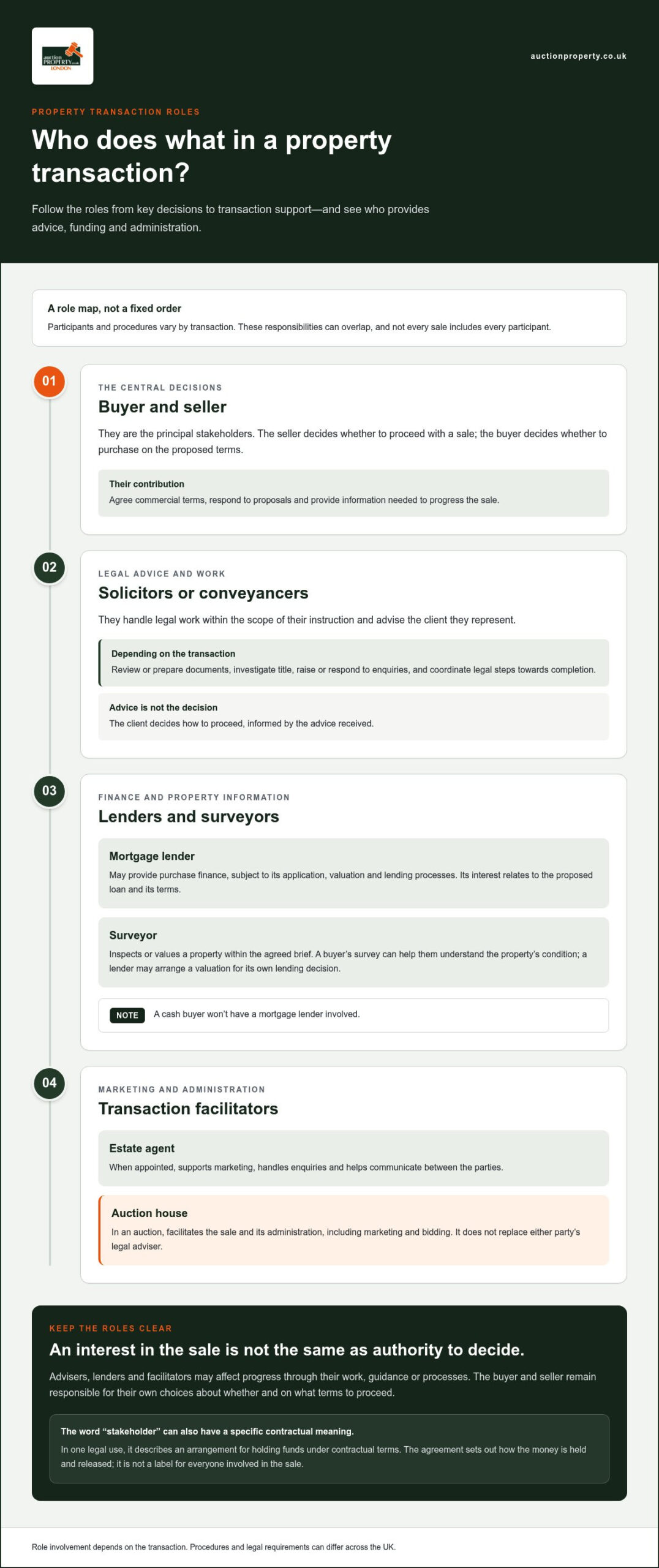
A stakeholder’s role depends on what they contribute, not simply on whether they have an interest in the sale. Buyers and sellers make the central commercial decisions. Advisers provide guidance, finance providers may fund a purchase, and facilitators help progress the transaction. Each participant is generally responsible for their own part of the process, while the buyer and seller decide whether and on what terms to proceed.
This role map answers “what is a stakeholder in a property transaction?” in practical terms. Not every sale includes every professional or funding arrangement. A cash purchase won’t involve a mortgage lender, for example, and an estate agency such as Residential Links is involved only when appointed to market and manage a sale. Focus on the work a person performs as well as the interest that connects them to the transaction.
What do buyers, sellers, and conveyancers contribute?
Buyers and sellers are the main decision-makers. They agree commercial terms, respond to proposals and provide information needed to progress the sale. The seller supplies relevant property details. The buyer provides information required for the purchase and, where applicable, their funding. Their choices shape the transaction, even when advisers explain the options.
Solicitors or conveyancers handle legal work within the scope of their instruction. Depending on the transaction and jurisdiction, this can include reviewing or preparing documents, investigating title, raising or responding to enquiries, and coordinating legal steps towards completion. They advise the client they represent, but don’t make that client’s commercial decisions. The client decides how to proceed, informed by the advice received.
How do lenders, surveyors, and estate agents fit in?
Other stakeholders contribute a defined service or resource. Their involvement can affect progress, but it doesn’t give them general control over the buyer’s or seller’s choices.
- Mortgage lenders may provide finance, subject to their application, valuation and lending processes. Their interest is connected to the proposed loan and its terms, not to representing the buyer in every part of the transaction.
- Surveyors inspect or value a property within the agreed brief. A buyer may commission a survey to understand the property’s condition; a lender may arrange a valuation for its own lending decision. These are different purposes.
- Estate agents, when appointed, support marketing, handle enquiries and help communicate between parties. Professional conduct expectations for property agency are addressed in RICS professional standards.
Local authorities or land registration bodies may also provide information or carry out administrative functions where relevant. They aren’t substitutes for the parties’ advisers, and their involvement doesn’t necessarily mean they decide the commercial terms.
In an auction sale, the auction house can facilitate marketing, bidding and sale administration. It doesn’t replace the buyer’s or seller’s legal representative. If you’re considering this route, explore online property auctions to see how an auction setting brings these roles together.
How do a stakeholder’s interest and responsibility differ?
A stakeholder’s interest explains why a transaction matters to them. Their responsibility describes the work they’re expected to perform, while their decision-making authority shows what they can decide for themselves. These ideas are related, but they aren’t interchangeable. Someone can be affected by a sale without having the right to direct either party’s choices.
The table offers a practical comparison, not a complete account of legal duties. Responsibilities depend on the person’s role, the terms of their instruction or agreement, and the rules that apply to the transaction.
| Participant | Typical interest | Typical responsibility | Decision-making authority |
|---|---|---|---|
| Buyer or seller | To acquire or sell the property on suitable terms | Make decisions and provide information relevant to their part in the sale | Decides whether to proceed, subject to any binding commitments |
| Solicitor or conveyancer | To act for their client in the legal work | Provide legal services within their instruction | Advises the client, but doesn’t make the client’s commercial choices |
| Mortgage lender, where involved | To assess and manage its proposed lending | Apply its own lending process and terms | Makes decisions about its finance, not the sale on behalf of buyer or seller |
| Surveyor, when instructed | To carry out an agreed inspection or valuation | Report within the scope of the brief | Provides findings, not the parties’ purchase decision |
| Agent or auction house, when appointed | To facilitate aspects of the sale | Support agreed marketing, communication or auction administration | Doesn’t replace the parties’ decisions or legal advisers |
Who makes decisions, and who provides advice?
The buyer and seller decide whether a proposed deal works for them. Their appointed professionals help them understand the legal, financial or physical information relevant to that decision. For example, a surveyor may report a defect. The buyer can use that information to decide how to proceed, but the surveyor doesn’t decide whether the buyer should continue.
A lender has a different kind of authority: it makes decisions within its own lending process. Its assessment may affect whether a buyer can use that finance, but it doesn’t make the seller accept an offer. The answer to “what is a stakeholder in a property transaction?” is clearer when you separate involvement from control. A stakeholder may influence the process without controlling another party’s choices.
Can someone be involved without being a main stakeholder?
Yes. Some people contribute at only one stage. A surveyor may be instructed to inspect a property, for example, while a local authority may provide information relevant to a search. Their input can matter without making them principal decision-makers. By contrast, someone who receives an occasional update may have little direct involvement or influence.
Roles can also change in importance as the transaction progresses. A lender may be central while finance is assessed, then have a different part later. An auction house may be closely involved in marketing and bidding, while the parties’ legal representatives handle legal work. The participants depend on the property, sale method and funding. Check who is responsible for the next action rather than assuming that everyone with an interest can make or approve the decision.
How do stakeholders work together through a property transaction?
A transaction progresses when each participant completes their part and shares relevant information with the people who need it. The sequence and legal steps depend on the UK jurisdiction, property, funding and sale structure. Treat the stages below as a practical overview, not a fixed timetable or legal checklist.
- Agree the proposed terms. Buyer and seller establish the basis on which they intend to proceed. If an agent or auction house is involved, it may help communicate the agreed position and manage sale administration.
- Arrange checks and gather information. The buyer, their legal representative and, where relevant, a lender or surveyor may need different details. Clarify who is requesting each item and who should supply it.
- Prepare and review documents. The parties’ legal representatives handle documents and legal enquiries within their instructions. Send information to the relevant representative rather than assuming another participant will forward it.
- Progress towards completion. Once the necessary steps and contractual requirements are addressed, the parties and their representatives coordinate the actions required to complete. The precise process varies by jurisdiction and transaction structure.
- Register the change where applicable. After completion, ownership records may need updating through the relevant land registration process. The responsible party and steps depend on the jurisdiction and circumstances.
For an auction, the method of sale and its terms shape responsibilities and key milestones. A UK property auctions guide can provide further context on how buyers, sellers, legal representatives and an auction house may interact during a sale.
What information should each participant keep track of?
Keep a simple record of who is involved, their roles, outstanding requests and agreed next steps. Note who is expected to respond and whether a document has been sent or received. This makes it easier to spot a stalled task and direct a follow-up to the right person.
Send documents to the appointed professional or party handling that issue. A lender’s request, for example, may need to go to the buyer’s finance contact, while a legal enquiry should reach the relevant legal representative. Don’t assume an update has been passed on or actioned. Ask for acknowledgement when a change affects the next step.
What can slow communication or create confusion?
Common sources of friction include unclear task ownership, incomplete information and changes that aren’t shared with everyone affected. If a document is missing, establish who needs to provide it. If a date or key detail changes, tell the relevant participants promptly and keep a written record.
Direct each question to the person responsible for that subject. Ask the legal representative about legal documentation, the lender about its finance process, and the appointed agent or auction house about sale administration. Clear ownership helps the right person respond without implying that one stakeholder controls the whole transaction. If you’re considering an auction sale, explore online property auctions as one way to bring the sale process and its participants together.
How does the stakeholder map change in a property auction?
An auction adds a visible facilitator to the transaction, but it doesn’t change the basic distinction between decision-makers and advisers. The seller chooses to offer the property for sale and sets their instructions. Bidders assess whether to compete and, if successful, proceed according to the applicable auction terms. Each party remains responsible for its own decisions and appointed legal advice.
The auction house supports the sale process by helping prepare the property for market, presenting information to potential buyers, managing bidding and handling related administration. The seller’s and buyer’s legal representatives deal with legal advice and documentation within their instructions. These boundaries matter: the auction house facilitates the transaction but doesn’t replace either party’s solicitor or conveyancer.
What does an auction house contribute to the transaction?
Auction Property Ltd supports property sales through valuations, marketing, online auction facilitation and legal administrative assistance. These services help connect the seller’s instructions with buyer interest and keep relevant sale information organised. The auction house can coordinate practical steps around the auction, while the seller decides whether to offer the property and the buyer decides whether and how to bid.
For buyers, the legal pack is an important source of sale information to review as part of their assessment. The auction house provides administrative support around the process, but doesn’t interpret legal documents as the buyer’s adviser or decide whether a purchase suits their circumstances. Direct questions about legal meaning to your appointed legal representative.
What should buyers and sellers understand about auction roles?
Auction terms and the transaction structure determine what happens after bidding, including the relevant contractual steps and requirements. Don’t assume that every auction follows the same timetable or that the process is identical across the UK. Read the applicable terms, understand what action is expected from you, and direct legal questions to your appointed representative.
For sellers, the auction house can help organise marketing and the auction process, while the seller’s legal representative handles legal matters within their instruction. Buyers should assess the property and sale documents before bidding, with advice from their own professionals where needed. Facilitation supports the process, but it doesn’t transfer a party’s decisions to someone else.
If you’re selling, the UK guide to selling a house at auction explains the process in more detail. To see how an auction can bring buyers, sellers and transaction support together, explore online property auctions.
In this setting, asking “what is a stakeholder in a property transaction?” means looking at both the people making decisions and those helping the sale progress. Identify each role, read the relevant terms and keep legal advice with the professionals appointed to provide it.
Take the next step with a clearer plan
Before you act, write down who is handling each outstanding task and which decisions remain yours. This turns a crowded list of names into a practical plan, whether you’re buying, selling or weighing up an auction. Understanding what is a stakeholder in a property transaction helps you direct questions to the right person and keep your next move clear.
If an auction could suit your plans, consider how its process fits your priorities. Auction Property Ltd provides an online property auction platform, with support that includes valuations, marketing and legal administrative assistance. The auction house facilitates the sale, while decisions remain with you and legal advice remains with your appointed professionals.
Explore how Auction Property Ltd supports property sales through online auctions and take an informed next step.
Frequently Asked Questions
Is an estate agent a stakeholder in a property transaction?
Can a property transaction have stakeholders who are not directly involved in the sale?
Yes. Someone can be affected by a sale or development without negotiating or signing the sale documents. A neighbouring owner might be affected by a proposed development, for example, while a building manager may provide information about a leasehold property. Their involvement and influence depend on the circumstances. Being affected doesn’t, by itself, make someone a party to the sale or give them control over it.
Is a conveyancer the same as a stakeholder?
No. A conveyancer is a professional who handles legal work within their client’s instructions. “Stakeholder” is a broader description of someone with an interest or role in a transaction. It can also describe a specific contractual function involving funds. A conveyancer may therefore be a stakeholder in the broad sense, but the terms aren’t interchangeable. Check the context in which the word is used.
What does it mean when a deposit is held as stakeholder?
It means the deposit is held under a particular contractual arrangement, rather than “stakeholder” simply describing someone involved in the sale. The agreement should explain who holds the money and the conditions for its release. Don’t assume the arrangements are identical across transactions or UK jurisdictions. If a contract uses this wording, ask your appointed legal representative to explain the relevant clause before making assumptions about when funds can be released.
Who should I contact if a property transaction is delayed?
Start with the person responsible for the outstanding step. If a legal document or enquiry is holding things up, ask your conveyancer or solicitor what’s needed and who must respond. If finance is the issue, contact the lender or your finance contact. For a survey report, ask the surveyor. Keep a record of the query, response and next action so you can follow up with the right participant.
Does every property transaction have the same stakeholders?
No. The people involved depend on the property, how it’s being sold, whether the buyer needs finance and which UK jurisdiction applies. A cash purchase won’t require a mortgage lender, while an auction may involve an auction house. The answer to “what is a stakeholder in a property transaction” depends on the roles and interests in that particular sale, not on a fixed list of participants.
Can one person have more than one role in a property transaction?
Yes. A participant may have more than one function, but each capacity should be clear. For example, a solicitor could handle legal work for a client and separately be named in the contract to hold funds under specified terms. Those functions have different responsibilities. Check the agreement to see which role applies, and direct questions about legal advice to the professional acting for you.