

You might have the keys, the planning permission, and a clear vision for your new development, but an invisible legal ghost from the 1800s could still shut your project down instantly. Understanding what are restrictive covenants on a property is the difference between securing a high-yield asset and inheriting a permanent legal headache. These private agreements stay attached to the land regardless of who owns it. They frequently override modern council approvals; your “done deal” could be anything but.
It’s exhausting to navigate thick legal packs only to find jargon that threatens your investment strategy. We’ll help you decode these documents so you know exactly how restrictive covenants affect property value and usage rights before the hammer falls. This guide details the specific restrictions common in 2026, explains how to identify them in the Land Registry, and outlines the latest legal pathways to modify or insure against them effectively. You’ll gain the clarity needed to manage these risks and move from curiosity to a confident, binding transaction.
Key Takeaways
- Understand that restrictive covenants are private legal agreements that can block development or specific land uses even if you have full planning permission.
- Learn exactly what are restrictive covenants on a property and why identifying them in the legal pack is critical before the binding exchange of a property auction.
- Master the process of using HM Land Registry records to pinpoint who holds the “benefit” of a covenant and who carries the “burden” of the restriction.
- Discover the 2026 legal frameworks and Upper Tribunal costs involved in successfully challenging, modifying, or insuring against outdated property restrictions.
- Utilize professional legal pack administrative support to navigate complex jargon and secure transactional certainty for your next residential or commercial investment.
Understanding the Legal Framework of Restrictive Covenants
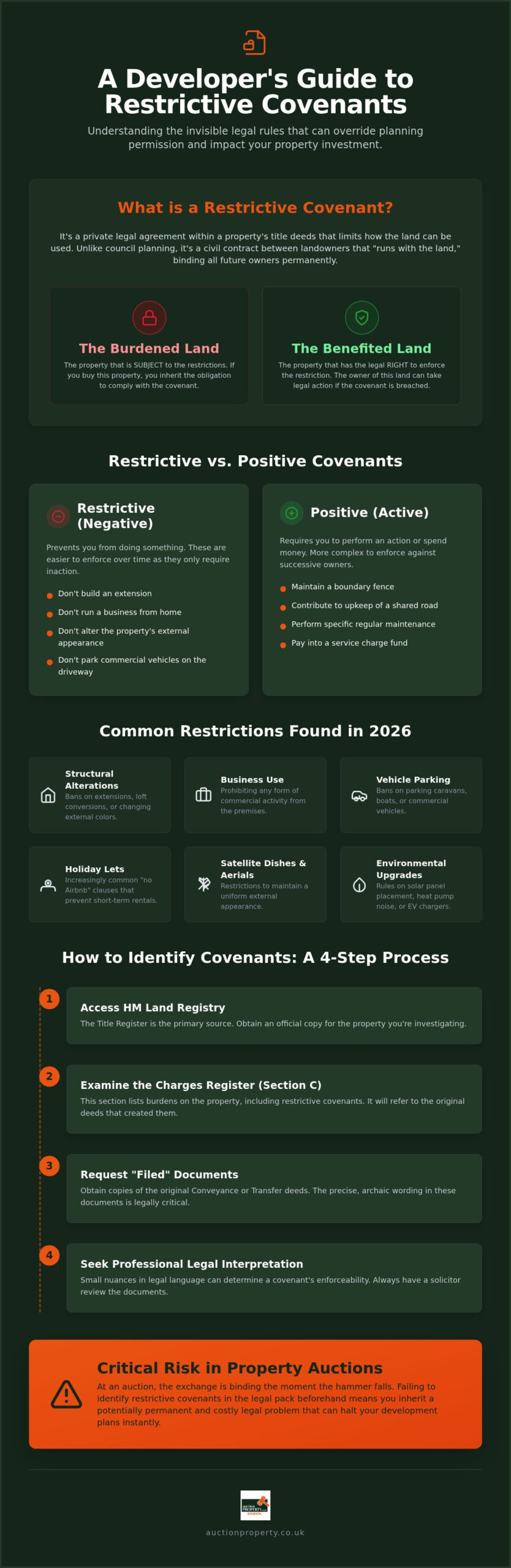
To grasp what are restrictive covenants on a property, you must look beyond standard ownership. These are private agreements recorded in a property’s title deeds that limit how a piece of land can be used or developed. Unlike local planning laws, which are governed by the council, restrictive covenants are civil contracts between landowners. They don’t expire simply because time has passed or the property has changed hands. They create a permanent legal relationship between two distinct plots of land: the burdened land and the benefited land.
Every restrictive covenant involves this dual structure. The burdened land is the property subject to the restriction, while the benefited land is the property that has the legal right to enforce it. If you buy a property with a covenant, you inherit the burden. These obligations are a form of Covenant (law) that “run with the land,” meaning they remain binding on all future owners regardless of how many times the asset is sold. This longevity makes them particularly dangerous for developers who fail to conduct thorough due diligence before an auction exchange.
The Difference Between Restrictive and Positive Covenants
Understanding the distinction between restrictive and positive covenants is vital for assessing your financial liability. A restrictive covenant is “negative” in nature; it prevents you from doing something. Examples include prohibitions against building extensions or running a business from home. These are generally easier for third parties to enforce over centuries because they don’t require the owner to take active steps, only to refrain from certain actions.
In contrast, positive covenants require an owner to perform an action or spend money. Common examples include a requirement to maintain a boundary fence or contribute to the upkeep of a shared private road. Legally, positive covenants are more complex to enforce against successive owners. They often require an “indemnity chain” to remain active. However, you shouldn’t ignore them. A broken chain can still lead to legal disputes that delay a sale or complicate a development project.
How Covenants are Registered at HM Land Registry
The Title Register serves as the primary source of truth for 2026 property encumbrances. When searching for what are restrictive covenants on a property, your first stop is the Charges Register (Section C) of the Title Register. This section lists the specific dates of the deeds that created the restrictions. It often provides a summary of the wording, but the summary is rarely enough for a full legal assessment.
You must often go a step further and request the “filed” documents, such as the original Conveyance or Transfer deed. These documents contain the precise, archaic language used when the covenant was first drafted. Digital records at HM Land Registry have made these documents more accessible in 2026, but the interpretation remains a specialized task. Small nuances in the original text can determine whether a neighbor can legally halt your construction or if the covenant has become “obsolete” under modern law.
Common Examples and Their Impact on Homeowners
Covenants aren’t just about blocking major developments. They often regulate the smallest details of your daily life. When you ask what are restrictive covenants on a property, you’ll find they range from structural prohibitions to strict lifestyle mandates. Common examples include bans on building extensions, installing satellite dishes, or altering the external colour of your home. These rules aim to maintain a specific aesthetic, but they can severely limit your ability to add value to your home or adapt it to your needs.
Usage restrictions are equally common and often more restrictive. Many older deeds contain “nuisance” clauses that prohibit parking caravans, boats, or commercial vehicles on driveways. You might also find bans on keeping specific animals or running any form of business from the premises. In the current market, “no holiday let” clauses are a major hurdle for those looking to list on platforms like Airbnb. These restrictions are legally binding. Ignoring them can lead to costly injunctions from neighbours who hold the benefit of the covenant.
The 2026 landscape has introduced new layers of complexity. Modern estates often include restrictions on environmental upgrades that didn’t exist a decade ago. You may find clauses that dictate the placement of solar panels, the external noise levels of heat pumps, or even where EV charging cables can be run. These “green” restrictions can clash with national net-zero goals, yet they remain enforceable private contracts. Always verify these details in the legal pack before you commit to a purchase.
Residential vs Commercial Covenant Patterns
The impact of a covenant depends heavily on the property type. Residential covenants typically focus on “single private dwelling” status. This prevents you from splitting a large house into flats. For those looking at an investment property, these clauses can make or break a business plan. Commercial covenants are different. They often focus on “non-compete” clauses. For instance, a former pub might be sold with a restriction that it cannot be used to sell alcohol in the future. This protects the seller’s other local interests but limits your exit strategy.
The ‘New Build’ Trap: Why Modern Estates Have More Rules
Newer developments are often the most heavily restricted. Developers use covenants to maintain a “showroom” appearance until every unit on the site is sold. This means you might be forbidden from changing your front door or even planting certain trees for several years. Many modern estates also involve management companies that have the power to charge fees for “approving” any changes you wish to make. A “no trade” covenant on a modern estate can even stop a quiet home-based consultancy if a neighbour decides to enforce the letter of the law. Checking the administrative details provided by Auction Property Ltd ensures you aren’t caught out by these estate-wide mandates.
The Critical Role of Restrictive Covenants in Property Auctions
In a traditional private treaty sale, you have weeks to negotiate or withdraw. At auction, the timeline shrinks to seconds. Once the gavel falls, you’ve entered a legally binding contract. If you discover a restriction against building your planned extension five minutes after the hammer drops, you’re still legally obligated to complete the purchase at the full price. This makes understanding what are restrictive covenants on a property a non-negotiable part of your pre-auction research. There’s no cooling-off period and no room for price adjustments based on late discoveries.
Covenants don’t just affect what you can build; they dictate how you can pay. Many high-street lenders refuse to secure funds against properties with aggressive restrictive covenants, especially those that prevent future development or include “buy-back” clauses for the original developer. This often renders a property “unmortgageable,” narrowing the pool of buyers to cash-rich investors. If you’re selling house fast at auction uk, you must be transparent about these limitations to attract the right professional bidders who can handle the associated risks.
Scrutinising the Legal Pack
You’ll find the Register of Title and Title Plan within our auction property listings. The Legal Pack is the definitive disclosure document provided before bidding begins, containing every recorded encumbrance on the land. Look for subjective “red flag” language. Phrases like “not to cause an annoyance” are notoriously difficult to define and give neighbours a broad platform to challenge your plans. If the pack is missing the original transfer deed mentioned in the charges register, treat that as a major warning sign.
The Risk of Injunctions and Damages
Ignoring a covenant is a high-stakes gamble. If you proceed with unauthorized work, the beneficiary can apply for a mandatory injunction. This isn’t just a fine; a court can force you to demolish the new structure at your own expense. For those looking at land for sale near me, a single restrictive covenant can permanently suppress the resale value by stripping away the development potential that justified the initial purchase price. You must weigh the cost of indemnity insurance against the potential for a total project halt.
How to Identify, Challenge, or Remove a Restrictive Covenant
Discovering what are restrictive covenants on a property is only the first step. You must then determine if they are enforceable and how to neutralize them. Start by obtaining official copies of the Title Register from HM Land Registry. You’ll also need the “filed” documents, usually the original Transfer or Conveyance. These documents allow you to identify the beneficiary. If the beneficiary is a defunct developer or a company that no longer exists, enforcement becomes significantly more difficult. If they are a neighbor or a local authority, you may need to negotiate a formal Release or Modification for a negotiated fee.
When negotiation fails, the Law of Property Act 1925 (Section 84) provides a path through the Upper Tribunal (Lands Chamber). As of July 13, 2026, the fees for this process are strictly defined. Lodging an application costs £1,025. If the case proceeds to a hearing as to entitlement, you’ll pay £640. A full substantive hearing costs £1,281. While this route offers a permanent legal solution, it’s time-consuming and carries the risk of being blocked by recent precedents like Butler v Flagship Housing Group (2026), which reinforced how difficult it is to remove covenants even with planning permission.
Is the Covenant Still Enforceable?
Not every covenant written in the 19th century remains valid today. To be enforceable, a covenant must pass the “annexation” test; it must actually “touch and concern” the land it’s meant to benefit. You can also challenge a covenant if it’s deemed obsolete. This happens when the character of the neighborhood has changed so drastically that the original restriction no longer serves a purpose. Additionally, the “20-year rule” can offer a defense. If a covenant has been openly breached for over 20 years without objection, the court may consider the right to enforce it as lost through long-term inaction.
Indemnity Insurance: The Investor’s Secret Weapon
For most auction buyers, restrictive covenant indemnity insurance is the preferred solution. It’s faster than a legal battle and provides financial protection against future claims or the cost of demolishing a structure. However, you must follow the “Golden Rule”: never contact the beneficiary before taking out a policy. If you alert the neighbor or developer to the breach, insurers will almost certainly refuse to cover the risk. Policies in 2026 are typically one-off payments that remain with the property, providing the certainty needed to move a project forward without waiting for a Tribunal decision. Secure professional administrative support for your next auction bid to ensure your legal pack review includes an assessment of these insurance options.
Navigating Legal Packs and Covenants with Auction Property Ltd
Success in the auction room depends on the quality of your pre-bid intelligence. While many buyers struggle to identify what are restrictive covenants on a property, our platform is built to front-load this critical data. We provide comprehensive legal packs for every auction house uk listing, ensuring that restrictions are visible long before the first bid is placed. This transparency removes the “hidden surprise” factor that often leads to transaction failure in traditional sales models. We prioritize clarity so you can focus on the numbers.
Our expert team provides administrative support to help you navigate the technicalities of these documents. We don’t just host listings; we facilitate a secure environment where seasoned investors and first-time buyers can act with confidence. By providing clear, digitized access to the Charges Register and original deeds, we help you determine the impact of a covenant on your specific development goals. This commitment to clarity is why we’re the preferred choice for commercial property auction participants who require precise data to justify high-stakes investments.
Due Diligence Made Simple
Efficiency is at the core of our transaction model. You can use our online portal to review title documents 24/7, allowing you to perform due diligence on your own schedule. If the language in a deed is particularly archaic, we can connect you with specialist solicitors from our nationwide network. These professionals understand the brisk pace of the auction market and can provide rapid assessments of what are restrictive covenants on a property. This proactive approach ensures your finances are prepared for a certain outcome, whether that involves standard lending or a cash-ready strategy.
Ready to Buy or Sell?
We ensure all parties are protected through rigorous legal disclosure. For sellers, providing a clear and complete legal pack up front attracts more serious bidders and prevents last-minute withdrawals. For buyers, the speed of the hammer means moving from a successful bid to completion in as little as 28 days. This accelerated timeline is only possible when the legal hurdles, such as property covenants, are addressed and understood before the auction begins. Contact the Auction Property Ltd team for a professional valuation or to browse our latest lots to start your journey toward a secure, high-speed property transaction.
Execute Your Strategy with Total Confidence
Restrictive covenants don’t have to be deal-breakers if you approach them with the right data. By mastering what are restrictive covenants on a property before you enter the auction room, you transform a potential legal nightmare into a manageable variable. These private agreements are permanent; they require either a formal release, a Tribunal order, or a robust indemnity policy to neutralize. Success in the 2026 market relies on front-loading this due diligence and acting on facts rather than assumptions.
Auction Property Ltd provides the transparency required to make these high-stakes decisions with speed and certainty. As a professional property auction house based in London, we specialize in residential, commercial, and land auctions with a nationwide reach. Our platform ensures you have access to expert administrative support and comprehensive legal packs, stripping away the administrative hurdles of traditional sales. We position you to move from curiosity to completion in record time.
Secure your next investment with Auction Property Ltd; browse our current listings today. Take control of your property portfolio and bid with the clarity that only an expert partner can provide. We look forward to helping you secure your next high-yield asset.
Frequently Asked Questions
Do restrictive covenants expire after a certain number of years?
Restrictive covenants do not expire automatically regardless of how much time has passed. They remain binding on the land for centuries unless they are formally discharged or modified by the Upper Tribunal. While a covenant may become “obsolete” if the character of the neighborhood changes significantly, it stays on the title deeds until a legal process removes it.
Can I ignore a restrictive covenant if the original company no longer exists?
You cannot safely ignore a covenant simply because the original developer or company is defunct. The legal “benefit” of the restriction often passes to the current owners of neighboring plots or is transferred to a successor entity. Always verify the status of the beneficiary in the auction legal pack to avoid an unexpected injunction from a current neighbor who still holds enforcement rights.
How much does it cost to remove a restrictive covenant in 2026?
Removing a covenant involves specific government fees as of July 2026. Lodging an application with the Upper Tribunal (Lands Chamber) costs £1,025, with a hearing as to entitlement priced at £640. If the case reaches a substantive hearing, the fee is £1,281. These figures exclude your own legal representation costs and any compensation you might have to pay the beneficiary to secure a release.
Will a restrictive covenant stop me from getting a mortgage?
Certain covenants can make a property unmortgageable if they significantly restrict the land’s use or resale value. Lenders often reject applications for properties with aggressive restrictions, such as “buy-back” clauses or total bans on development. Understanding what are restrictive covenants on a property is vital for auction bidders; if a lender refuses the risk, you’ll need to complete the purchase as a cash investor.
Can a neighbor enforce a covenant if they aren’t mentioned in the deeds?
Neighbors can often enforce a covenant even if they aren’t named personally in your specific documents. If their land was part of the original “scheme of development,” the benefit is legally annexed to their plot. This gives them a private right to take civil action to prevent you from breaching the terms, even if you have already secured local council planning permission.
What is the difference between a restrictive covenant and an easement?
A restrictive covenant prevents you from doing something on your own land, while an easement grants someone else a specific right to use your land. For example, a covenant might stop you from building an extension, whereas an easement might give a neighbor the right to run utility pipes under your garden. Both are legal encumbrances that appear on the Charges Register of the Title Register.
Does indemnity insurance cover the cost of removing an extension?
Indemnity insurance typically covers the financial losses associated with a successful legal challenge, including forced demolition. If a beneficiary enforces a covenant against your new extension, the policy pays for legal defense, the resulting loss in property value, and the physical cost of removal. It’s an essential tool for managing the risks associated with what are restrictive covenants on a property during a fast-paced auction transaction.
How can I find out who owns the ‘benefited land’ for my property?
Identifying the owner of the benefited land requires a detailed search of the Charges Register within the Title Register. This section identifies the specific historic deeds that created the restriction. You will often need to purchase Title Register copies for neighboring properties from HM Land Registry to confirm which current landowners hold the legal power to enforce the rules against you.