

An auction property’s EPC is a clue, not a verdict. When understanding energy performance certificates (EPC) for auction homes, start with what the rating can tell you and where it stops short. An A to G band estimates energy performance under standard assumptions. It does not predict your actual bills or confirm the property’s current condition.
A low rating does not automatically mean a home will be costly to run, and a high rating is no guarantee that no further checks are needed. The certificate’s age, assessment details and recommendations all need context.
This guide explains how to read an EPC, which details may warrant further investigation and what the certificate cannot establish. You’ll also learn how to use it alongside auction lot information and other available documents as part of your due diligence, so you can weigh up the information before deciding whether to bid.
Key Takeaways
- Use the A to G rating as a snapshot of assessed energy performance, not a complete verdict on the home.
- Read estimated costs as guide figures. Household behaviour, tariffs, occupancy and property use affect actual energy bills.
- When understanding energy performance certificates (EPC) for auction homes, compare the rating, assessment date, recommendations and property details for consistency.
- Identify the property first, then search the appropriate EPC register. Routes and terminology vary across UK nations.
- Review the EPC alongside other lot information before deciding whether to bid. Keep the non-refundable auction-day deposit and fixed completion timeframe in mind.
What an EPC tells you about an auction home
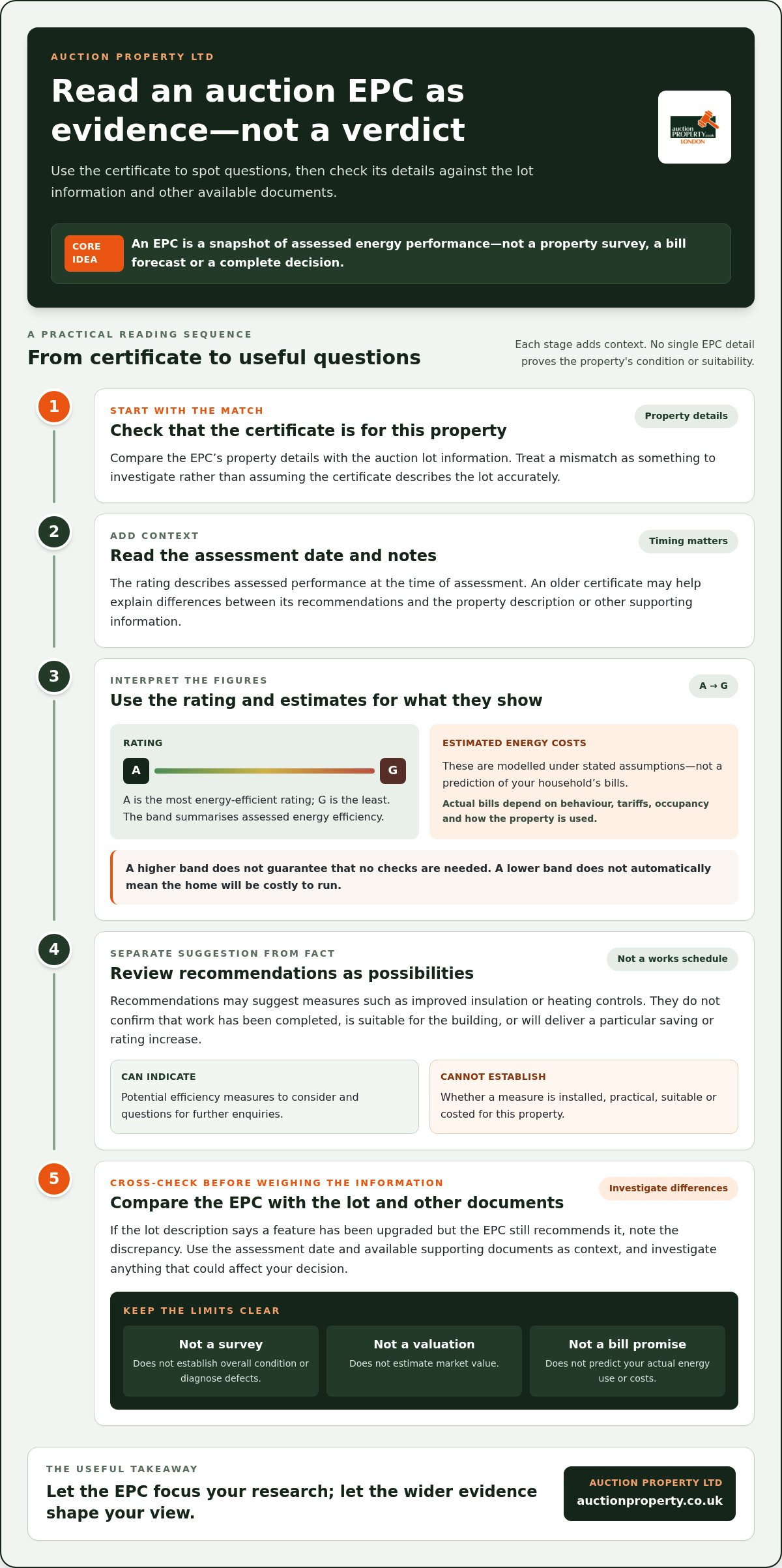
An Energy Performance Certificate (EPC) summarises a property’s assessed energy performance and assigns it a rating from A to G. For a buyer, the rating is a useful starting point, not a complete assessment of the home. It can highlight areas to investigate, but it does not confirm the building’s overall condition or whether it suits your plans.
This distinction matters at auction, where you need to assess the available information before deciding whether to bid. An EPC is not an appliance energy label, which rates an individual product such as a fridge. Nor is it a building survey, which examines property condition, or a valuation, which estimates market value. Treat it as one research input alongside the lot details and your other due diligence.
What information appears on an Energy Performance Certificate?
An EPC typically shows the property’s energy-efficiency rating, estimated energy information and recommendations for potential improvements. It may also include an environmental-impact rating, which indicates estimated carbon emissions, and heat-demand estimates. The certificate provides a structured overview, not a detailed diagnosis of how the home performs in every circumstance.
Some certificates include primary energy use, an estimate of the energy required at source to supply the property’s energy needs, including energy used in generation and delivery. This figure describes assessed performance. It is not a meter reading or a prediction of your personal consumption. The Energy Performance Certificate overview explains the certificate’s purpose and rating approach in the UK and elsewhere.
Recommendations may identify measures such as improved insulation or heating controls. Read them as suggestions to investigate, not as a guaranteed works schedule or a quote. The certificate may not establish the cost, practicality or suitability of a measure for that particular building.
What the A-G EPC rating means for a buyer
The scale runs from A, the most energy-efficient rating, to G, the least efficient. A higher band can indicate stronger assessed energy performance, while a lower band may flag potential inefficiencies or areas worth examining. The rating summarises the assessment; it does not prove that a particular feature is present, working or in good condition.
Use the band to guide your next question. If an older certificate gives a low rating and recommends insulation, compare that information with the property description and any available supporting documents. If the certificate suggests good performance, do not assume every room, heating system or building element has been checked for defects. The EPC alone cannot tell you whether the home suits your budget, intended use or renovation plans.
When understanding energy performance certificates (EPC) for auction homes, keep their purpose clear: use the document to identify useful clues, then investigate anything that could affect your decision. A rating can focus your attention, but it should not make the decision for you.
How to interpret EPC ratings, recommendations, and estimated costs
An EPC’s estimated energy information is based on an assessment method and standard assumptions, not a measurement of how a future household will use energy. Treat the figures as a comparison point, not a personal forecast. Actual bills depend on factors such as household behaviour, energy tariffs, occupancy and how the property is used. For example, a home occupied throughout the day may have different energy use from one used mainly in the evenings.
An EPC estimates a property’s energy performance. It does not promise what your household’s bills will be.
Use each part of the certificate to answer a different question:
| EPC detail | What it can help you assess | What it can’t confirm |
|---|---|---|
| Rating | Assessed energy efficiency at the time of assessment | Current condition or your future bills |
| Estimated costs | Modelled energy-cost information under stated assumptions | Your tariff, occupancy or actual consumption |
| Recommendations | Potential measures to consider | Whether work has been completed or is suitable |
Check the certificate’s assessment date and read its notes alongside the property details. The GOV.UK guidance on Energy Performance Certificates explains official EPC information and requirements. For an auction lot, use the certificate to identify questions for your wider research, rather than treating an estimate as a settled running-cost figure.
How EPC recommendations relate to a home’s energy performance
Recommendations identify possible efficiency improvements; they do not record completed work. Separate suggested measures from features the EPC describes as already present. If insulation appears as a recommendation, do not assume it is installed simply because it is listed. Likewise, do not assume a recommendation is practical for the building or will deliver a particular saving or rating increase without property-specific evidence.
Use the recommendations to guide further enquiries and compare them with the available lot information. If a recommendation concerns a feature that the property description says has already been upgraded, note the discrepancy. The assessment date may help explain why the documents differ.
Why an EPC does not replace a property survey
An EPC assesses energy performance, not the home’s complete physical condition. It is not a structural inspection and does not establish the condition of every element, the cause of a defect or the maintenance work required. A favourable energy rating cannot rule out repairs, while a lower rating does not by itself prove that a property has serious defects.
Keep these investigations distinct. Use EPC findings to explore energy efficiency, review the auction property information for other relevant details, and consider structural, maintenance and legal matters separately. This matters before bidding, when the auction process includes a non-refundable deposit on the day and a predetermined completion timeframe. To put an assessment in context, view relevant auction lots and compare their available information with the certificate.
How to use an EPC when assessing an auction home
Before deciding whether to bid, cross-check the EPC against the details available for the lot. The aim is not to reach a verdict from one rating. Confirm that the certificate appears to relate to the property, identify points that need clarification and add those questions to your wider pre-bid research.
A pre-bid EPC review checklist
Work through the certificate in a consistent order. Record what it says, then compare those details with the lot information rather than relying on memory or assumptions.
- Match the property. Compare the address and property description on the certificate with the auction lot. If they do not appear to match, pause and investigate the discrepancy.
- Check the assessment date. Note when the EPC was produced. It may not reflect later alterations, changes to heating or insulation, or the property’s current presentation.
- Record the rating and energy information. Keep the band and key figures together when reviewing other documents. Treat estimates as assessment information, not as a forecast of your personal bills.
- Review the recommendations. Separate measures suggested for potential improvement from features described as already installed. Note anything that could affect your plans or require further enquiry.
- List inconsistencies and questions. If, for example, the EPC recommends a measure that the lot description appears to say is already present, record the mismatch and seek clarity from the available property information.
A missing detail, outdated assessment or unexpected recommendation is a prompt for further investigation, not automatically a reason to abandon the lot. Its relevance depends on the property, your intended use and what the other information shows. A low rating alone does not establish the home’s overall value, condition or suitability.
Putting EPC findings alongside auction information
Use the EPC as one document in your assessment, not as a substitute for reviewing the wider property information. Auction lots may have different supporting documents, so do not assume an EPC is included in every legal pack. Check what information is available for the specific lot and compare it with the certificate, noting where details align and where questions remain.
For example, an EPC may recommend improved insulation, while other lot information refers to building work or alterations. That combination gives you a specific point to investigate; it does not confirm what work was completed or whether it meets your needs. Keep EPC-related questions separate from other enquiries about title, condition, access or the terms of sale.
Understanding energy performance certificates (EPC) for auction homes means using the certificate to sharpen your due diligence, then weighing its findings against the rest of the evidence before bidding. Review the lot information and auction terms together to assess the property in the context of the auction process.
Finding, checking, and understanding an auction property’s EPC
Check the certificate before relying on it. First identify the property, then search the register for its UK nation and compare the certificate with the auction lot details. Register routes and terminology differ across the UK, so use the appropriate official source rather than assuming one search process applies everywhere.
How to check whether an EPC already exists
Start with the property address and any identifying details shown in the lot information. Use them to search the official EPC register for the relevant nation. Public registers can help locate an existing certificate, but take care if the address format differs or the property has multiple units. If no result appears, do not assume the property is exempt or that auction rules remove any requirement. Check current official guidance and the lot information for the next step.
- Identify the property. Note the address and property type associated with the auction lot.
- Choose the appropriate register. England, Wales and Northern Ireland use a different route from Scotland, which has its own EPC framework and processes.
- Review the result. Match the certificate to the lot, then check its assessment date, rating and property details for consistency.
How validity and UK-wide differences affect your review
In England, Wales and Northern Ireland, an EPC is generally valid for 10 years from issue, unless a newer certificate has been produced. A newer assessment may replace an older one, so check the register for the latest record rather than relying on a document found elsewhere. Scotland has its own EPC framework, so check its current certificate and register guidance separately.
When understanding energy performance certificates (EPC) for auction homes, keep the jurisdiction clear. Certificate requirements and exemptions can differ, and rules may change. Read current official guidance for the property’s nation before making a legal assumption. GOV.UK guidance on Energy Performance Certificates is relevant to England and Wales. For Scotland or Northern Ireland, use the guidance applicable to that nation.
If a certificate is missing, unclear or appears to describe a different property, treat that as an open due-diligence question, not proof of an auction exception. Check the official rules and compare the available documents before deciding how to proceed. Apply the same caution to an exemption: do not assume one exists, applies to the lot or carries over to a new owner without verifying the current position.
Once you’ve checked the certificate and its jurisdiction, compare it with the lot information before making a bid decision. View available auction lots and assess each property’s documents as part of your preparation.
From EPC research to your next auction decision
Use the EPC to sharpen your questions, then make your decision from the full picture. A certificate can highlight energy-efficiency points to investigate, but it cannot determine whether a lot suits your finances, intended use or property plans. A clear sequence helps you move from reviewing the certificate to making a considered bidding decision without treating one document as the final word.
- Review the EPC. Check that it relates to the property and note its rating, assessment date and recommendations.
- Write down questions. Record anything unclear or inconsistent with the lot description, as well as details that could affect your plans.
- Assess the other lot information. Read the available documents and terms of sale, keeping EPC findings in context.
- Decide whether to proceed. Bid only when you’ve considered the information and understand the auction process and your obligations as a successful bidder.
What to understand before registering to bid
Review the EPC alongside the available lot information before making a bidding decision. A non-refundable deposit is required on auction day, and successful bidders face a predetermined, non-negotiable completion timeframe. Lots have guide prices, but a guide price is not the final sale price. The final sale price is determined by the highest bid.
Keep those points in mind as you set your own limit. The EPC may inform your assessment of a property, but it does not establish its value or tell you what to bid. Understanding energy performance certificates (EPC) for auction homes means using energy information as one part of due diligence, then making a decision based on the lot and auction terms as a whole.
How to follow an auction and take the next step
Each auction has a set date and time. Check the details for the relevant lot so you know when bidding is scheduled. You can also watch auctions through the live-stream option. Watching helps you follow the auction, but it does not replace reviewing the documents or preparing for the commitments involved if you become the successful bidder.
Complete your checks before the auction begins. If the lot fits your plans and you’re ready to proceed under the stated terms, view our lots and register to bid.
Turn your research into a confident next step
The value of understanding energy performance certificates (EPC) for auction homes lies in how you use the information: not to predict every cost or settle every question, but to decide what needs attention before you commit. Note any unanswered points and weigh them against your plans for the property. If the remaining questions could change your decision, resolve them using the available lot information before bidding.
That preparation gives you a clearer basis for judging whether a property fits your priorities, rather than letting one certificate detail drive the decision. Auction lots display guide prices, while the final sale price is determined by the highest bid. You can also watch auctions through the live-stream option. Before registering, make sure you understand the non-refundable auction-day deposit and predetermined completion timeframe that apply to a successful bid.
Ready to explore what’s available? View our lots and register to bid once you’ve completed your checks and are comfortable with your next step. A considered decision is a strong start to your auction journey.
Frequently Asked Questions
What is an EPC rating, and what do the A to G bands mean?
An EPC rating is a band showing a property’s assessed energy performance, from A, the most efficient, to G, the least efficient. The band helps you compare assessment results, but it is not a measure of the home’s overall quality. A G rating, for example, may prompt you to investigate energy-related features, but it does not establish that the property is structurally unsound or unsuitable to buy. Use it as one due-diligence clue.
How long is an Energy Performance Certificate valid for in the UK?
An EPC is generally valid for 10 years in England, Wales and Northern Ireland, unless a newer certificate has been issued. Check the certificate date and search the relevant register for a later record before relying on an older copy. Scotland has its own EPC framework, so verify the validity guidance that applies there. When understanding energy performance certificates (EPC) for auction homes, confirm the current position for the property’s nation before bidding.
Can you buy a property at auction if it has a low EPC rating?
A low EPC rating does not, by itself, prevent you from buying a property at auction. However, if you plan to rent it out, check the rules for the property’s UK nation and intended use. In England and Wales, privately rented homes generally need at least an E rating unless a valid exemption applies. A rating alone does not establish whether an exemption exists or whether the property meets requirements, so verify current official guidance before bidding.
Does an EPC tell you the actual energy bills for an auction home?
No. EPC energy-cost figures are estimates based on the assessment’s standard assumptions, not a record of the property’s current bills or a prediction of your costs. A household’s tariff, occupancy, daily habits and use of heating can all affect actual spending. For instance, a buyer living in a home throughout the day may use energy differently from a household that is out for most working hours. Use the figures for context, not as a guarantee for budgeting.
What happens if an auction property has no EPC available?
If you cannot find an EPC, first check that the address and property details were entered correctly, then search the register for the relevant nation. A missing search result does not prove the property is exempt or that auction rules create an exception. Review the available lot information and current official guidance to understand the next step. If the certificate status remains unclear, treat it as an open due-diligence question before deciding whether to bid.
Do EPC rules differ between England, Wales, Northern Ireland, and Scotland?
Yes. EPC systems, register routes and related requirements vary across the UK. England, Wales and Northern Ireland use a shared register route for certificates, while Scotland has a separate framework and process. Rules can also depend on how the property will be used, including whether it will be rented. Check current official guidance for the property’s nation rather than applying rules from another part of the UK.
Can EPC recommendations tell me what repairs an auction property needs?
No. EPC recommendations suggest possible energy-efficiency improvements; they are not a repair schedule or a full assessment of the property’s condition. For example, a recommendation about insulation does not tell you whether existing insulation is damaged, missing or suitable for the building. Use the certificate to identify energy-related questions, then assess condition and maintenance matters through the other available property information. Do not treat a recommendation as confirmation that work has been completed or is required.