

In a property auction, the fall of the hammer is final, but what you’re actually buying is buried within the dense columns of Land Registry documents. Bidding without a complete understanding of title deeds for auction properties isn’t just risky; it’s a fast track to inherited legal liabilities that could devalue your investment overnight. You likely feel the pressure of the compressed auction timeline, where technical terminology and complex boundary rights often obscure the true nature of the lot.
We understand that the stakes are high and the window for due diligence is narrow. This 2026 guide is designed to strip away the confusion, promising to help you master the complexities of UK title deeds so you can identify hidden risks and bid with total confidence. We’ll examine the critical impact of the Leasehold and Freehold Reform Act 2024, break down the latest 2026 Land Registry fee scales, and show you exactly how to spot “red flag” restrictive covenants. By the end of this article, you’ll have a clear, actionable framework for reviewing legal packs and securing assets that are free from administrative hurdles.
Key Takeaways
- Identify the three critical sections of the Title Register to uncover hidden financial liabilities and ownership restrictions before the auction starts.
- Master the skill of understanding title deeds for auction properties to detect “deal-breaker” covenants that could prevent future development or renovations.
- Learn how to interpret Title Plans accurately, including the nuances of the General Boundaries rule and how it impacts your actual land ownership.
- Spot easements and rights of way that may grant third parties access to your site, potentially devaluing your investment.
- Use professional legal packs to compress your due diligence timeframe and move from curiosity to a binding bid with absolute clarity.
What Are Title Deeds and Why Do They Rule the Auction Room?
Title deeds represent the definitive legal history of a property. They document ownership, past transactions, and any burdens attached to the land. If you are understanding title deeds for auction properties, you are essentially reading the DNA of your potential investment. In a traditional sale, you might have months to untangle these records. At auction, you have minutes. The principle of “Caveat Emptor”, or buyer beware, is the absolute rule. Once the hammer falls, you have exchanged contracts. If the deed contains a surprise liability, it becomes your liability immediately.
A property auction moves at a pace that traditional conveyancing cannot match. By August 2026, data shows that 82% of UK auction transactions occur through online bidding platforms, making the speed of information paramount. This is why the legal pack is your most vital tool. It centralizes the title deeds, providing a transparent look at what you are actually buying before you commit your capital. You aren’t just bidding on bricks and mortar; you are bidding on the rights and restrictions contained within those documents.
The Shift from Paper to Digital in 2026
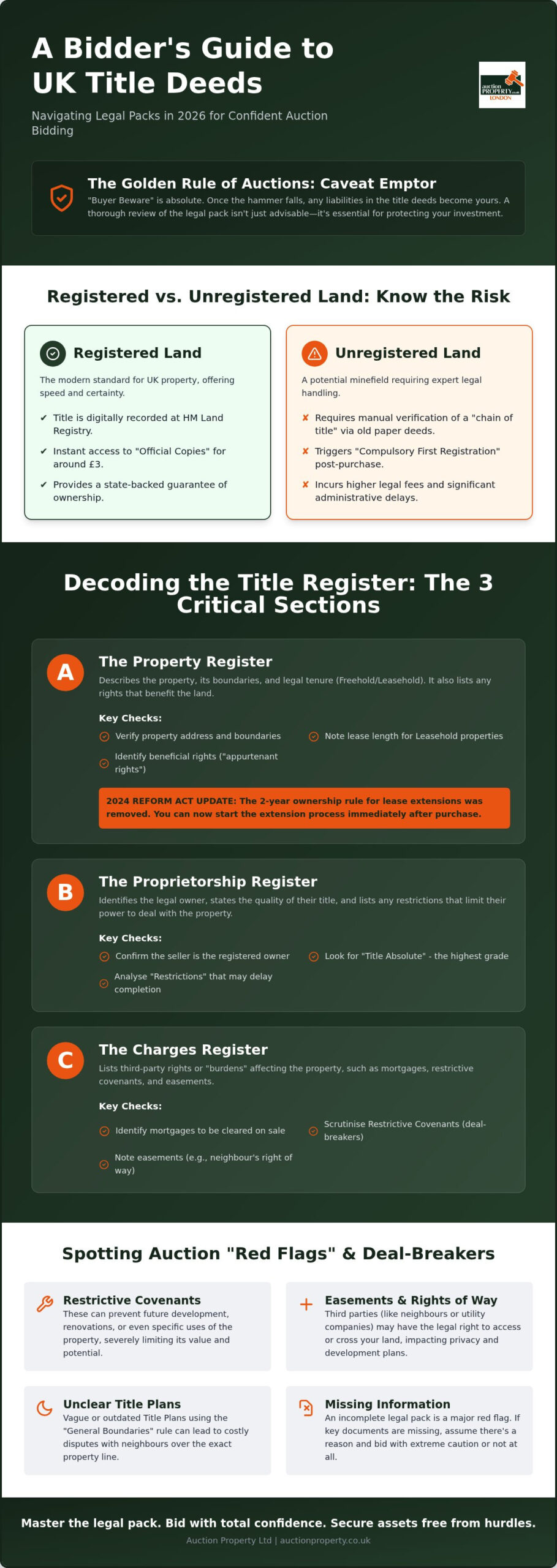
The days of chasing physical parchment are largely over. By 2026, the HM Land Registry digital register has become the primary source of truth for almost all UK property. You don’t need “original” paper deeds for registered land anymore. Instead, investors rely on “Official Copies” of the register and title plan. These digital documents cost £3 each and provide an instant, legally binding snapshot of the property’s status. Accessing this data through a digital legal pack ensures you aren’t bidding on outdated information or expired records.
Registered vs. Unregistered Land: The Auction Risk
Unregistered land remains a significant hurdle in the 2026 market. If a property hasn’t changed hands for decades, it won’t be on the digital register. This adds layers of complexity to your due diligence. You must manually verify a “chain of title” through physical deeds to prove ownership. Buying unregistered property at auction triggers “compulsory first registration,” a process that requires expert legal handling and can lead to delays. Auction Property Ltd prioritizes transparency for these lots, ensuring the legal pack clarifies the registration status to prevent post-sale complications. Always check if a lot is registered before you set your maximum bid, as unregistered land often requires a higher budget for legal fees and administrative time.
Decoding the Title Register: The Three Essential Sections
The Title Register acts as the heart of any property document. To succeed in a fast-paced environment, you must look beyond the surface level of a listing. Every property has a unique Title Number; this is your gateway to national data and the key to verifying the seller’s claims. Before you bid, you must identify the tenure. Freehold offers absolute ownership, while Leasehold involves a finite term that dictates your long-term ROI. If you need to get a copy of the deeds, ensure you are looking at the most recent digital version to avoid outdated entries that could mask recent liabilities.
A: The Property Register (Description and Tenure)
This section describes the land and the estate. Verify that the address and physical boundaries match the auction catalogue exactly. Look for “appurtenant rights,” which are benefits like a right of way over a neighbor’s land. For leasehold properties, this part is critical. It lists the lease date and length. Under the Leasehold and Freehold Reform Act 2024, the two-year ownership requirement for extensions was removed on January 31, 2025. This means you can start the extension process immediately after your auction purchase completes, significantly boosting the property’s potential value.
B: The Proprietorship Register (Ownership and Restrictions)
Here, you confirm the seller’s legal authority. It lists the current owner’s name and the class of title. “Title Absolute” is the gold standard for security. Watch for “Restrictions.” These often state that no disposition of the registered estate is to be registered without a certificate signed by a specific person or company. This can delay your completion if not handled before the hammer falls. Price paid data is also visible here; use this to gauge the seller’s potential margins and inform your own bidding strategy. If you are understanding title deeds for auction properties, this section tells you who you are actually dealing with.
C: The Charges Register (Debts and Burdens)
The Charges Register is the list of third-party interests in the land. This is the most high-stakes area for any investor. It lists mortgages, financial charges, and restrictive covenants that “run with the land.” When you sell house fast at auction uk, the legal pack must show how these charges will be discharged. If a mortgage is listed, your solicitor must ensure the seller’s proceeds will cover the debt so you receive a “clean” title. Ignoring a notice here could leave you responsible for a previous owner’s debt, turning a bargain into a financial burden.
Covenants, Easements, and Burdens: Identifying Auction Deal-Breakers
While the previous sections detailed the structure of the register, the specific entries within the Charges Register often determine a lot’s true value. When you are understanding title deeds for auction properties, you must differentiate between what you own and what you are allowed to do with it. Burdens like covenants and easements don’t just exist on paper; they dictate your ability to renovate, extend, or even inhabit the property. Ignoring these entries can turn a high-yield investment into a legal stalemate.
Restrictive Covenants: Development Killers
A restrictive covenant is an “invisible no” that stays with the land regardless of who owns it. Common examples include “no trade or business to be carried out” or “no additional building in the garden.” These are not mere suggestions. If you plan to convert a residential house into an HMO or build a separate annex, a restrictive covenant can stop your project before it starts. By 2026, many older covenants remain legally enforceable, though some may be challenged if the original purpose is no longer relevant. To understand how these are categorized, refer to The ABC of title registers for a breakdown of where these entries appear. If a beneficiary, such as a neighboring landowner, still exists, they can seek an injunction to halt your work or demand a significant payout for a “release” of the covenant.
Easements and Rights of Way
Easements grant third parties specific rights over your land. This could be a utility company needing access to pipes or a neighbor using a shared driveway. These rights of way can ruin your privacy and complicate security. They also prevent you from building over the affected area; you cannot extend your kitchen if it blocks a neighbor’s legal path or sits atop a high-pressure water main. Watch out for “prescriptive easements,” which are unwritten rights established through 20 years of continuous use. These won’t always show up on the deed initially but are often disclosed in the seller’s property information form within the legal pack. Spotting these red flags early allows you to adjust your bid to account for the restricted footprint.
Positive covenants are equally important for your budget. Unlike restrictive ones, these require you to take action, such as maintaining a shared boundary fence or paying into a private road fund. These ongoing costs must be factored into your ROI calculations. If a deed contains a “defective title” or a missing covenant from decades ago, indemnity insurance has become a standard tool in 2026. This one-off payment protects you against future legal challenges, allowing you to bid with confidence even when the paperwork isn’t perfect. Always check the legal pack to see if the seller has already provided an indemnity policy for known issues.
Interpreting the Title Plan: Boundaries and Access Rights
The Title Plan is the map that brings the legal text of the Register to life. While the Register provides the “what” of the transaction, the Plan provides the “where.” When you are understanding title deeds for auction properties, you must treat the Title Plan as a guided approximation rather than a surgical blueprint. It is based on Ordnance Survey (OS) data, which is designed for location and identification rather than centimeter-perfect accuracy. Bidding on a lot without cross-referencing the plan against the physical site is a high-stakes gamble that often leads to boundary disputes.
The Red Line vs. Reality
Many investors lose money by assuming the red line on the plan matches the physical fence on site. Title Plans in England and Wales show general boundaries only, not precise measurements. This means the legal boundary could be several inches or even feet away from the physical barrier you see during a viewing. If a neighbor has moved a fence over time, the Title Plan might not yet reflect that encroachment. You should also use the plan to identify “T-marks.” These symbols indicate which party is responsible for maintaining a specific boundary. If the T-mark is on your side of the line, the cost of maintaining that wall or fence is your financial burden, not your neighbor’s.
Access and ‘Landlocked’ Properties
A property is only as valuable as its access. A “landlocked” lot has no direct legal route to a public highway, which is a common issue with land for sale near me. This often happens when a previous developer retains a “ransom strip.” This is a tiny sliver of land between the property and the road. The owner of that strip can demand a massive fee, sometimes a significant percentage of the property’s total value, just to grant you a right of way. If the deed doesn’t explicitly state a “granted right of access,” you are buying a lot you cannot legally reach without further negotiation.
Always cross-reference the Title Plan with the physical structures. Look for discrepancies where a neighbor’s garage or shed appears to overlap your red line. If the plan shows a shared driveway that isn’t mentioned in the Register, you need to investigate the “prescriptive rights” mentioned in previous sections. Auction Property Ltd assists in clarifying these access issues by providing comprehensive legal packs that highlight potential ransom strips and boundary anomalies before the auction begins. Browse our current auction lots to review legal packs and title plans for yourself today.
Securing Your Investment with Auction Property Ltd
Mastering the theory behind understanding title deeds for auction properties is only half the battle. To succeed in the 2026 market, you need a platform that translates complex legal data into actionable investment opportunities. Auction Property Ltd bridges this gap by providing a transparent, tech-forward environment where speed and security coexist. We recognize that the high-stakes nature of property auctions requires more than just access to listings; it requires a partner that removes the administrative hurdles associated with traditional sales methods.
Our national auction service covers residential, commercial, and land development sites across the UK. We prioritize legal transparency by ensuring that the critical data points you need—from financial charges to boundary plans—are available well before the bidding starts. If you encounter a lot with complex title issues or unregistered land, our expert team provides the legal administrative assistance necessary to clarify the situation. This support allows you to move from curiosity to action without the delays that often plague the private treaty market.
The Advantage of Our Legal Pack Transparency
Every lot we list comes with immediate access to a comprehensive legal pack. This structured environment is designed for rapid investor due diligence, allowing you to review title registers and plans the moment a property goes live. We’ve digitized the traditional auction experience to strip away the intimidation factor, providing you with the exact same information a seasoned professional uses to calculate their maximum bid. Our platform ensures you don’t have to chase solicitors for basic title information; instead, you can focus on analyzing the ROI and spotting the “red flag” covenants we’ve discussed in earlier sections.
Bidding with Certainty in 2026
The security of our online auction infrastructure is paramount for national buyers. With 82% of UK auction transactions now occurring online, we’ve built a facilitator that ensures every bid is backed by legal oversight and transactional certainty. When the hammer falls on our platform, the outcome is guaranteed. You won’t face the 31% fall-through rate common in traditional sales; instead, you enter a fixed 28-day completion window with a clean title and a clear path to ownership. This level of efficiency is essential for professionals who need to recycle capital quickly and grow their portfolios with confidence.
Don’t let legal complexity hold back your investment strategy. Take the next step by creating your account and gaining full access to our digital legal packs. Register today to browse our latest UK auction catalogue and start reviewing the title deeds for our upcoming residential and commercial lots. Your ability to bid with total confidence starts with the right data and the right platform.
Master the Market with Legal Clarity
Success in the 2026 auction room belongs to those who treat due diligence as a prerequisite, not an afterthought. You’ve learned how to decode the three sections of the register, spot development-killing covenants, and interpret title plans to avoid landlocked lots. These documents are the only protection you have in a “buyer beware” environment where the fall of the hammer is final. By mastering the skill of understanding title deeds for auction properties, you transform from a casual bidder into a precise market operator who knows exactly where the value lies.
Auction Property Ltd provides the infrastructure you need to execute these strategies with speed and certainty. As a professional national property auction house, we offer a transparent online bidding platform backed by comprehensive legal administrative support. We remove the friction from the transaction process, ensuring you have immediate access to the legal packs required to make informed decisions. Don’t let hidden liabilities stall your portfolio growth. Start your property search with Auction Property Ltd today and bid with the confidence of a seasoned insider. Your next high-yield investment is waiting.
Frequently Asked Questions
Can I buy a property at auction if the title deeds are missing?
Yes, you can purchase property with missing deeds, but it involves significantly higher risk. This typically occurs with unregistered land where the physical “title deeds” have been lost or destroyed. The seller must provide a “reconstitution of title” using statutory declarations to prove a clear chain of ownership. You’ll need to apply for first registration after the auction, which can be a complex and lengthy process.
What is the difference between a Title Register and a Title Plan?
The Title Register is the text-based legal record of the property, detailing ownership, tenure, and any financial charges or restrictive covenants. In contrast, the Title Plan is a map based on Ordnance Survey data that provides a visual representation of the property’s location. While the Register tells you who owns the land and what burdens exist, the Plan shows you the general boundaries of that land.
How do I find out if an auction property has restrictive covenants?
You must check Section C, the Charges Register, of the Title Register. This section lists all third-party interests, including covenants that limit how the land can be used. When understanding title deeds for auction properties, you should also look for a “Schedule of Restrictive Covenants” at the end of the document, which contains the specific wording of these legal “nos.”
What happens if I find a mistake in the title deeds after the auction?
Because auction contracts are legally binding the moment the hammer falls, you generally inherit the title as it stands. Under the principle of caveat emptor, it’s your responsibility to identify errors before bidding. If the mistake is a minor clerical error by the Land Registry, it can often be corrected post-completion, but substantive legal defects may require you to purchase indemnity insurance to protect your investment.
Do I need a solicitor to read the title deeds before I bid at auction?
Professional legal review is essential for any auction purchase. While investors can spot obvious red flags, a solicitor identifies technical issues like “overriding interests” or complex easements that aren’t immediately apparent. They ensure that the special conditions of sale don’t contain hidden costs, providing the legal certainty you need to bid with total confidence.
What is a ‘Charge’ on a title deed and should it stop me from bidding?
A charge is a legal interest held by a third party, most commonly a mortgage lender using the property as security for a loan. It shouldn’t stop you from bidding as long as the legal pack confirms the charge will be discharged upon completion. Your solicitor must verify that the seller’s proceeds are sufficient to clear the debt so you receive the property free of any previous financial burdens.
Is a digital copy of the title deed as valid as the original paper version?
Yes, the digital “Official Copy” issued by HM Land Registry is the definitive legal proof of ownership in 2026. For registered land, physical paper deeds are considered historical documents and aren’t required for the transfer of title. The digital register is updated in real-time, making it more reliable than old paper bundles that may not reflect recent changes or charges.
How much does it cost to get an official copy of title deeds in 2026?
The current cost for an official copy of the title register or the title plan is £3 per document when ordered through the Land Registry’s electronic service. A complete set for a single property typically costs £6. Accessing these documents is a fundamental step in understanding title deeds for auction properties and should be done for every lot on your shortlist before the auction begins.