

In the 2026 UK property market, your profit isn’t made when you sell a renovated home; it’s secured the moment the auctioneer’s gavel falls. Success depends on your ability to spot value where others see risk, especially as auction stock surged by over 36% in mid-2026. You probably recognise that the traditional market moves too slowly, yet the speed of an auction brings its own set of anxieties. You’re right to be cautious about contractor price creep in a high-inflation environment or the nightmare of discovering a structural “budget killer” after you’ve already committed your deposit.
This guide changes that dynamic by providing a professional framework for finding properties to renovate at auction uk. We’ll show you how to master the 28-day window and manage renovation budgets to ensure maximum ROI. You’ll gain clarity on 2026 compliance costs, including the implications of the Building Safety Act and the shifting energy standards. We’ll move through a repeatable system for evaluating lots and interrogating legal packs, giving you the confidence to bid on properties needing major work without the usual administrative hurdles. By the end, you’ll have a clear, action-oriented path to securing high-margin investment projects in today’s competitive landscape.
Key Takeaways
- Learn the professional framework for finding properties to renovate at auction uk by using the auction legal pack as your primary budgeting and risk-assessment tool.
- Categorise your investment into hard and soft costs to account for 2026 compliance requirements, including the Building Safety Act and new energy efficiency standards.
- Identify high-yield “value-add” opportunities and calculate ceiling prices to prevent over-development and protect your profit margins.
- Implement a “Contingency Tier” system and detailed Scope of Work documents to eliminate contractor price creep and manage structural risks.
- Master the “Buy, Refurbish, Refinance” (BRR) model to leverage the speed of the auction process for rapid portfolio scaling.
The Pre-Purchase Phase: Finding and Budgeting Before the Gavel Falls
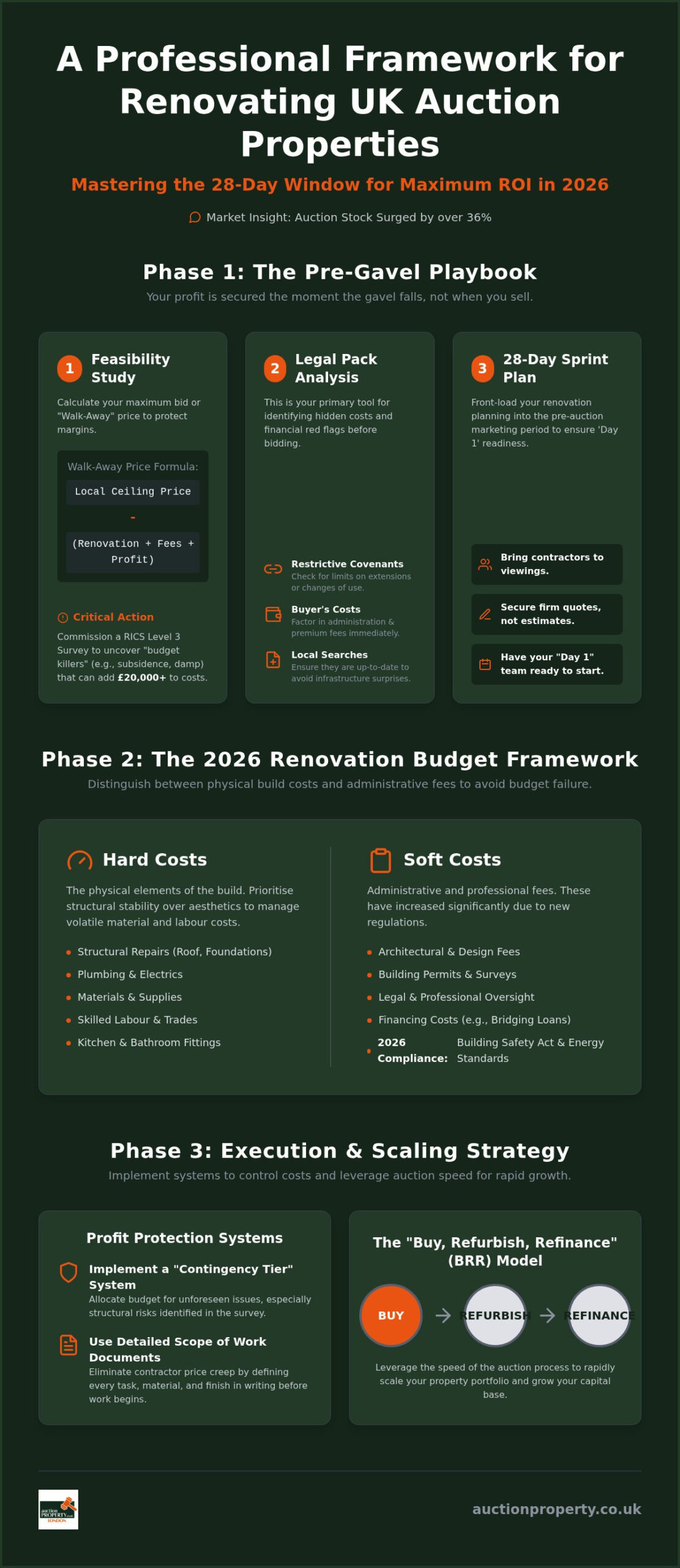
Profitable property investment begins with a rigorous pre-purchase framework. In 2026, finding properties to renovate at auction uk requires more than just browsing a catalogue; it demands a forensic approach to due diligence. You must identify high-potential lots while simultaneously calculating a “Walk-Away” price that protects your margin. This price isn’t a guess. It’s the result of a “Back-of-Envelope” feasibility study that subtracts your estimated renovation costs, buyer premiums, and a healthy profit margin from the local ceiling price.
To avoid structural “budget killers”, always commission a RICS Home Survey Level 3. While a basic valuation might satisfy a lender, only a Level 3 survey provides the technical depth needed to spot subsidence, damp, or roof failures. These issues can easily add £20,000 to a budget, turning a lucrative flip into a financial burden. Many seasoned investors source stock through government auctions because these lots often come with clear titles and straightforward disposal motives, providing a solid foundation for your first feasibility check.
Analysing the Auction Legal Pack for Hidden Costs
The legal pack is your most valuable tool for identifying financial red flags before you bid. Don’t wait until the day of the auction to read it. You must scrutinise the special conditions of sale for outstanding service charges, ground rent arrears, or specific legal fees that the seller expects you to cover. These costs are often buried in the fine print and can significantly impact your initial capital requirements.
- Restrictive Covenants: Check for limitations on extensions or changes of use that could stifle your renovation plans.
- Buyer Costs: Factor in Buyer’s Administration and Premium Fees immediately. These are often fixed percentages of the purchase price and must be paid on the day.
- Local Searches: Ensure the searches are up to date to avoid surprises regarding planned infrastructure or environmental risks.
The 28-Day Completion Sprint: Front-Loading Your Budget
The auction model operates on a timeline that traditional buyers find intimidating. You typically have 28 days from the fall of the hammer to complete the purchase. This means your renovation planning must happen during the three-week marketing period before the auction. Bring your contractors to the viewings. Secure firm quotes rather than vague estimates so you can bid with certainty.
You need your “Day 1” renovation team ready to start the moment you receive the keys. Delays are expensive. If you’re using a bridging loan to fund the purchase and works, remember that interest is charged monthly. Every week your team isn’t on-site is a week where interest eats into your ROI. Efficiency is the only way to maintain your margins in a high-inflation market.
The 2026 Renovation Framework: Hard vs. Soft Costs
Successful investment in 2026 requires a binary understanding of your budget. You must distinguish between hard costs, the physical elements of the build, and soft costs, the administrative and professional fees that facilitate the project. When finding properties to renovate at auction uk, many investors fail because they only account for the former. In the current market, soft costs have increased significantly due to more stringent regulatory requirements and the professional oversight mandated by the Building Safety Act 2022. This legislation ensures that even residential refurbishments meet modern safety standards, particularly regarding fire safety and structural integrity. Ignoring these compliance layers will lead to project delays and potential legal hurdles during the resale phase.
Inflationary pressures in 2026 have also shifted trade rates and material procurement strategies. While house price growth is expected to remain around 2% to 4%, the cost of skilled labour and raw materials has seen higher volatility. You must build a framework that prioritises structural stability over aesthetic finishes. To manage your capital effectively, you can browse current investment property listings to identify lots where the required works align with your specific trade network and procurement capabilities.
Hard Costs: The Core Construction Budget
Hard costs represent your most significant capital outlay. Prioritise funds for essential structural components, such as roof repairs, damp proofing, and electrical rewiring, before allocating money to cosmetic upgrades. In the 2026 market, kitchens and bathrooms remain the primary drivers of value-add. However, you should adopt a bulk-buying strategy for materials if you are managing multiple lots. Procurement of timber, insulation, and plasterboard in larger quantities can hedge against the price fluctuations seen in mid-2026, protecting your overall ROI.
Soft Costs: The Often Overlooked Expenses
Soft costs are the “invisible” expenses that can erode your profit margins if not tracked meticulously. These include professional fees for architects, structural engineers, and party wall surveyors. In 2026, planning permission and building regulations application fees have seen adjustments to reflect new environmental standards. Furthermore, standard home insurance is insufficient for unmodernised auction lots. You must secure specialist renovation insurance that covers the property while it is vacant and undergoing major works. This ensures your investment is protected against fire, theft, and public liability throughout the duration of the project.
Prioritising for Profit: Where to Spend and Where to Save
When finding properties to renovate at auction uk, your primary objective is to maximise the delta between your total investment and the final resale value. The “Golden Rule” of UK renovation is simple: prioritise value-add structural changes over fleeting aesthetic trends. While a high-end designer kitchen might look impressive in a catalogue, it rarely provides a pound-for-pound return if the underlying property lacks structural integrity. You must calculate the ceiling price for the specific street and housing type before you start. With national house price growth expected to remain between 2% and 4% in 2026, over-developing a property beyond its local market limit is a fast way to erode your ROI.
Energy efficiency has become a significant value driver in 2026. Buyers are increasingly sensitive to EPC ratings as the government pushes toward the Future Homes Standard. Budget for essential upgrades like high-performance insulation and, where feasible, heat pump installations. These aren’t just “green” choices; they’re defensive financial moves that make your property more liquid and attractive to the 2026 buyer pool. Tailor your finish level to your target demographic. A high-yield HMO (House in Multiple Occupation) requires durable, commercial-grade finishes, whereas a single-family home demands a focus on “homely” curb appeal and functional living spaces.
The ROI Hierarchy for Auction Properties
Structural integrity and damp proofing must always take precedence. A dry, solid house is easier to sell or refinance than one with a luxury bathroom hiding a rising damp problem. Once the shell is secure, focus on optimising the floor plan. Adding an extra bedroom through a loft conversion or by reconfiguring internal walls is often the single most effective way to jump-to a higher valuation bracket. Don’t underestimate curb appeal. Low-cost improvements like a professional front door respray, tidy masonry, and basic landscaping provide a disproportionate boost to the initial valuation by creating a positive first impression for surveyors and buyers alike.
Smart Savings for Professional Investors
Protect your margins by using professional procurement strategies. Open trade accounts with national merchants to access volume-based discounts that aren’t available to the general public. Consider sourcing ex-display kitchen units or high-quality “seconds” for flooring; these items offer significant savings without compromising the final quality of the build. You must also be realistic about the DIY vs professional trade balance. While doing your own demolition or painting saves on labour, it can extend your timeline. In the fast-paced auction environment, a three-week delay in finishing the project often costs more in bridging loan interest than you saved by not hiring a professional decorator. Apply the “Good Enough” principle for rental properties: choose materials that are durable and easily replaceable rather than bespoke or high-maintenance.
Executing the Plan: Managing Trades and Contingencies
Once you’ve succeeded in finding properties to renovate at auction uk, the transition from investor to project manager must be instantaneous. The 28-day completion period isn’t just for legal paperwork; it’s your window to finalise your Scope of Work (SoW) documents. A detailed SoW is your primary defence against post-auction price creep. It defines every task, material specification, and deadline before a contractor sets foot on-site. Without this level of granularity, you’re vulnerable to “hidden extra” charges that trades often apply when they encounter the complexities of an unmodernised auction lot.
Digital project management tools are no longer optional for the professional investor. Use them to track your renovation spending against your initial feasibility study in real-time. This transparency allows you to spot budget deviations early and adjust your strategy before they compound. To secure your next high-margin project, view our current residential property auctions and begin your due diligence today.
The 20% Contingency Rule for Fixer-Uppers
Generic investment advice often suggests a 10% contingency fund. In the 2026 market, this is a recipe for failure. Auction properties frequently come with unknown histories and hidden structural defects that only become apparent during the strip-out phase. You must implement a “Contingency Tier” system of at least 20%.
- Tier 1 (10%): Reserved strictly for structural emergencies, such as unexpected subsidence or major roof failures.
- Tier 2 (10%): Allocated for market volatility, including trade price increases or supply chain delays.
If you reach the final stages of the renovation with your Tier 2 funds intact, you can strategically re-allocate them into high-impact finishes. Upgrading to premium worktops or high-spec lighting in the final week can significantly boost your final valuation without risking your initial capital.
Contractor Management on a Timeline
Your choice of contract type determines your level of financial risk. Fixed-price contracts are the professional standard for auction renovations. They provide cost certainty and place the burden of efficiency on the contractor. Avoid day rates; they lack the urgency required to maintain the momentum of an auction flip and can lead to “timeline drift” that eats into your ROI through extended bridging loan interest.
Coordinating multiple trades requires a strict sequence to ensure no one is standing idle. Your electrician and plumber must complete first-fix works before the plasterers arrive. Maintain this rhythm by using a “snagging list” system. Never release the final 10% of a trade’s payment until every item on their specific snagging list is completed to a professional standard. This ensures the quality of the finish matches the expectations of the 2026 buyer pool.
Scaling Your Strategy: From Fixer-Upper to Auction Success
Scaling your investment strategy requires a transition from individual project management to a repeatable, data-driven system. The “Buy, Refurbish, Refinance” (BRR) model is particularly effective when finding properties to renovate at auction uk because the speed of the transaction accelerates your capital recycling. In the 2026 market, the ability to complete a renovation and refinance within a six-month window allows you to move onto the next lot while your competitors are still waiting for traditional conveyancing to clear. Transparency in your renovation budget isn’t just for your own records; it’s a critical tool for building trust with lenders and private partners. When you can present a forensic breakdown of your spend against a realised valuation, you establish the professional credibility needed to secure higher leverage on future projects.
The finality of the gavel transforms your calculated budget into a realised profit. Every successful flip or rental conversion provides data points that refine your future bidding strategy. By strictly adhering to the frameworks discussed in this guide, you ensure that each project contributes to a scalable portfolio rather than becoming an isolated financial burden. Efficiency is the primary driver of growth in the auction sector.
Post-Renovation Valuation and Refinancing
Once the works are complete, compare your total final spend against the initial house valuation to track your precise performance. Analyse any budget variances meticulously. Did the structural repairs cost more than anticipated? Did the labour for the energy efficiency upgrades meet the 2026 trade rates? Use these insights to adjust your “Walk-Away” price for the next auction. For a deeper dive into the mechanics of the bidding process, consult our guide on Mastering the Property Auction. This ensures your next acquisition is even more efficient than the last.
Ready for Your Next Renovation Project?
Auction Property Ltd provides the national infrastructure you need to maintain your investment momentum. Our transparent online bidding platform allows you to identify and secure residential, commercial, or land development lots with speed and certainty. Whether you’re looking to acquire more stock or need to Sell House Fast at Auction UK to free up capital for a larger development, we facilitate every stage of the transaction. Success in finding properties to renovate at auction uk is a cycle of disciplined budgeting and rapid execution. Start your next project by reviewing our current national listings and preparing your next feasibility study.
Master the 2026 Auction Cycle
Success in the 2026 market depends on moving from speculative bidding to calculated execution. You’ve learned that the auction legal pack is your primary budgeting tool and that a 20% contingency is essential to protect your ROI against structural unknowns. Finding properties to renovate at auction uk is a high-stakes process that rewards those who front-load their due diligence and prioritise structural integrity over aesthetic trends.
We provide the professional infrastructure to turn these insights into action. Browse our latest national auction catalogue for your next renovation project to access our transparent online bidding platform. Our national reach for all property types ensures you can source high-yield opportunities in any region; our expert legal administrative support removes the friction from the pre-purchase phase. Take control of your next project today and turn the finality of the gavel into a guaranteed outcome for your property portfolio. The opportunity to scale is ready when you are.
Frequently Asked Questions
How much should I realistically set aside for a contingency fund in 2026?
You should set aside a minimum of 20% of your total build cost for a contingency fund in 2026. While traditional advice suggests 10%, the current volatility in material prices and trade availability makes this insufficient. This fund acts as a financial buffer against structural surprises or price creep. If you’re finding properties to renovate at auction uk, high-intensity projects often reveal hidden defects during the initial strip-out phase that require immediate capital.
What are the most common hidden costs found in auction property legal packs?
Common hidden costs include buyer’s premiums, administration fees, and arrears for service charges or ground rent. These are often detailed in the “Special Conditions of Sale” section of the legal pack. You might also find costs related to local authority searches or specific legal fees that the seller expects the buyer to reimburse. Always review these documents before bidding to ensure these figures are factored into your maximum walk-away price.
Can I include renovation costs in my property auction mortgage or bridging loan?
You can include renovation costs by using a specialist refurbishment bridging loan. These products typically lend based on the current value of the property and provide additional tranches of funding as you hit specific renovation milestones. Traditional mortgages are rarely suitable for properties in disrepair. A refurbishment bridge allows you to secure the property quickly and fund the works, providing the liquidity needed to reach the refinancing stage once the project is complete.
How does the Building Safety Act 2022 affect my UK renovation budget?
The Building Safety Act 2022 increases your budget by mandating stricter compliance and professional oversight for structural and fire safety works. You’ll need to account for higher professional fees for qualified inspectors and structural engineers. Even for smaller residential renovations, you must ensure that all works are documented and meet current safety standards. This prevents legal hurdles during resale and ensures the property is insurable and safe for future occupants.
Is it cheaper to manage the renovation myself or hire a professional project manager?
Managing the renovation yourself is cheaper in terms of upfront fees, but hiring a project manager often saves more in the long run. A professional manager prevents expensive scheduling errors and ensures trades are held to fixed-price contracts. If you lack experience, the cost of a project manager is usually offset by their ability to negotiate trade rates and maintain the strict 28-day momentum required for successful auction investments.
How do I calculate the potential ROI of a renovation before the auction begins?
Calculate ROI by subtracting the purchase price, total renovation costs, and all associated fees from the projected Gross Development Value (GDV). Use local comparable sales from 2026 to determine a realistic ceiling price for the area. Ensure your calculation includes soft costs like insurance and bridging interest. This forensic approach allows you to set a clear bidding limit when finding properties to renovate at auction uk, protecting your profit margins from the start.
Should I buy materials myself or let the builder handle procurement in 2026?
Letting your builder handle procurement is generally more efficient for professional renovations. Builders often access trade discounts and take responsibility for the correct quantities and delivery schedules. If you buy materials yourself, you assume the risk of delays and incorrect specifications. However, you might choose to source high-end finishes or ex-display units yourself to secure specific aesthetic results while leaving the core structural materials to the trade professionals.
What building regulations do I need to budget for when renovating an auction lot?
You must budget for compliance with Part L regarding fuel and power, Part P for electrical safety, and Part B for fire safety. In 2026, energy efficiency is a primary focus, so expect higher costs for insulation and ventilation to meet updated EPC requirements. Budget for building control application fees and the cost of obtaining necessary certificates. These documents are essential for a successful exit strategy, whether you’re selling or moving to a long-term mortgage.