

Buying a tenanted property at auction transfers ownership, not an automatic right to remove the tenant. If you’re asking how to serve notice to tenants after buying at auction, first identify the tenancy and the property’s jurisdiction. The existing tenancy may continue after completion, so the auction timetable doesn’t mean the tenant must leave immediately.
It’s understandable to want a clear route to vacant possession, especially when auction completion dates are fixed and the deposit paid on auction day is non-refundable. But serving notice is only one step. It doesn’t, by itself, end the tenancy or give you possession of the property.
This guide explains what to check in the lot documents before bidding, how the rules differ across England, Wales, Scotland and Northern Ireland, and why the correct notice depends on the tenancy and your grounds for possession. In England, private landlords have had to use the Section 8 process since 1 May 2026. You’ll also learn how notice periods, court proceedings and possession fit together, so you can plan a lawful next step rather than treat an auction purchase as an eviction process.
Key Takeaways
- Read the lot documents before bidding to understand tenancy details that could affect your plans.
- Identify the tenancy type and property jurisdiction before deciding whether to keep the tenant in place or seek possession.
- Learn how to serve notice to tenants after buying at auction by checking the applicable grounds, prescribed form, notice period and service rules.
- Plan for different outcomes, including the tenant leaving, disputing the notice or remaining after it expires.
- Understand when a court process may be needed to obtain possession, and factor that into your post-auction plans.
What happens to a tenancy when you buy a property at auction?
The sale itself doesn’t automatically end an existing tenancy. If a property is occupied by a tenant, the change of ownership generally makes the buyer the new landlord, while the tenancy and the tenant’s rights continue under the applicable law. The agreement and property documents help establish what kind of tenancy exists and what options may be available. The relevant rules depend on where the property is in the UK.
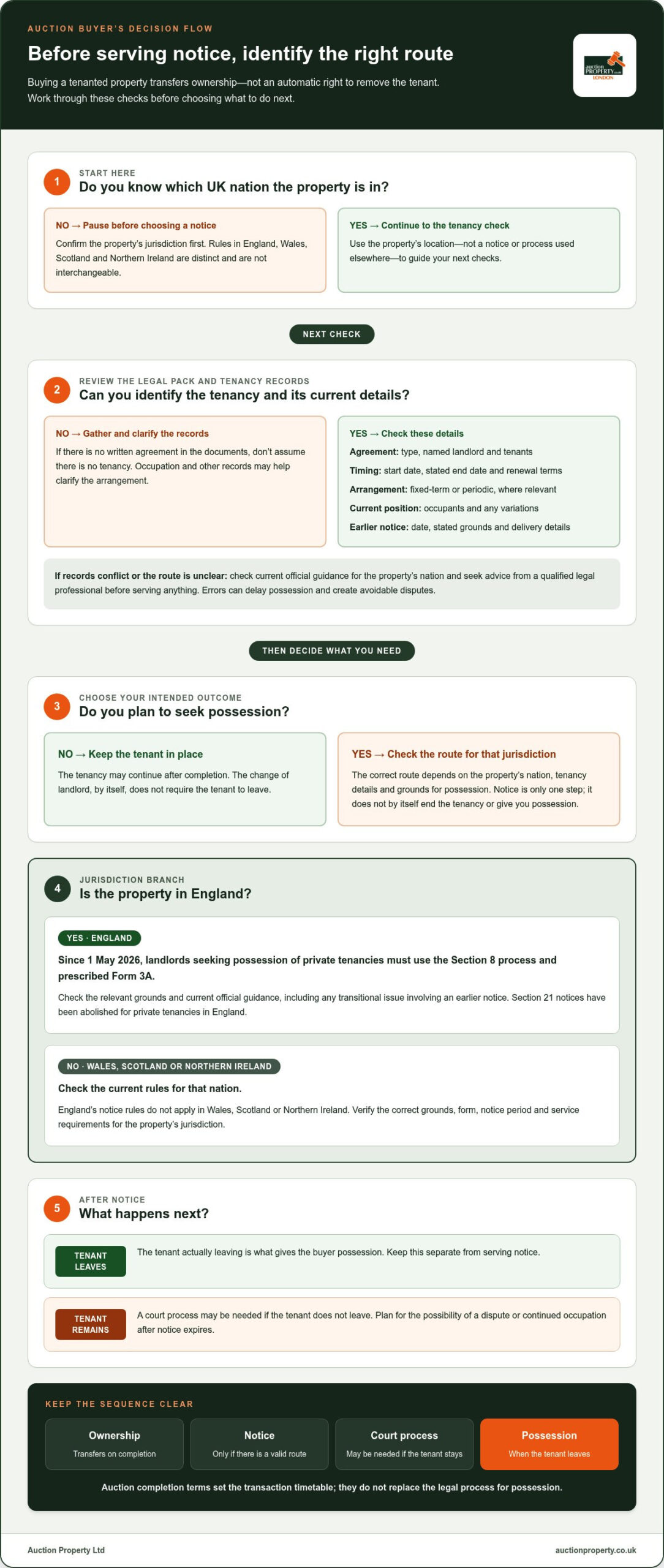
Keep four events separate: ownership transfers on completion; a landlord may then serve notice if there is a valid route to possession; a court process may be needed if the tenant doesn’t leave; and the tenant actually leaving is what gives the buyer possession. Notice alone doesn’t complete this sequence. Auction completion terms set the transaction timetable, but they don’t replace the legal process for possession.
Does buying at auction end the tenant’s agreement?
No. A change of landlord, by itself, doesn’t establish that the property is vacant or that the tenant must leave. Before deciding how to serve notice to tenants after buying at auction, review the tenancy agreement and identify the named landlord and tenant, any stated term, and any provisions relevant to ending the tenancy. Check the property’s jurisdiction too: rules in England, Wales, Scotland and Northern Ireland aren’t interchangeable.
If there’s no written agreement in the documents, don’t assume there’s no tenancy. Occupation and other records may still help clarify the arrangement. Landlord and tenant rights and responsibilities are shaped by both the agreement and the law. The general Landlord-tenant law overview can provide background, but it doesn’t replace checking the rules that apply to the property.
What does vacant possession mean for an auction buyer?
A property sold with a tenant in place is different from one represented as being sold with vacant possession. In the first case, plan on the basis that the tenancy may continue after completion. In the second, the auction description indicates that the property is intended to be handed over without an occupier, but the lot documents matter. Don’t treat a marketing phrase alone as proof of the position.
Compare the lot description with the legal pack before bidding. Look for details about occupation, the tenancy agreement, rent and any documents describing the sale conditions. If the marketing and legal documents appear inconsistent, investigate the discrepancy before committing. Auction purchases involve a non-refundable deposit on auction day and a predetermined, non-negotiable completion timeframe, so resolve uncertainty before bidding rather than relying on a quick outcome after completion.
Use your pre-bid review to decide whether the property suits your plans with the tenant in place or whether you need to understand the lawful route to possession. The purchase transfers ownership; it doesn’t guarantee immediate vacant possession.
Check the property’s jurisdiction and tenancy before choosing a notice
Start with the property’s location, not the wording of a notice you’ve seen elsewhere. Residential tenancy law differs across England, Wales, Scotland and Northern Ireland, so a term or process used in one nation may not apply in another. Confirm the jurisdiction first, then identify the tenancy and check the current official guidance for that nation before taking action.
Use the legal pack and tenancy records to build a clear picture. Record:
- the agreement type and the names of the landlord and tenants;
- the tenancy start date and any stated end date or renewal terms;
- whether the arrangement is fixed-term or periodic, where that distinction applies;
- who currently occupies the property and whether the agreement has been varied;
- any notice already served, including its date, stated grounds and delivery details.
These details can affect which grounds, forms, notice periods and service rules apply. If the documents conflict or the correct route remains unclear, get advice from a qualified legal professional before serving anything. Errors can delay possession and create avoidable disputes.
How do UK tenancy rules vary by jurisdiction?
England, Wales, Scotland and Northern Ireland each have distinct legal frameworks. Keep examples tied to the property’s nation and verify them against current official guidance. UK-wide shorthand is not a substitute for checking the rules that apply to a specific tenancy.
In England, as of October 2026, the Renters’ Rights Act 2025 changes that took effect on 1 May 2026 have converted existing and new assured shorthold tenancies into rolling assured periodic tenancies. Section 21 notices have been abolished for private tenancies, and landlords seeking possession must use the Section 8 process and prescribed Form 3A. Check official guidance for the relevant grounds and any transitional issue involving an earlier notice. These English rules don’t apply in Wales, Scotland or Northern Ireland.
Which tenancy details affect the notice route?
Check the agreement alongside the history of the tenancy. A document may have been renewed or varied, and the named landlord or occupants may not match the current records. Note the start date, any stated term, how rent is arranged and whether a notice has already been served. These facts help you identify what to check before selecting a notice route.
Then confirm which current rules govern that tenancy in its jurisdiction. The required grounds, prescribed form, notice period and permitted service method can depend on both location and tenancy details. If an existing notice is involved, don’t rely on its title alone: its timing, content and status may matter. Follow a clear sequence: confirm jurisdiction, establish the tenancy facts, then verify the applicable procedure.
Before bidding, use the lot’s legal pack to review tenancy documents and flag gaps for investigation. This preparation can help clarify your next step without assuming that the purchase itself resolves the tenancy.
For the how to serve notice to tenants after buying at auction decision, keep the jurisdiction and tenancy records together with your property due diligence. You can review auction properties and their legal packs before committing.
Should you serve notice or keep the tenant in place?
There isn’t one right choice for every auction buyer. Keeping the tenant may suit a plan to hold the property as a rental investment, while seeking possession may be relevant if you intend to use the property differently. Compare both options against your intended use, the tenancy agreement and the property documents before deciding. Rental continuity and vacant possession are different investment outcomes, and neither should be assumed from the sale alone.
Make the decision in this order:
- Set out what you want to do with the property and when.
- Review the agreement and legal pack for tenancy terms, obligations and information about the current arrangement.
- Check whether your intended next step has a lawful route under the rules for the property’s jurisdiction and tenancy.
The auction’s fixed completion timetable doesn’t shorten a notice period or override the process for seeking possession. Build a realistic plan around the tenancy, not just the completion date.
When might retaining the tenancy suit your plans?
An occupied property may suit a buyer who intends to keep it as a rental investment and continue the landlord and tenant relationship. Existing occupation can mean there’s no immediate need to secure vacant possession, but it doesn’t guarantee rent will be paid, that the tenancy will continue unchanged or that the tenant’s conduct will meet your expectations.
Read the agreement and legal pack to understand the rights and obligations that come with the tenancy. Consider the stated rent, payment arrangements, term and any relevant correspondence or variations. Use those records to assess whether the existing arrangement fits your investment plan. Don’t treat projected rent as certain income or assume the terms can be changed simply because the landlord has changed. For landlords choosing to retain tenants, working with professional residential operators such as E&S Property Management offers a practical blueprint for handling ongoing management and tenant communications effectively.
When might seeking possession be relevant?
Seeking possession may be worth considering if your plans require the property to be empty, such as using it yourself or preparing it for another purpose. But your intended use doesn’t, by itself, establish a valid legal ground. The available route depends on the jurisdiction, tenancy and current law, so verify the relevant grounds, eligibility tests, forms and notice periods before serving notice.
Notice expiry isn’t the same as possession. A tenant may leave, agree a later date, dispute the notice or remain in the property. If they don’t leave, you may need to follow the applicable court process to obtain possession. Don’t plan a move, refurbishment or onward transaction on the assumption that the notice date guarantees the property will be empty.
For how to serve notice to tenants after buying at auction, start with your intended outcome, then check the tenancy facts and the lawful options available. If those don’t align, pause and reassess your plan before taking action. That way, your timeline isn’t built on an assumption the tenancy or legal process doesn’t support.
How to prepare and serve a valid tenant notice
Use a careful sequence rather than relying on a generic template or a quick message to the tenant. The correct notice, grounds, notice period and service method depend on the property’s jurisdiction and the tenancy. A notice that looks complete can still be challenged if it uses the wrong form, states an unsupported ground or is served incorrectly. Treat preparation and proof of service as part of the same process.
- Confirm the jurisdiction and tenancy. Check the property’s location, agreement, start date, current status and any variations or earlier notices.
- Identify the lawful route. Match your reason for seeking possession to a ground that applies to this tenancy, and verify the current eligibility requirements.
- Check the prescribed notice requirements. Confirm the correct form, wording, notice period and service method using current official guidance for that jurisdiction.
- Prepare and serve the notice. Check all details against the tenancy records, use a permitted service method and keep dated evidence.
What should you check before serving notice?
Before preparing documents, check that the proposed ground fits both the tenancy facts and current law. Verify the tenant and landlord names, property address, relevant dates, required wording and any prescribed form. Don’t assume an old form remains valid. Also check whether a transitional rule affects the tenancy or notice route, particularly if a notice was served before a legal change.
For example, in England, Section 21 notices were abolished for private tenancies from 1 May 2026. A landlord seeking possession must use the Section 8 process and prescribed Form 3A. The transitional deadline for starting court proceedings on pre-change notices passed on 31 July 2026. Check current official guidance before relying on a notice or choosing a ground. These rules are England-specific, not a UK-wide template.
How should notice be delivered and recorded?
Use a delivery method allowed by the tenancy agreement and applicable law, and confirm the rules before sending the notice. A text, email or informal conversation may help communicate with a tenant, but don’t assume it counts as formal service. Keep a complete copy of the notice and record when, how and to whom it was delivered.
Retain supporting evidence, such as a dated service record, proof of posting or other permitted delivery documentation. Note the address used and the relevant service date. If service is defective, progress may be delayed or contested. A record helps you explain what was done, but it can’t guarantee a legal outcome. Where the agreement and current requirements appear to conflict, pause and seek qualified legal advice before serving notice.
Good preparation starts before the auction commitment. Review the lot’s legal pack alongside the tenancy information so you can identify issues that may affect your plan. Explore auction lots and legal packs as part of your pre-bid due diligence.
What happens after notice, and how auction buyers can plan ahead
Once notice has been served, prepare for more than one possible outcome. The tenant may leave by the relevant date, agree to leave later, dispute the notice or remain in the property. Keep your plans flexible until possession is lawfully secured. A notice is not a court order, and its expiry doesn’t necessarily mean you can take over the property.
If the tenant remains, the next step depends on the property’s jurisdiction and the circumstances of the tenancy. Follow the applicable court process rather than treating the notice date as a guaranteed handover. In England, a landlord seeking possession through the Section 8 process must apply to the court if the tenant doesn’t leave. A possession order may be needed, and if the tenant still stays, enforcement may need to be carried out by court bailiffs.
- The tenant leaves: Arrange a lawful handover and confirm the property is vacant before proceeding with your plans.
- The tenant agrees to a later date: Keep a clear record of the arrangement, but don’t assume an informal agreement changes the formal process.
- The tenant disputes the notice: Review the grounds, documents and service evidence, and get legal advice promptly.
- The tenant remains: Check the court and enforcement steps that apply in the property’s jurisdiction.
What if the tenant stays after the notice period?
Don’t change the locks, remove the tenant’s belongings or use pressure to make them leave. If they remain, lawful possession may require a court order and authorised enforcement under the relevant jurisdiction’s rules. In England, check the current possession procedure and terminology before acting. If the tenant challenges the notice or possession is disputed, seek qualified legal advice promptly and preserve the tenancy documents and service records.
How can auction buyers reduce tenancy surprises?
Start before bidding. Read the legal pack and identify the tenancy agreement, occupancy details and any wording about vacant possession. Compare those documents with the lot description. If the information is unclear or appears inconsistent, investigate before committing. Knowing what the documents say helps you plan for occupation after completion without assuming the tenant will leave on a particular date.
Factor the auction timetable into that decision. Completion takes place within a predetermined, non-negotiable timeframe, and the deposit paid on auction day is non-refundable. Neither changes the tenant’s rights or shortens the time required for a lawful possession process. Decide whether the property still fits your plans if the tenant remains while you follow the applicable steps.
For how to serve notice to tenants after buying at auction, plan around both the tenancy and the time needed to obtain possession, not just the date of purchase. Review auction lots and legal packs as part of your pre-bid due diligence.
Make your next bid with a clear plan
Before you commit to a tenanted property, decide what you need the investment to deliver and whether your plans allow for the existing occupier to remain. Use that goal to guide your due diligence, rather than treating notice as a shortcut to immediate access. If you’re weighing how to serve notice to tenants after buying at auction, keep the tenancy details and your intended next step in view, and verify the applicable requirements before acting.
Auction Property Ltd helps buyers purchase property through auction, with auctions held at a set date and time and a predetermined completion timeframe. Make tenancy research part of your decision before bidding. You can also watch the auction through the live-stream option.
Take the next step with your investment plans in mind. Explore properties available to buy at auction, review the information for each lot, and move forward with a considered view of what happens after purchase. Careful preparation puts you in a stronger position to make a confident, well-informed bid.
Frequently Asked Questions
Can I evict a tenant immediately after buying a property at auction?
No. Buying the property doesn’t itself give you the right to remove an occupier. First establish whether there’s a tenancy and what legal route applies to it. Don’t change the locks, remove belongings or pressure the tenant to leave. If you’re working out how to serve notice to tenants after buying at auction, distinguish notice from the legal steps required to obtain possession.
Does the tenant’s agreement continue when the property is sold?
Usually, a sale doesn’t automatically end an existing tenancy, but the effect depends on the agreement and the law governing that property. Check whether the agreement identifies a fixed term, a periodic arrangement or other conditions that affect the tenancy. A change in ownership doesn’t, by itself, rewrite those terms. Review the signed agreement and any later written variations before deciding what to do.
How much notice must I give a tenant after buying at auction?
There’s no single notice period for every UK tenancy. It depends on the jurisdiction, tenancy and legal ground. In England, under the rules in force in October 2026, the selling and landlord-or-family-moving-in grounds each require four months’ notice, with restrictions on when those grounds may be used. Other grounds have different requirements. Check the current rules and prescribed form for the specific case before serving notice.
Can I serve notice before the auction purchase completes?
Don’t assume you can serve notice before completion. The right to give notice depends on who is legally entitled to act as landlord, the tenancy and any relevant arrangements made as part of the sale. Before completion, the seller may still be the landlord. Confirm who can validly serve notice and when with a qualified legal adviser, and avoid relying on a notice simply because the auction contract has been exchanged.
What happens if a tenant does not leave when the notice expires?
Notice expiry doesn’t automatically authorise you to take possession. You may need to apply to court under the procedure for the property’s jurisdiction. In England, a landlord using the Section 8 process must pursue a possession claim, and a court hearing is required. If a possession order is made but the tenant remains, lawful enforcement may be needed. Don’t attempt to remove the tenant yourself; get legal advice if the claim is disputed.
Does the Renters’ Rights Act 2025 apply to every UK auction property?
No. The Act’s private-tenancy reforms described here apply in England, not automatically across the whole UK. Wales, Scotland and Northern Ireland have separate tenancy frameworks, so the property’s location determines which rules to check. For an English property, use current official guidance on the Act and any transitional provisions, especially if a notice or court claim began before the changes took effect.