

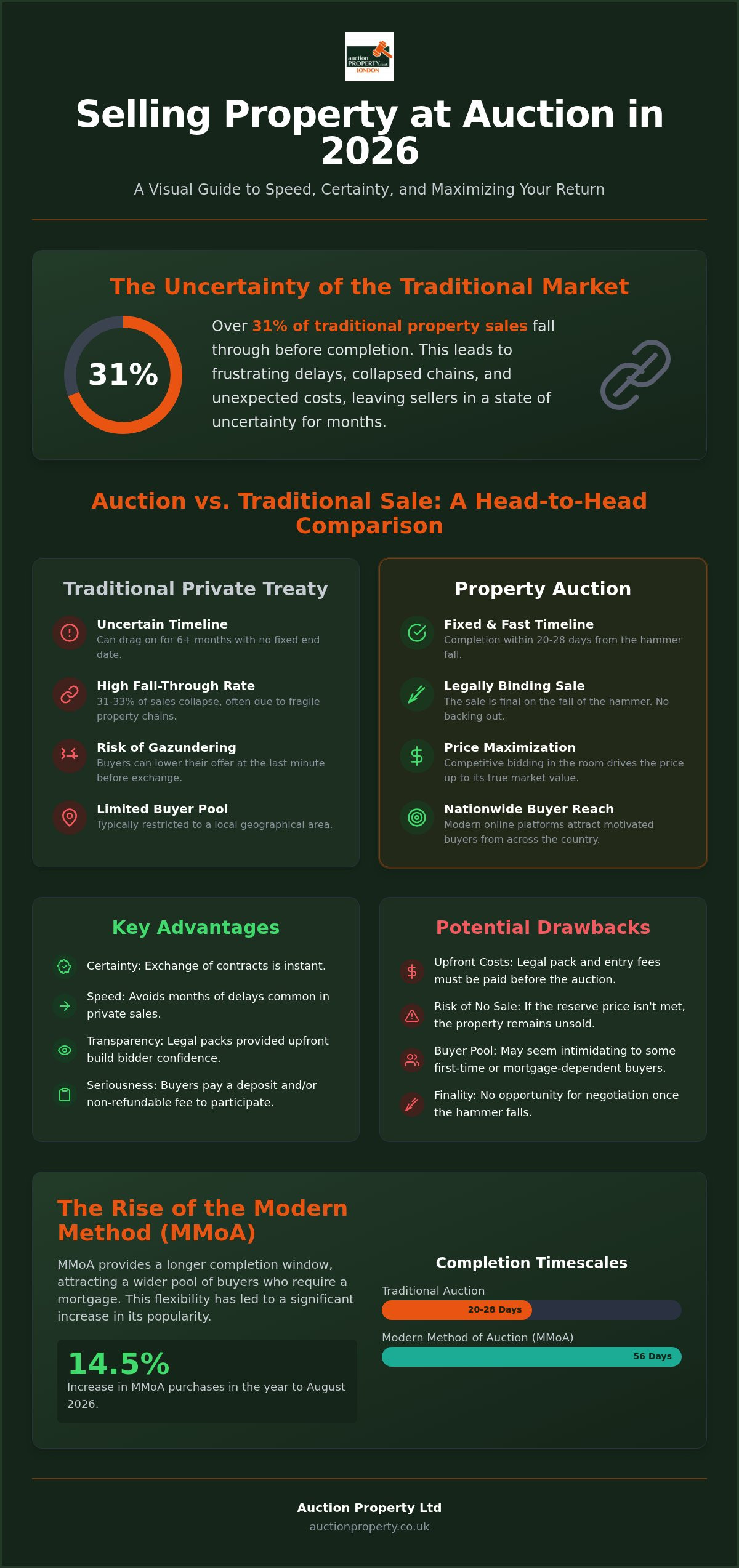
With over 31% of traditional UK property sales currently falling through before completion, that “sold” sign on your lawn often feels more like a suggestion than a certainty. It’s frustrating to navigate a market where delays are the norm and chains collapse without warning. You need a transaction that’s final, transparent, and executed on your timeline instead of being left at the mercy of a hesitant buyer.
This guide examines the selling property at auction pros and cons to help you decide if the auction room is the right strategic move for your asset in 2026. We’ll strip away the intimidation factor to show how this model provides a fixed exit date and utilizes competitive bidding to maximize your return. You’ll learn how the latest 2026 home buying reforms, including mandatory upfront sales packs, are streamlining the process for both residential and commercial sellers. We provide a clear breakdown of the financial commitments, the speed of the modern method versus traditional auctions, and the specific risks you must mitigate to ensure a successful hammer fall.
Key Takeaways
- Secure a legally binding exchange of contracts the moment the hammer falls, targeting a completion window of 20 to 28 days.
- Weigh the critical selling property at auction pros and cons to decide if immediate certainty justifies the upfront investment in legal and entry fees.
- Navigate the 2026 property landscape by understanding how current mortgage rates and regulatory reforms are shifting the advantage toward the auction room.
- Master the preparation process by instructing solicitors early for Legal Pack provision to build bidder confidence and minimize the risk of an unsold lot.
- Leverage modern online bidding infrastructure to remove administrative hurdles and access a broader pool of motivated nationwide buyers.
The Shift Toward Property Auctions in the 2026 Market
In July 2026, UK property auctions raised £215.4 million across 1,569 recorded sales. This momentum reflects a fundamental shift in how sellers approach the market. While house prices are seeing a modest growth of 2% to 4% this year, the real story lies in the volume of transactions moving toward the gavel. Sellers are pivoting because the traditional market is struggling with significant volatility. Although mortgage rates have stabilized, the 5% Stamp Duty surcharge on additional properties is prompting many landlords to exit the market. This surge in listings is finding a ready audience in the auction room where speed is guaranteed.
When you evaluate selling property at auction pros and cons, the primary advantage in the current climate is the elimination of the “maybe.” Traditional agency models are currently hampered by a 31% to 33% fall-through rate. In a private treaty sale, there’s no legal commitment until the exchange of contracts; this often takes months of negotiation and administrative delays. Long chains create a fragile environment where one buyer’s mortgage issue can collapse multiple transactions simultaneously.
Why Traditional Sales Are Faltering
The frustration of the traditional market stems from a lack of transparency and speed. By mastering the property auction, you bypass the typical hurdles of the high street agent. You replace months of uncertainty with a fixed timeframe where the fall of the hammer represents a legally binding contract. The 2026 home buying reforms now require sellers to provide upfront “sales packs” with key property information. This regulatory change plays directly into the strengths of the auction room, as comprehensive legal packs are already the standard. Sellers who embrace this level of openness early in the process are finding it much easier to attract serious, cash-ready buyers.
The Rise of the Modern Method and Online Bidding
Digital transformation has democratized the industry. Modern online platforms provide 24/7 transparency and a nationwide reach that no local agent can match. Analyzing the selling property at auction pros and cons reveals that the modern bidding infrastructure is the superior alternative for those who value time above all else. Understanding how property auctions work in this digital-first era is essential for any seller. Unlike traditional auctions that require immediate completion, the Modern Method of Auction (MMoA) offers a 56-day window. This attracts a wider pool of private buyers who need mortgage financing. In the year to August 2026, MMoA purchases increased by 14.5% as more people realized they could buy a home with the same speed as an investor. This online infrastructure removes the friction of physical attendance, allowing bidders to engage securely from any location.
The Unrivalled Advantages: Why Speed and Certainty Win
The speed of a property auction is unparalleled in the UK market. While traditional sales can drag on for six months or more, an auction completion typically occurs within 20 to 28 days of the hammer falling. This compressed timeline isn’t just about convenience; it’s a strategic tool for managing liquidity and reducing holding costs. When you evaluate selling property at auction pros and cons, the primary advantage is the absolute finality of the transaction. The fall of the gavel constitutes a legally binding exchange of contracts. There’s no room for cold feet, renegotiation, or the dreaded practice of gazundering. Once the hammer strikes, the price is fixed and the deal is done.
Guaranteed Completion and the End of Chains
In a traditional sale, you’re often trapped in a chain where your success depends on a stranger’s mortgage approval. Auctions eliminate this vulnerability. The winning bidder is legally obligated to pay a 10% deposit and sign the contract immediately. This security is often bolstered by a non-refundable buyer premium or administration fee, ensuring only serious, financially capable parties participate. For those who need to sell house fast at auction uk, this level of commitment provides peace of mind that the high street simply cannot offer. This guide to buying and selling highlights that the immediate exchange is why many institutional sellers choose this route. It removes the administrative hurdles and delays associated with traditional methods.
Maximising Value Through Transparency
Many sellers fear they’ll lose money by avoiding the open market, but the opposite is often true. A competitive auction environment creates intense momentum. We use a “Guide Price” as a strategic magnet to attract a high volume of viewers and registered bidders. This transparency prevents the “best and final offer” guesswork that often leaves money on the table in traditional sales. Transparent bidding ensures every participant knows exactly where they stand, removing the friction of secret negotiations.
When multiple parties compete in a public forum, the psychology of the room takes over. Bidders see their rivals’ actions, which validates the property’s value and often drives the final price well beyond initial expectations. In July 2026, the median hammer price was 27.3% over the guide price for lots with published outcomes. This bidding war advantage ensures you achieve the true market value through an open, honest process. If you’re ready to bypass the delays of the traditional market, you can browse our upcoming residential auctions to see this momentum in action.
Navigating the Risks: Potential Drawbacks of the Auction Room
Every strategic exit requires a balanced view of the trade-offs. While we’ve highlighted the speed of the transaction, a full analysis of selling property at auction pros and cons must address the specific risks. The auction room is a high-performance environment that demands upfront capital and a willingness to accept market-driven results. You’re trading the broad, often slow exposure of the open market for a concentrated burst of high-intensity interest.
Success under the hammer isn’t free. You’ll need to invest in a comprehensive Legal Pack before your listing goes live. This document is the backbone of bidder confidence; without it, you won’t attract serious interest. You’ll also encounter entry fees to cover marketing and catalogue placement. These are typically non-refundable disbursements. This means you’re committed financially before a single bid is placed, unlike the traditional “no sale, no fee” models that often hide the true cost of lost time.
The 28-day completion window is a double-edged sword. While it provides the speed you need, it often excludes “lifestyle” buyers who rely on lengthy chain-dependent sales or complex mortgage approvals. This narrows your pool of potential buyers to cash-ready investors and professionals. You’re trading the volume of viewers for the quality and liquidity of the bidders who actually show up.
Understanding the Fee Structure
Auction houses typically operate on two financial models: seller commissions or buyer premiums. You must distinguish between these early in your planning. A seller commission is a percentage of the final price, while a buyer’s premium shifts the cost to the winning bidder. It’s a myth that auctions are entirely risk-free regarding costs. Even if your property doesn’t reach its reserve, you’re usually responsible for the legal and marketing costs incurred during the campaign. When comparing these to traditional estate agent percentages, you must factor in the “cost of time” and the financial impact of a 31% fall-through rate in the private treaty market.
The Challenge of the Reserve Price
Setting your reserve price is the most critical tactical decision you’ll make. If you set it too high, you risk “burning” the property. An unsold lot carries a stigma that can make future marketing more difficult. However, if the bidding stops just below your target, the process isn’t necessarily over. Most auctioneers enter immediate negotiations with the highest registered bidders to bridge the gap. Relying on expert-led valuations is the only way to ensure your reserve price is grounded in current 2026 market data rather than optimistic speculation. This ensures your property remains attractive while protecting your minimum financial requirements.
Strategic Preparation: How to Maximise Your Success Rate
Maximising your outcome requires a systematic approach that begins long before the auctioneer takes the podium. When weighing the selling property at auction pros and cons, the success of your sale often hinges on the quality of your upfront preparation. You must treat the pre-auction phase as a high-intensity campaign designed to eliminate buyer doubt and build competitive pressure. This structured methodology removes the administrative hurdles that typically stall traditional transactions.
Step 1 is obtaining a professional valuation grounded in 2026 market data. With house price growth currently forecast at 2% to 4%, an accurate valuation ensures your guide price acts as an effective lead magnet. Next, instruct your solicitor immediately. A delayed legal pack is the most common reason for a lot being withdrawn or failing to attract bids. You must also implement an aggressive marketing strategy across major portals, combined with a realistic reserve price that protects your asset without stifling the room’s energy. Finally, remain open to pre-auction offers. A “sale prior” can sometimes secure a premium price from a buyer who wants to avoid the competition of the live event.
The Power of the Legal Pack
A comprehensive Legal Pack is your most potent tool for conversion. It must include title deeds, local authority searches, leases, and any special conditions of sale. When bidders review a “clean” pack, they gain the confidence to bid to their maximum limit because the risk of hidden liabilities is removed. Auction Property Ltd provides specialized administrative support for Legal Pack Provision, ensuring your documentation meets the rigorous standards required for a nationwide online sale. This transparency is what separates a successful hammer fall from an unsold lot. If you’re ready to start the process, you can request a professional property valuation to determine your ideal entry price.
Effective Marketing and Viewings
Visual impact is non-negotiable in an online environment. You need professional photography and detailed floorplans to capture attention in digital catalogues. We recommend managing “open house” viewing sessions to concentrate interest into specific windows. This strategy forces potential buyers to see their competition in person, building the psychological momentum that carries over into the bidding room. We use digital data to track interest levels and engagement before the auction day, allowing us to adjust the strategy in real-time. This level of insight ensures that every lot receives the maximum possible exposure before the bidding window opens.
Choosing the Right Platform: The Auction Property Ltd Advantage
Successfully navigating the selling property at auction pros and cons requires a partner that prioritizes speed and security above all else. In 2026, a tech-forward auction house isn’t just a convenience; it’s a strategic necessity for securing a nationwide audience. Traditional physical auctions often limit your reach to local bidders. Our online infrastructure removes these geographic boundaries, ensuring every lot receives maximum exposure across the UK. This digital-first approach allows us to maintain the gravitas of a traditional sale while utilizing modern tools to accelerate every step of the transaction.
Our expert team manages the entire process from the initial valuation to the final fall of the gavel. We understand the nuances of all types of property, whether you’re offloading a residential investment, a commercial unit, or a development site. This versatility ensures that your specific asset is marketed to the right pool of qualified buyers. We strip away the intimidation factor of the industry, replacing it with a sense of clarity and opportunity for every client we serve.
A Transparent and Efficient Process
We’ve digitized the traditional industry experience to eliminate administrative hurdles and delays. Our online platform provides a secure environment where bidding is visible in real-time, creating a level playing field for seasoned investors and first-time sellers alike. This 24/7 transparency builds trust and encourages the competitive momentum needed to drive prices upward. Because our reach is nationwide, we aren’t restricted by local market downturns. We find the buyer who values your property most, regardless of their location. This friction-free model is the superior alternative to the slow, chain-dependent methods of the high street.
Ready to Sell? Next Steps
Take control of your property sale today. Start by requesting a professional property appraisal and valuation through our secure platform. Our team utilizes current 2026 market data to provide an accurate figure that protects your interests while attracting serious bidders. Once instructed, we’ll move rapidly to prepare your marketing and assist with Legal Pack Provision to ensure your security. The timeline from instruction to a successful sale is designed for maximum efficiency, typically culminating in a legally binding contract within weeks. Join the modern era of property transactions and secure your guaranteed outcome now.
Secure Your Property Exit in 2026
The 2026 UK market demands a transaction model that prioritizes speed and legal finality. By weighing the selling property at auction pros and cons, you can move away from the uncertainty of traditional chains and toward a guaranteed completion window of 20 to 28 days. While the auction room requires upfront investment in legal packs and marketing, the reward is a transparent process where competitive bidding drives your asset to its true market value. Success hinges on expert preparation and choosing a platform that provides nationwide reach through a modern, tech-forward infrastructure.
Auction Property Ltd offers the clarity you need to navigate this high-stakes environment. Our specialist team handles residential and commercial assets with a focus on efficiency and security. We utilize a secure online bidding infrastructure and maintain transparent fee structures to ensure you remain in control of the process from instruction to the final hammer fall. Remove the administrative hurdles of the high street and transition to a more reliable way to sell.
Request a Professional Property Valuation for Auction Today to discover the potential of your property in the current market. We’re ready to help you achieve a fast, secure, and successful sale.
Frequently Asked Questions
Is selling at auction faster than a traditional estate agent?
Yes, selling at auction is significantly faster than the traditional estate agency route. While a private treaty sale can take over six months, a traditional auction completion typically occurs within 28 days of the hammer falling. The Modern Method of Auction offers a 56-day window, which is still much quicker than the high street average. These fixed timeframes eliminate the delays caused by long chains and hesitant buyers.
What happens if my property doesn’t meet the reserve price?
If the bidding fails to reach your confidential reserve price, the lot is withdrawn as unsold. However, the process doesn’t necessarily end there. Our expert team immediately enters negotiations with the highest registered bidders to see if a deal can be struck. Many properties that fail to sell under the hammer are successfully placed under contract within hours of the auction closing through these direct post-auction discussions.
Who pays the auctioneer’s fees, the buyer or the seller?
Both parties typically contribute to the costs of the transaction. The seller pays a commission based on the final hammer price, which covers marketing and appraisal services. The buyer is responsible for a non-refundable administration fee or buyer’s premium upon the exchange of contracts. When evaluating selling property at auction pros and cons, you must factor in how these fees compare to the potential costs of a collapsed traditional sale.
Can I accept an offer before the auction starts?
You can accept a “sale prior” offer at any point before the auction begins. If an attractive offer is made, we can facilitate an immediate exchange of contracts under the same auction conditions. This provides the same legal security and speed as a live sale while allowing you to capitalize on a motivated buyer’s interest early. It is a strategic way to bypass the live bidding process if the price is right.
What is the difference between a guide price and a reserve price?
The guide price is a public marketing figure used to attract interest, while the reserve price is the confidential minimum you are willing to accept. The reserve is usually set within 10% of the guide price. Understanding this distinction is vital when assessing selling property at auction pros and cons. A strategic guide price acts as a magnet for bidders, while the reserve protects your asset from being sold too cheaply.
Do I need a solicitor to sell my house at auction?
You must instruct a solicitor to handle the legal aspects of the sale. Their primary role is to prepare the comprehensive Legal Pack, which includes title deeds, searches, and special conditions of sale. This document is essential for building bidder confidence and ensuring a secure transaction. We provide administrative assistance for Legal Pack Provision to ensure your documentation meets the required standards for a nationwide online sale.
Is an auction sale legally binding as soon as the bidding ends?
Yes, the sale becomes legally binding the moment the hammer falls or the online timer expires. This constitutes an immediate exchange of contracts. The winning bidder is legally obligated to pay their deposit and sign the contract on the day. Unlike traditional sales where buyers can withdraw at any time before exchange, an auction provides absolute certainty and prevents the risk of gazundering or last-minute fall-throughs.
Can I sell a property with a sitting tenant at auction?
You can absolutely sell a property with a sitting tenant at auction. These lots are highly attractive to investors who want immediate rental yield without the hassle of finding new occupants. Whether it is residential or commercial property, selling with a tenant in situ is a standard practice. You simply need to include the tenancy agreement and rent schedule in your Legal Pack to provide full transparency to potential bidders.