

The traditional housing market is often the least effective place to settle an estate, particularly when beneficiaries are scrutinizing every decision you make. As an executor, you’re likely balancing a property in poor condition with the urgent need for a liquid payout. A probate property auction provides the specific legal and financial safeguards you need to move forward. It replaces months of uncertainty with a transparent, competitive environment that proves you’ve achieved the best possible price for the asset.
It’s understandable to feel overwhelmed by the administrative burden, especially with the probate application fee rising to £526 in July 2026. You want a process that minimizes hassle and eliminates the risk of a sale collapsing at the last minute. This guide shows you how to use a professional auction to secure a sale date and meet your fiduciary obligations with confidence. We’ll examine the 2026 tax thresholds, the 28-day completion cycle, and how digital platforms are now the standard for achieving maximum market reach.
Key Takeaways
- Understand the 28-day completion cycle that allows executors to settle estates significantly faster than traditional private treaty sales.
- Learn how to meet HMRC valuation requirements and set strategic reserve prices to fulfill your fiduciary duties with confidence.
- Discover how a probate property auction creates a transparent, competitive environment that provides irrefutable proof of market value to all beneficiaries.
- Ensure a secure transaction with an immediate exchange of contracts, removing the risk of sales falling through or buyers renegotiating.
- Streamline the administrative burden by leveraging professional legal pack provision and digital platforms that reach a nationwide pool of motivated buyers.
Understanding the Probate Property Auction Process in 2026
Selling inherited assets requires more than just finding a buyer. It requires a defensible process that stands up to legal scrutiny. A probate property auction is a legally binding method to achieve fair market value for a deceased person’s property at a specific point in time. For an executor or administrator, this is the most efficient path to fulfilling their legal obligations. You aren’t just selling a house; you’re liquidating an estate asset while under the watchful eyes of beneficiaries and, potentially, the courts.
Understanding the Probate Process is the first step for any executor appointed to manage a deceased person’s estate. Once the legal right to deal with the property is established, the executor must decide on the most effective disposal method. Choosing a probate property auction isn’t just about speed. It’s about creating a transparent audit trail. This transparency is the single most critical factor in probate transactions. It protects you from accusations of underselling the property or showing favoritism toward a specific buyer. In a public forum, the market determines the price, providing you with irrefutable proof that you’ve met your fiduciary duties.
What is a Probate Sale?
A probate sale differs significantly from a standard residential transaction. In a typical sale, the owner usually sells by choice. In probate, the sale is often a legal necessity to distribute assets among beneficiaries or settle estate debts. Unlike the traditional market where offers can be withdrawn at any time, the fall of the auction gavel creates an immediate, legally binding contract. This finality is essential when managing multiple stakeholders who expect a definitive outcome. The process strips away the emotional negotiation often found in private sales and replaces it with a structured, professional transaction.
Key Benefits for Executors and Solicitors
Speed remains a primary driver for choosing an auction. Traditional sales are often plagued by “chain-free” delays or buyers who cannot secure financing at the last minute. Auctions bypass these hurdles entirely through a streamlined framework.
- Immediate Certainty: A 10% deposit is paid by the successful bidder the moment the auction ends. This financial commitment eliminates the risk of gazundering or the buyer pulling out.
- Fixed Timelines: Most auction sales complete within 28 days of the exchange of contracts. This allows for a predictable distribution of funds to beneficiaries, which is often a point of significant pressure for executors.
- Proof of Market Value: Because the sale happens in an open, competitive environment, it provides a clear record that the property was sold for the highest price the market would bear on that day.
By using this model, executors can manage properties that are in poor condition or located far away without the need for multiple viewings or long-term maintenance. It’s a pragmatic solution designed for high-stakes estate administration.
Legal Requirements and Valuations for Inherited Property
Executing a probate property auction requires strict adherence to HMRC guidelines. You can’t simply guess the value of the estate. A formal valuation is the cornerstone of your Legal and Tax Requirements. In 2026, the standard nil-rate band remains frozen at £325,000, and the residence nil-rate band at £175,000. Accurate valuation prevents overpaying Inheritance Tax or facing penalties for under-declaring assets. While you can market a property before a Grant of Probate is issued, exchange and completion require the legal document to be in your possession.
Setting the right price is a tactical decision that balances speed with your fiduciary duty. The “Guide Price” is the figure the public sees; it’s designed to generate interest and momentum. The “Reserve Price” is the confidential minimum you’re willing to accept. By law, the reserve cannot exceed the guide price by more than 10%. This structure ensures transparency and prevents the “bait and switch” tactics that can lead to beneficiary disputes. It provides a clear, defensible record of your decision-making process.
The Role of the RICS Valuation
Standard estate agent appraisals are often too informal for probate purposes. HMRC prefers a Red Book valuation from a RICS-qualified surveyor to establish the “Open Market Value” at the date of death. This figure serves as the baseline for the estate’s tax liability. Auction Property Ltd assists by coordinating professional appraisals that satisfy both legal requirements and auction strategy. You need a valuation that stands up to scrutiny if the District Valuer reviews the file. If you’re unsure where to start, you can request a review of your property’s auction potential to ensure your documentation is market-ready.
Grant of Probate and Auction Timelines
Many executors ask if they can sell at auction without probate. You can begin marketing and even reach the auction day while the application is pending. However, the legal pack must clearly state that completion is contingent on the grant being issued. This approach allows you to build market momentum during the 9 to 12 months it typically takes for the registry to process applications. It’s a proactive way to reduce the time the property sits empty and vulnerable to deterioration.
A robust legal pack is non-negotiable for a successful transaction. It should include:
- Title deeds and office copies
- Local authority and environmental searches
- Special conditions of sale
- A valid Energy Performance Certificate (EPC)
- Draft probate application or death certificate
Coordinating with solicitors early ensures the legal pack is robust enough to withstand buyer due diligence. This preparation is what allows for a secure exchange of contracts the moment the hammer falls.
Auction vs. Private Treaty: Which is Better for Probate Sales?
Choosing between an auction and a private treaty sale is a choice between certainty and speculation. In the traditional market, sales typically take three to six months to reach completion. During this window, you’re vulnerable to gazundering, where buyers lower their offer at the last minute, or chain collapses that restart the entire process. A probate property auction eliminates these variables. It provides a legally binding exchange of contracts the moment the hammer falls, with completion usually following in just 28 days. This speed is vital when beneficiaries are eager for a resolution or when estate taxes are due.
Transparency is your greatest defense as an executor. When you’re evaluating options for an inherited home, you must consider the risk of family disputes. Private treaty negotiations happen behind closed doors, which can lead to accusations of favoritism or poor management. In contrast, an auction is a public event. Everyone sees the bids. This open competition provides an undeniable record that the property achieved its true market value on that specific day. It removes the emotional weight from your shoulders and places the responsibility for the price squarely on the market.
Certainty of Sale
For grieving families, the psychological benefit of a fixed completion date cannot be overstated. You’re likely managing a property that requires significant modernisation, which often scares off traditional mortgage-reliant buyers. These properties thrive in an auction environment where cash-ready investors compete for the opportunity to add value. By choosing this route, you eliminate the “chain” risk entirely. There is no waiting for a buyer to sell their own home first. You can explore the full benefits of selling your house fast at auction to understand how this model prioritizes your time over traditional market friction.
Achieving Fair Market Value
Many executors fear that an auction means selling for less. The reality is often the opposite. Competitive bidding frequently drives the final price well above the initial valuation, particularly for properties with renovation potential. For example, a property in need of a full strip-out might be valued at £200,000 by an agent. In a probate property auction, three or four motivated investors can push that price to £235,000 within minutes. This outcome isn’t just a financial win; it’s a documented success that satisfies every beneficiary. You gain a clear audit trail that proves you maximized the estate’s value without the delays of the open market.
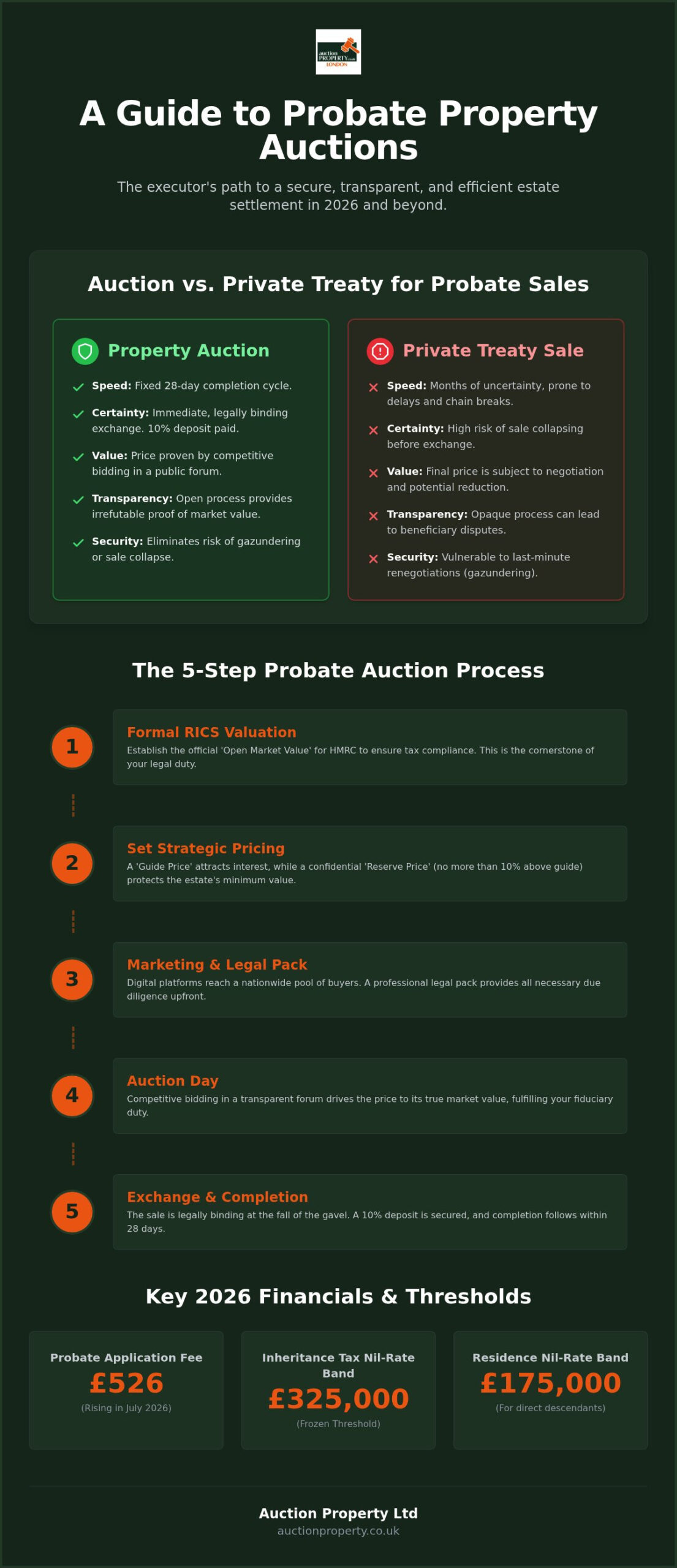
A Step-by-Step Guide to the Probate Property Auction
Moving from the decision to sell to the actual execution requires a disciplined approach. You’ll follow a sequence designed to maximize exposure while protecting the estate’s interests. This structured method removes the guesswork and ensures every action contributes to a secure, final outcome. By following this roadmap, you can manage a probate property auction with the precision required of a professional executor.
- Step 1: Initial Appraisal and Strategy Discussion: Meet with an expert to determine if the property is suitable for auction. This goes beyond a simple valuation; it’s a strategic review of market demand and investor appetite.
- Step 2: Instruction and Legal Pack Preparation: Your solicitor compiles the essential documents, including title deeds, searches, and special conditions. This pack is the foundation of buyer confidence and transparency.
- Step 3: Marketing Phase: The property is launched across major online portals and shared with a nationwide database of developers and investors to build competitive momentum.
- Step 4: Auction Day: Bidding takes place on a secure digital platform. Registered buyers compete in real-time, or via pre-arranged proxy bids, ensuring the highest price is reached.
- Step 5: Exchange and Completion: The moment the virtual hammer falls, a legally binding exchange occurs. The buyer pays a 10% deposit, and completion typically follows within 28 days.
Preparing the Property for Sale
You don’t need to spend months renovating or clearing every room. In a probate property auction, many buyers actively seek properties they can modernize themselves. You must decide whether to clear the building or sell it “as seen” with its contents. Selling “as seen” is often the most efficient choice for executors living far away. Ensure you have a valid Energy Performance Certificate (EPC) and perform basic maintenance to keep the property secure and weather-tight. Our marketing strategy targets a national audience, ensuring investors see the potential regardless of the property’s current state.
What Happens on Auction Day?
Modern auctions utilize sophisticated online bidding platforms. Bidders must register in advance and pass strict anti-money laundering checks, which filters out time-wasters. This digital environment allows beneficiaries to watch the sale live, providing a clear audit trail of the transaction. If you want to understand the mechanics of the bidding room, mastering the property auction process will help you navigate the day with confidence. We manage the reserve price strictly; if bidding doesn’t meet your confidential minimum, the property isn’t sold, ensuring the estate’s value is always protected.
Ready to move forward? Request a professional auction appraisal to see how we can simplify your estate administration.
Maximising Estate Value with Auction Property Ltd
Auction Property Ltd provides the national reach and technical infrastructure necessary to liquidate inherited assets effectively. We understand that as an executor, you’re often working under intense pressure from beneficiaries and strict legal timelines. Our team manages the high-stakes nature of these transactions with professional gravitas, ensuring every step from the initial valuation to the final fall of the gavel is handled with precision. We replace the ambiguity of the traditional market with a friction-free process designed for speed and security. Our commitment is to strip away the administrative hurdles and provide a clear, defensible path to a successful sale.
Why Choose Our Online Auction Platform?
Digital auctions have transformed how inherited assets are sold. Our online auction infrastructure allows beneficiaries to watch the sale live from any location, providing them with a sense of involvement and total transparency. This visibility is a powerful tool for preventing disputes and proving that the best price was achieved in an open forum. By leveraging a nationwide buyer pool, we ensure your property isn’t limited to local interest. Whether the asset is a residential home or a commercial development site, we connect it with motivated investors across the UK. Our secure legal pack provision further streamlines the transaction, ensuring all necessary data is available for buyer due diligence well before the probate property auction begins.
Getting Started with Your Probate Valuation
Your journey begins with a clear, realistic appraisal. We take a no-nonsense consultancy approach, providing you with an expert valuation that reflects current 2026 market conditions and HMRC requirements. We don’t rely on inflated estimates to win your business; we provide data-driven figures that lead to a guaranteed sale. Our support extends through the entire administrative cycle, reducing your burden during a difficult period of grief. You gain a partner that values your time and prioritizes the finality of the transaction. We handle the professional marketing and property appraisals as part of our comprehensive service, ensuring you have everything needed to meet your fiduciary duties.
Don’t let an inherited property sit empty while you navigate the delays of the traditional market. Take the first step toward a secure and transparent exit. Book a professional probate property valuation today to secure a transparent and efficient outcome for the estate.
Finalise Your Probate Sale with Confidence
Managing a deceased estate is a high-stakes responsibility that demands clarity and speed. You’ve seen how the 28-day completion cycle removes the uncertainty of the traditional market while the public bidding process provides irrefutable proof of market value. A probate property auction isn’t just a transaction; it’s a strategic legal safeguard for executors. It ensures you meet your fiduciary duties without the administrative delays often associated with private treaty sales.
Our platform offers a transparent online bidding environment where all beneficiaries can watch the sale live. With our national reach for all UK property types and expert legal administrative assistance, we manage every detail from valuation to the final exchange. You don’t have to navigate this complex process alone. Instruct Auction Property Ltd for your probate sale today and move forward with the certainty of a guaranteed outcome. You’re now equipped to turn a challenging inheritance into a secure and finalized result.
Frequently Asked Questions
Do I need a Grant of Probate before I can sell a property at auction?
No, you don’t need the Grant of Probate to begin the process. You can instruct an auctioneer and market the property “subject to probate” to build momentum while your application is processed. However, the legal exchange of contracts and the final completion cannot take place until the formal grant is issued by the registry. This proactive approach is a common strategy in a probate property auction to reduce the time an asset sits empty.
How long does it take to sell a probate property at auction?
The entire process typically takes between eight and ten weeks from instruction to completion. This includes a three to four-week intensive marketing period followed by the auction day itself. Once the hammer falls, the buyer is legally committed to a 28-day completion period. This timeline is significantly faster than the three to six months usually required for traditional private treaty sales in the 2026 market.
What happens if the property doesn’t reach its reserve price?
If the highest bid falls below your confidential reserve, the property is withdrawn from the sale as “unsold.” In these instances, the auctioneer immediately engages with the highest bidders to see if a deal can be negotiated at a price you find acceptable. Many properties that fail to meet their reserve on the day are sold through these private negotiations within 24 hours of the event ending.
Who pays the auction fees in a probate sale?
Fees are typically settled by the estate and are often deducted directly from the sale proceeds upon completion. This ensures that executors don’t have to provide significant upfront capital from their own pockets. You should check the specific terms of your agreement, as some auction models may involve a buyer’s premium or reservation fee that shifts part of the cost to the purchaser.
Can beneficiaries bid on the probate property themselves?
Yes, beneficiaries are legally permitted to bid on a probate property auction if they wish to acquire the asset for themselves. They must register as bidders and satisfy the same anti-money laundering checks as any other participant. This method is often preferred in family situations as it provides a transparent, market-led way to determine the “buy-out” price, preventing accusations of undervaluation among siblings or other heirs.
Is an auction suitable for a probate property in poor condition?
Yes, properties requiring significant modernisation or structural repair are the most successful assets in an auction environment. These lots attract professional developers and cash buyers who aren’t restricted by the strict survey requirements of traditional mortgage lenders. Selling an unmodernised home via auction removes the need for you to carry out expensive repairs or clearances before the sale.
What are the risks of selling a probate property via an estate agent?
The primary risks include lengthy delays, chain collapses, and “gazundering,” where a buyer lowers their offer just before exchange. These issues are particularly problematic for executors who face pressure from beneficiaries for a quick payout. Additionally, a private treaty sale lacks the public transparency of an auction, which can leave you vulnerable to claims that the property was sold below its true market potential.
How is the reserve price determined for a probate auction?
The reserve price is a confidential figure agreed upon by the executor and the auctioneer before the sale begins. It’s informed by the RICS probate valuation and current market demand. By law, the reserve price cannot be set more than 10% above the starting guide price. This ensures the guide price remains a realistic reflection of the minimum amount the seller is prepared to accept, maintaining trust with potential bidders.