

A Local Authority Search combines an LLC1 search of the Local Land Charges Register with CON29 enquiries about a property and its surroundings. Understanding local authority searches means knowing that they can reveal matters such as planning history, building regulation issues, road proposals and legal charges recorded against the property. Buyers can obtain an official search through the council or a Personal Regulated search through an independent search provider.
It’s easy to treat the search as one more conveyancing document, but the search type matters: both routes use established forms, while the way the information is gathered differs. This guide explains what the search can uncover, how LLC1 and CON29 divide the enquiries, and how council and regulated searches are governed.
You’ll also see where a local authority search has limits, including why nearby land and development proposals may need separate investigation. Understanding these distinctions helps you assess the results and what they could mean for your purchase.
Key Takeaways
- See how LLC1 and CON29 cover different records, from registered charges to planning and infrastructure enquiries.
- Learn what a search can reveal about building work, road schemes and planning history, and where its scope ends.
- Understand the distinction between a council search and a Personal Regulated search, including how each is governed.
- Know which factors affect search costs and turnaround times, so you can plan the transaction with fewer surprises.
- For auction purchases, use the legal pack to assess the property and its documents before the sale proceeds.
CON29 planning and infrastructure enquiries
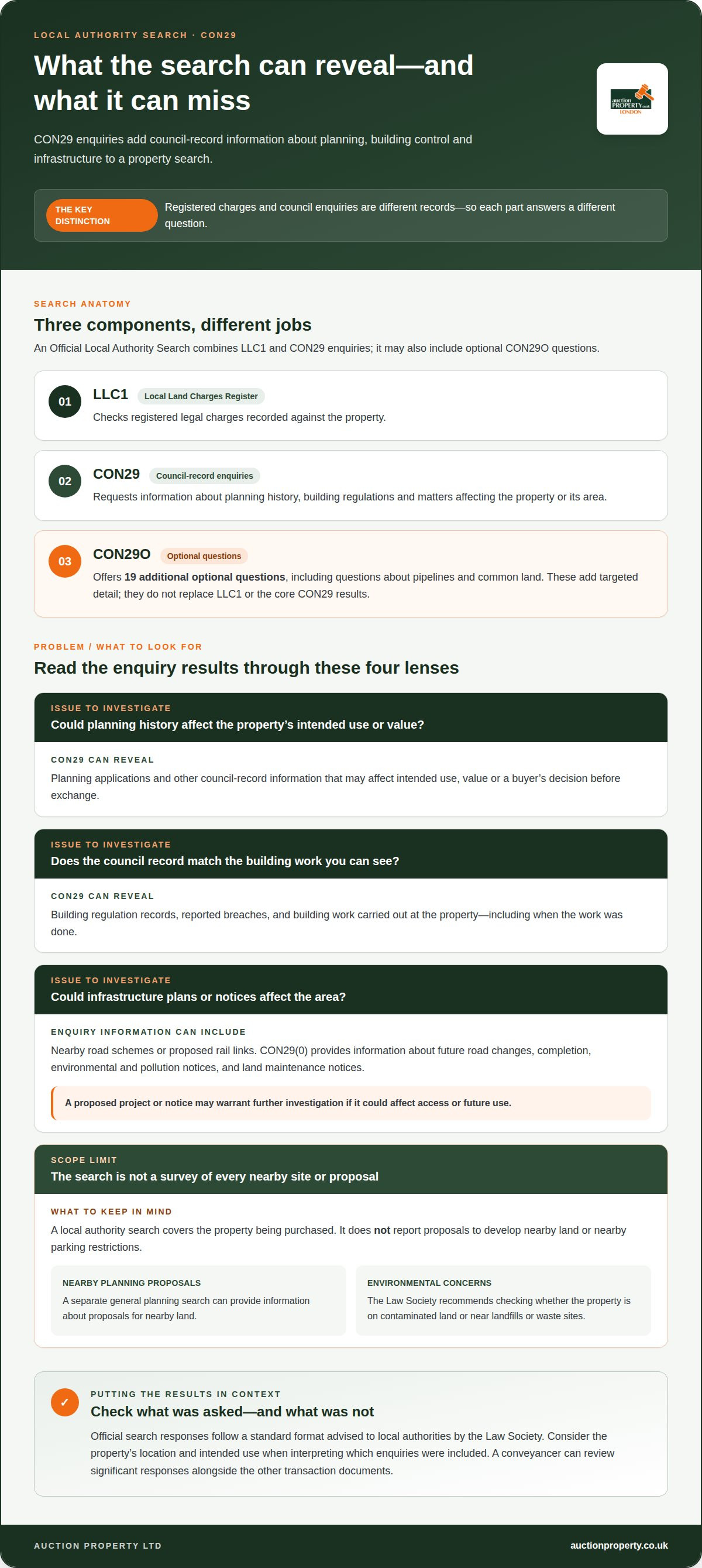
CON29 enquiries add planning, building control and infrastructure information to a property search. Their responses can flag records that may affect intended use, value or a buyer’s decision before exchange.
Official Search Components
An Official Local Authority Search combines LLC1 with CON29 enquiries, and may include CON29O optional questions. The components answer different questions: LLC1 searches the Local Land Charges Register, while CON29 requests information from council records. This distinction matters because planning permissions and road proposals appear through enquiries, not as the same type of registered charge.
Official search responses follow a standard format advised to local authorities by the Law Society. This helps your conveyancer review the council’s answers alongside the other transaction documents. A mortgage lender may require a local authority search, so the search type and its contents can be important before exchange.
CON29 Enquiries
CON29 is the set of enquiries about planning history, building regulations and matters affecting a property or its area. Responses can reveal planning applications and building regulation breaches recorded by the council. They can also identify building work carried out at the property and when that work was done, helping a buyer compare the council record with the building’s visible condition.
Infrastructure information can include nearby road schemes or proposed rail links that could affect the area. CON29(0) provides information about future road changes, completion, environmental and pollution notices, and land maintenance notices. These records may prompt further investigation when a proposed project or notice could affect access or future use.
Scope matters. A local authority search covers the property being purchased, but does not report proposals to develop nearby land. A separate general planning search can provide information about nearby planning proposals. The Law Society recommends checking whether a property is on contaminated land or near landfills or waste sites, as these environmental concerns may need investigation beyond the council search.
Optional CON29 Questions
CON29O is the optional enquiry form used to ask additional questions beyond the standard CON29 enquiries. An Official Local Authority Search can use CON29O for 19 additional optional questions, including questions about pipelines and common land. Official searches comprise LLC1, CON29 and CON29O, which can be ordered together or separately.
Optional questions add targeted detail where a property or its setting makes a topic relevant. For example, a pipeline enquiry may help clarify whether relevant records exist for the site; a common land enquiry may help identify an issue requiring further review. The answers do not replace the core LLC1 or CON29 results. Consider the property’s location and intended use when interpreting which enquiries were included, then discuss any significant response with the conveyancer before proceeding.
What is a Local Authority Search?
A local authority search checks council records relevant to a property purchase. Its cost and timing depend on whether it is an official or personal search, the council involved and the enquiries requested.
Search Costs and Turnaround Times
Search costs and turnaround times vary by council and search route, affecting your transaction budget and schedule. Each authority sets its own rate, and additional fees may apply for extra properties or larger sites.
An independent search company carries out a personal search. Local authority searches in the UK usually take two to six weeks, although reported turnaround times range from two days to ten weeks. The government target is ten working days, but actual timing depends on the council’s processing.
Ordering a Local Authority Search
A conveyancer or solicitor usually orders the search after the buyer’s offer is accepted. This allows the results to inform legal enquiries as the purchase progresses. Provide the property’s full address and identify the property clearly, so the search covers the correct council records.
Your conveyancer can request an official search from the council or arrange a personal search through an independent company. Specify whether the transaction needs additional enquiries, as the search type and scope affect the information returned and may affect costs. An unusual site, for example, may require attention to more than the standard property record.
Whether Searches Are Compulsory
A local authority search is not a universal legal requirement for every UK purchase, but mortgage lenders require one when the purchase is funded by a mortgage. For the lender’s purposes, the search must be no older than six months at completion. If the transaction takes longer than expected, an older report may no longer meet this requirement.
A cash buyer can proceed without a local authority search, but doing so leaves council-record risks undiscovered. The search may reveal legal restrictions, planned developments or environmental issues that could affect the property. Weigh these risks against the cost and timing before deciding to proceed without a report.
Search Limitations and Risks
A local authority search covers the property being purchased, not every proposal in the surrounding area. It does not report nearby development proposals or parking restrictions. A separate general planning search can provide information about nearby planning proposals and help address this gap.
Search freshness matters too. Some searches are valid for only three months, while auction searches older than six months may not reflect recent planning applications or council decisions. Compare the report date with the expected completion date. If a finding could affect the property’s value, a buyer may renegotiate the purchase price.
If search findings are shaping your purchase route, review property auction opportunities alongside the property’s legal information.
LLC1 and the Local Land Charges Register
The LLC1 searches the Local Land Charges Register for entries recorded against a property in England and Wales. The register is maintained pursuant to the Land Charges Act 1925, and its results can reveal restrictions or financial obligations that matter to a buyer.
Unlike a general review of council files, an LLC1 search focuses on registered local land charges. These can affect how an owner uses a property or what must be addressed during a purchase. For example, a result may identify listed building status, conservation area controls or a tree preservation order. Each can place constraints on works or changes to the site.
Financial entries matter too. An LLC1 can list charges for money a council may be owed for work already carried out on the property. Councils may attach property debts for services such as road maintenance or emergency repairs. A buyer should treat an entry as a specific issue to understand, not simply as background information.
For example, if the register shows a council charge linked to emergency repairs, your conveyancer can establish what work it concerns and how it affects the purchase. A debt recorded against a property may have implications for the transaction and your plans. A mortgage lender may also consider relevant search findings as part of its lending requirements.
Read the LLC1 search results alongside the property’s address and the legal documents. Check that the report relates to the correct property, then note each entry’s type and description. A listed building entry raises different questions from a financial charge, while a tree preservation order may affect plans for a garden or development.
- Listed building status: identifies a property with this designation in the register.
- Conservation area controls: flags controls recorded for properties in designated areas.
- Tree preservation orders: identifies controls relevant to protected trees.
- Financial charges: shows council amounts potentially owed for completed work.
These entries do not all have the same practical effect. A tree preservation order may matter if you plan landscaping, while a recorded charge calls for clarity about the debt and how it will be treated. The register gives you and your conveyancer a clear starting point for examining each recorded matter before you commit to the purchase.
The LLC1 is one component of the wider local authority search, not a full account of every issue affecting a property. Its value lies in identifying formal entries on the register. Use those search results to guide focused legal enquiries, especially where a restriction or charge could change the property’s use, planned works or purchase terms.
Regulated and council local authority search types
The key distinction is who gathers the council information: the council or an independent search provider. Understanding local authority searches starts with recognising this difference, then comparing the report’s scope and presentation.
An Official Local Authority Search is carried out directly by the relevant council. An Official Local Authority Search brings together searches of relevant council records and enquiries, which may be requested together or separately. Personal Regulated searches are carried out by independent providers using council records. Both Official Local Authority and Personal Regulated searches include a full search of the Local Land Charges Register and Planning Register, plus data answering CON29R enquiries.
The comparison is not simply council versus private company. Both Official Local Authority and Personal Regulated searches comply with the Search Code, and both are accepted by 95% of mortgage lenders. Regulated searches cover the same areas as council searches and use the same documents. They can also include insurance covering information accuracy and professional indemnity.
Presentation can differ. Official responses use a standard format advised to local authorities by the Law Society. Personal Regulated search reports may vary in layout between providers, even when they supply the same essential information. During conveyancing, focus on the enquiry, council response, qualifications and referenced records, rather than the layout alone.
Local authority search results differ between councils because each holds records for properties in its area. Relevant planning applications, building regulations records and road schemes depend on the property’s location and the information held by that council. A practical guide to understanding local authority searches must account for local records: an answer about one council area cannot establish what applies elsewhere.
For example, a road scheme recorded by one council may be irrelevant to a property in another authority’s area. A building regulations response also relates to records relevant to the address searched. Identify the correct local authority, then assess its answers against the property’s plans, known works and intended use.
Choose a search type that fits the purchase and the lender’s requirements. Not all mortgage lenders accept personal local authority searches, so establish lender acceptance before proceeding. For auction purchases, consider this early: contracts usually exchange when the hammer falls, leaving limited time to address search issues afterwards.
The practical takeaway is to compare the search scope and responses, not just the provider route. Confirm that the report covers the required registers and enquiries, then read the council’s answers in the context of the specific property. A regulated search can provide the same essential information as an official search, while differing in who gathers it and how the findings are presented.
How much does a local authority search cost in England and Wales, and how long does it take?
Search costs depend on the council, search type and enquiries requested. Timing varies by authority too, so use local turnaround information when planning completion.
Each council sets its own official search rate, while regulated searches generally operate at a fixed rate across England and Wales.
These figures describe different scopes, rather than one universal fee. An official search may include LLC1, CON29 and optional CON29O enquiries, ordered together or separately. Extra properties and larger sites can attract additional council fees. The number and type of enquiries requested can therefore affect the total cost.
Timing varies widely. The government target for returning local authority search forms is ten working days, but council processing can take longer. Official searches in the UK usually take from one to six weeks. Regulated searches may be quicker in some areas, depending on access to records and local council processes.
July 2024 data recorded an average of 13 working days for an Official Local Authority search and 11 working days for a Personal Regulated search. These dated averages help compare routes, but they don’t describe every council’s current queue. Council workloads and the property’s location remain important factors.
Reports dated 19 August 2025 showed how turnaround can vary between individual councils: examples included 45 working days, 40 working days and 35 working days. These are council-specific figures from that date, not England-wide estimates or a current timetable for every authority.
Build the search into the transaction timetable early. A slow council response can delay conveyancing if enquiries remain unanswered before completion. For auction purchases, review the legal pack and search information before bidding, as exchange usually occurs when the hammer falls. Allow time to understand the findings, not just to receive the report.
If auction timing is part of your purchase plans, explore property auction opportunities and factor search enquiries into your preparation.
Auction Property: Residential Property Auctions
Auction Property Ltd offers Residential Property Auctions for buyers considering a purchase through auction. Use search findings alongside the legal pack before bidding, particularly if council records raise questions about permissions, restrictions or proposed works. Auction contracts usually exchange when the hammer falls, so understanding the property’s legal position beforehand is essential.
Auction Property Ltd also offers Commercial Property Auctions and Land and Development Site Auctions. The property type can affect which search findings matter most: for a development site, for example, pay close attention to planning records and land constraints. Legal Pack Provision gives buyers access to the property’s legal documents as part of their auction preparation.
Explore the available properties and legal information at auctionproperty.co.uk.
Turn your search findings into a confident next step
Understanding local authority searches can help you move from reviewing council records to making a considered property decision. Treat each response as part of the wider picture: relate the legal information to your plans for the property, then raise any unanswered points in your conveyancing discussions before committing.
Auction Property Ltd offers Residential Property Auctions, Commercial Property Auctions and Land and Development Site Auctions. If you’re considering an auction, include the property’s search findings in your preparation and review the relevant legal information before proceeding. Clear decisions start with understanding what you’re buying and how it fits your plans.
Contact Auction Property Ltd to discuss your next property move, or explore the options available. Take the next step with a clearer view and a plan that works for you.
Frequently Asked Questions
Property searches: What’s the difference between official searches and personal searches?
An official search is carried out directly by the local council; a personal search is compiled by an independent search company using council information. Both can provide the same essential information, including responses to CON29R enquiries. The main differences are who gathers the information and how the report is presented. Personal report formatting can vary, and mortgage lenders decide which search routes they accept.
How long do they take?
Local authority search turnaround can range from two days to ten weeks, depending on the council and property location. Searches usually take two to six weeks across the UK. July 2024 figures recorded averages of 13 working days for official searches and 11 working days for Personal Regulated searches. Treat averages as a planning guide, not a promise for a particular council or transaction.
Surely the Council option is more comprehensive?
Not automatically. Official and Personal Regulated searches cover the same areas and use the same documents, including relevant register searches and CON29R enquiry responses. Official reports follow a standardised format advised to councils by the Law Society, while Personal Regulated report layouts may vary. Compare the enquiries included and the actual council responses, rather than assuming the council route always returns more information.
What happens if the search reveals a problem?
Your conveyancer can explain an entry, establish what it relates to and raise focused enquiries. A planning or building regulations issue, for example, may call for further documents or clarification about the work. If auction searches reveal alterations made without necessary permissions, the buyer may need to regularise them after purchase. Findings that affect value may also provide grounds to renegotiate the purchase price.
What is CON29?
CON29 is the form of enquiries used to obtain information from a local authority about planning, building regulations and other property-related matters. Responses can identify relevant planning history, building regulation breaches, road schemes and proposed rail links. For example, a response about a nearby road scheme can alert a buyer to a proposed change that may affect the area around the property.
What is LLC1?
LLC1 is the search of the Local Land Charges Register for entries recorded against a property. It can identify matters such as listed building status, conservation area controls, tree preservation orders and financial charges for council work. For example, an entry for a council charge may relate to road maintenance or emergency repairs. Review each result with your conveyancer to understand its relevance to the purchase.
What searches are done during conveyancing?
Searches commonly considered during conveyancing include the local authority search, water and drainage search, environmental report and mining search. The property’s location and characteristics help determine which records are relevant. The Law Society recommends a water and drainage search to buyers in England and Wales. A mining search, for example, can report mine entries within 20 metres of a property’s boundaries.
Won’t the council search be quickest?
Not necessarily. Council processing times vary, and an official search can take from one to six weeks. Personal Regulated searches may sometimes be completed faster, particularly where search agents know local council processes. Speed depends on the relevant authority’s response and access to records. Compare current turnaround information for the property’s council when planning the conveyancing timetable.