

What if the most complex leasehold property at auction was actually your most profitable acquisition of 2026? While many investors retreat from high-rise lots due to legislative noise, the leasehold reform act property auction landscape now offers unprecedented clarity for those who understand the new rules of play. Since the abolition of the two-year ownership rule in January 2025, you’re no longer forced to wait to add value. You can now trigger lease extensions or freehold buyouts immediately upon registration, turning what used to be a long-term hold into a rapid turnaround opportunity.
You’re likely concerned about the 28-day completion window and the potential for hidden remediation costs under the Building Safety Act 2022. It’s a high-stakes environment where a missing landlord certificate can stall a deal or create an unexpected financial liability. This guide will show you how to navigate the latest ground rent proposals and building safety protocols to secure undervalued assets with total confidence. We’ll break down the current status of the 2024 Act, explain how to audit legal packs for 100% compliance, and reveal strategies for executing rapid exits in a shifting market.
Key Takeaways
- Learn how to leverage the latest leasehold reform act property auction changes to extend leases on Day 1, bypassing the old two-year ownership requirement.
- Identify critical compliance documents like the Leaseholder Deed of Certificate to protect your capital from remediation costs in high-rise residential investments.
- Master the 2026 due diligence checklist to navigate the 28-day auction completion window without overlooking essential safety documentation.
- Understand the current status of ground rent caps and marriage value to accurately price short-lease lots before the next wave of secondary legislation takes effect.
- Discover how to prepare leasehold lots for a transparent, high-speed sale using specialist legal administrative assistance to guarantee transaction certainty.
The 2026 Leasehold Reform Landscape: A New Era for Auctions
The 2026 property market isn’t just evolving; it’s being fundamentally restructured. For anyone engaging in a leasehold reform act property auction, the intersection of the Leasehold and Freehold Reform Act 2024 and the Building Safety Act 2022 has created a new standard for due diligence. We’ve moved past the initial confusion of 2024 into a period of full regulatory enforcement. If you’re dealing with residential high-rises, the focus has shifted from speculative value to documented safety and statutory rights.
This convergence means the “buyer beware” culture of the auction room is being replaced by a demand for total transparency. Investors now expect to see comprehensive safety data and clear ground rent structures before the hammer falls. With ground rent for new leases already capped at a peppercorn since June 2022, and existing leases facing proposed caps near £250, the valuation of modern flats now depends heavily on these legislative protections. Transparency is no longer a courtesy; it’s the primary driver of lot liquidity.
Key Legislative Drivers in 2026
The Leasehold Reform Act is the legislation that removes ownership barriers to lease extensions and freehold purchases. One of the most significant shifts is the move toward a 990-year statutory lease extension standard. While the abolition of marriage value, the premium paid when a lease drops below 80 years, is a core part of the 2024 Act, you must track the secondary legislation status carefully. As of August 2026, marriage value remains payable in many cases while valuation consultations continue. However, the abolition of the two-year ownership rule is fully in force. This allows buyers to start the extension process immediately after the auction contract is signed.
Why Auctions are the Preferred Exit for Leasehold Sellers
The private treaty market often stalls when faced with complex building safety enquiries. Traditional sales can drag on for months as solicitors grapple with remediation liabilities and landlord certificates. Auctions circumvent this friction by providing a fixed 28-day completion window. Sellers who provide a robust legal pack through Auction Property Ltd can achieve transaction certainty that the open market simply can’t match. Competitive bidding now prices in the new protections, ensuring that well-documented lots attract serious, informed capital. This speed is essential for investors looking to exit leasehold positions before further regulatory shifts occur in late 2027.
Capitalising on the Abolition of the Two-Year Ownership Rule
The removal of the two-year ownership requirement is the single most significant change for the leasehold reform act property auction market in 2026. Previously, investors buying short-lease properties were trapped in a two-year waiting period before they could legally compel a landlord to extend. This delay created a liquidity trap, forcing buyers to rely on sellers serving and assigning Section 42 notices. Now, the moment your ownership is registered, you have the right to act. This shift has fundamentally changed how the industry prices assets that were once considered unmortgageable.
By removing the two-year barrier, auction lots with leases under 70 years are now accessible to a broader range of buyers. Many lenders have updated their criteria to reflect this immediate right to extend, allowing buyers to secure finance more easily. This increased pool of potential bidders naturally reduces the traditional short-lease discount. While this means you might pay more at the gavel, the certainty of a Day 1 extension protects your exit strategy and reduces the overall risk profile of the investment.
Strategic Advantages for 2026 Investors
Instant value-add is no longer a long-term play. You can now calculate your extension premium using the official text of the Leasehold and Freehold Reform Act 2024 as a guide. It’s vital to remember that as of August 2026, marriage value remains payable for leases under 80 years while valuation consultations continue. However, the ability to trigger the process immediately allows for precise ROI modeling before you even place a bid. For those targeting smaller blocks, the Act also simplifies forcing a freehold acquisition. You can take control of management and service charges without the historic delays that used to plague collective enfranchisement.
Impact on Auction Inventory
We’re seeing a surge in short-lease residential lots as sellers realise they no longer need to serve a Section 42 notice to attract professional buyers. The process is cleaner and the legal packs are more straightforward. This transparency attracts competitive bidding, ensuring that the market value is accurately captured. To understand how this fits into the broader transactional environment, see our guide on Mastering the Property Auction. If you’re ready to find your next project, browse our latest investment property listings to see these reforms in action. The speed of the auction room, combined with these new statutory rights, provides a powerful mechanism for rapid portfolio growth.
Building Safety Act 2022: Liability and the Auction Buyer
Bidding on a high-rise leasehold in 2026 requires more than a glance at the floor plan. The Building Safety Act 2022 has introduced a rigid framework for Higher-Risk Buildings (HRBs), typically those at least 11 metres high or with five or more storeys. In any leasehold reform act property auction scenario, your first task is identifying the Principal Accountable Person (PAP). This individual or entity is legally responsible for the building’s safety case and must ensure all structural and fire risks are managed. If the legal pack doesn’t clearly identify the PAP, you’re looking at a significant red flag that could stall your 28-day completion.
Understanding the ‘Statutory Waterfall’ is vital for protecting your capital. This legal hierarchy dictates who pays for historical remediation. Cladding costs are generally prohibited from being passed to qualifying leaseholders. For non-cladding defects, costs are capped or eliminated based on the landlord’s wealth or the value of the lease. ‘Qualifying Leaseholder’ status is the most valuable asset you can find in a 2026 legal pack. It provides the statutory protection that ensures you aren’t hit with a five-figure bill for historical errors shortly after the hammer falls.
Remediation Costs and Auction Valuations
Who pays for cladding? The 2026 reality is that the developer or landlord is almost always first in line. As an auction buyer, you must verify if the building has a valid Building Assessment Certificate. This document confirms the Building Safety Regulator is satisfied with the safety management. Capped liabilities for non-cladding defects mean you can forecast your maximum exposure with precision. Always check the Leaseholder Deed of Certificate in the legal pack to confirm your protection level. If this document is missing, you’re potentially inheriting unlimited liability for historical safety defects.
The ‘Golden Thread’ of Information
The ‘Golden Thread’ is a mandatory digital trail of building safety data. It ensures that every safety decision, from construction through to the current sale, is documented and accessible to the regulator and leaseholders. Maintaining this digital record is a legal requirement for the PAP. Why is a missing safety case report a deal-breaker at auction? Without it, you can’t prove the building is safe to occupy or insure. In the high-stakes environment of a leasehold reform act property auction, the absence of the ‘Golden Thread’ documentation makes a lot virtually unmortgageable and extremely difficult to exit.
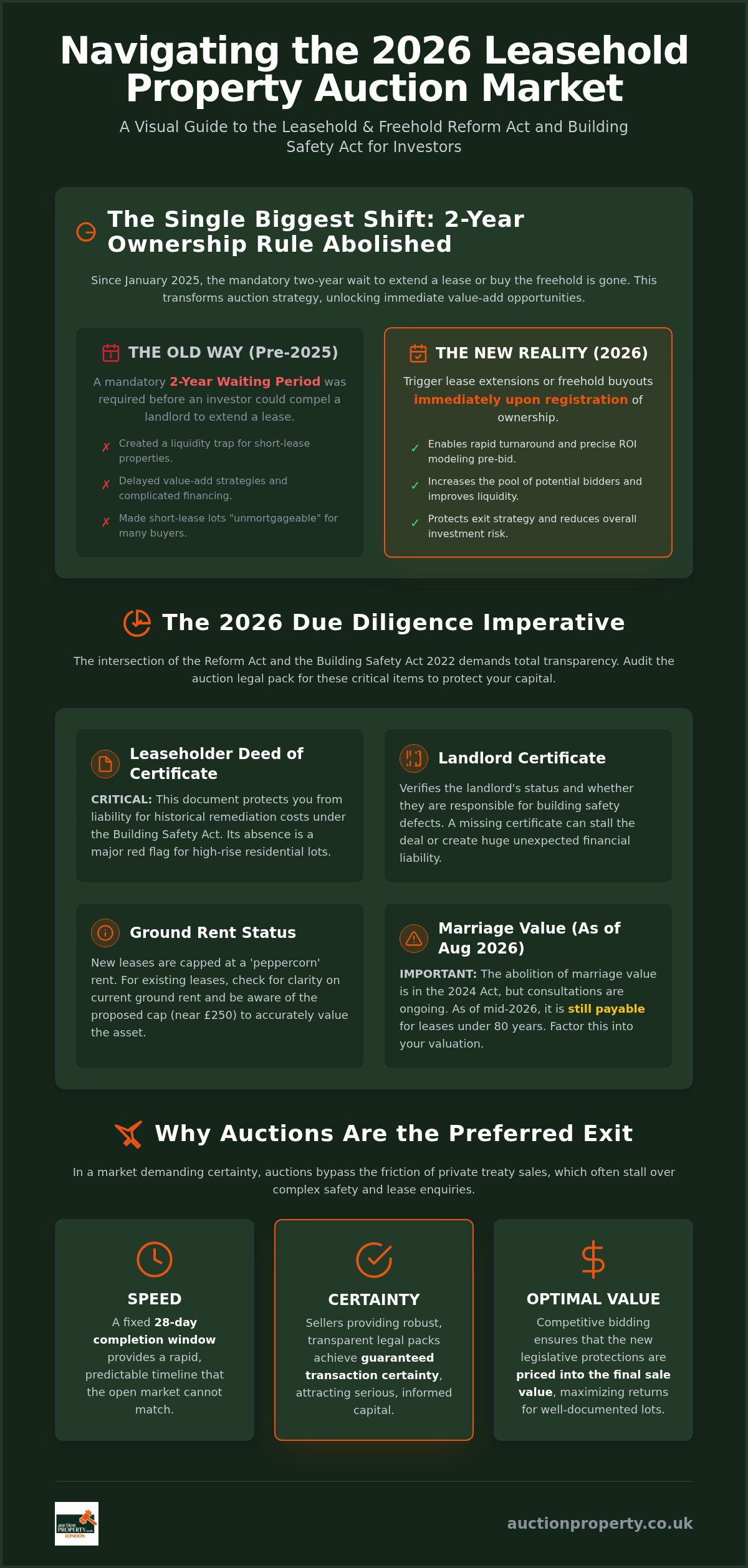
2026 Due Diligence: What to Look for in the Legal Pack
In a 28-day completion cycle, your window for due diligence is narrow and unforgiving. When reviewing a leasehold reform act property auction lot, the legal pack is your primary defense against unforeseen liabilities. The gavel’s fall is final; there’s no room for post-sale negotiations if you discover a missing safety certificate. You must ensure the pack contains a comprehensive digital trail that aligns with the Building Safety Act’s requirements, specifically for buildings over 11 metres.
Dissecting the certificates is your first priority. The Leaseholder Deed of Certificate confirms whether the current owner is a ‘qualifying leaseholder’, which dictates your protection from remediation costs. Pair this with the Landlord Certificate, which details the landlord’s group net worth and their legal obligation to fund safety works. Scrutinise the service charge accounts for any ‘remediation funds’ or unexplained spikes. These often signal that the landlord is attempting to bypass the statutory waterfall. Also, check for Building Liability Orders against the current owner, as these can transfer significant financial burdens to the new purchaser.
Critical Documents for Your Solicitor
Your solicitor must prioritise the LPE1 form. In 2026, this document should reflect the latest legislative updates, including ground rent status and building safety management. Look for explicit evidence of HRB registration with the Building Safety Regulator. If the building is an HRB and lacks this registration, the property is essentially illegal to occupy. For a deeper dive into identifying these risks, see our guide on How to Read an Auction Legal Pack: Key Red Flags. Ensuring these disclosures are present is the only way to guarantee transaction certainty.
Insurance and Mortgageability
Mortgageability in 2026 has shifted. The EWS1 form is still relevant, but ‘B-rated’ forms are no longer the automatic deal-breakers they were in 2023. If the legal pack proves that remediation is fully funded via the Building Safety Fund or a developer pledge, lenders are increasingly willing to provide finance. Securing auction finance for properties with ongoing works is now a streamlined process, provided the ‘Golden Thread’ of safety data is intact. Before you bid, ensure your lender accepts the current safety case report to avoid a failed completion. If you need assistance navigating these requirements, our team provides specialist legal pack provision to ensure every lot is auction-ready.
Strategic Selling: Maximising Value for Leasehold Lots
The 2026 market rewards sellers who provide clarity over those who attempt to hide complexity. Successfully navigating a leasehold reform act property auction as a seller means presenting a lot that is buyer-ready from the first day of marketing. Investors are currently hunting for assets where the heavy lifting of safety compliance is already documented. Auction Property Ltd provides the specialist legal administrative assistance required to navigate these safety reforms, ensuring your property stands out in a crowded catalogue. By providing a transparent legal pack, you remove the risk premium that buyers typically subtract from their bids when faced with uncertainty.
The 28-day auction timeline is your best tool for locking in a result before the next wave of secondary legislation hits in late 2027. Speed is a competitive advantage for sellers. It allows you to capitalise on current market demand while bypassing the protracted enquiries that often cause private treaty sales to collapse. Disclosing defects alongside a funded remediation plan doesn’t just build trust; it creates a floor for your property’s value. When bidders see a clear path to compliance, they bid with confidence rather than caution.
Positioning Your Lot for Success
Your marketing materials must lead with your property’s strongest 2026 credentials. If your flat has qualifying leaseholder status, highlight this prominently. It’s the primary protection against cladding costs and is a major draw for professional investors. We recommend providing a pre-approved legal pack that includes all relevant Building Safety Act certificates and a clear summary of the ground rent structure. This level of preparation is the gold standard for a leasehold reform act property auction. When setting your reserve price, account for the current sentiment. Balance the added value of the 2-year rule abolition against any outstanding non-cladding remediation costs to ensure your reserve triggers competitive bidding rather than stagnation.
The Future of Leasehold Transactions
The transition toward a commonhold system is on the horizon, but the immediate priority for 2026 is mastering the current regulatory enforcement. Staying ahead of these changes is the ultimate competitive advantage for any landlord or developer. Sellers who adapt to the digital golden thread of safety information now will find their assets far more liquid than those who lag behind. The market has no patience for administrative hurdles; it demands efficiency and transaction certainty. If you want to exit a complex leasehold position with speed and security, the auction room is your most effective platform. Sell your house fast at auction with Auction Property Ltd to ensure your transaction is handled with expert precision.
Secure Your Competitive Edge in the 2026 Leasehold Market
The 2026 leasehold reform act property auction landscape has evolved into a high-speed environment where clarity is the ultimate currency. You’ve seen how the removal of the two-year ownership rule allows for immediate value-add strategies, turning short-lease lots into rapid turnaround projects. Success now depends on your ability to audit the “Golden Thread” of safety data and confirm qualifying leaseholder protections within the legal pack. It’s no longer about waiting for secondary legislation to catch up; it’s about acting on the robust statutory rights currently in force.
Don’t let regulatory complexity stall your portfolio growth or prevent a successful exit. Auction Property Ltd provides the specialist legal administrative support needed for full Building Safety Act compliance. Our national reach and transparent online platform ensure you achieve transaction certainty with a guaranteed 28-day completion. Take control of your next move and sell your leasehold property with certainty at Auction Property Ltd. The market is moving fast, and with the right data, you’re ready to lead it.
Frequently Asked Questions
Does the Leasehold Reform Act 2024 apply to all auction properties?
The Act applies to residential leasehold properties across England and Wales. It doesn’t generally cover purely commercial leases unless the property is part of a mixed-use building with a significant residential component. When you’re browsing a leasehold reform act property auction, you must verify the specific lease category in the legal pack. The legislation specifically targets houses and flats to remove historic barriers like the two-year ownership requirement for extensions.
What is a ‘qualifying leaseholder’ in the context of a 2026 auction?
A qualifying leaseholder is someone who owned their flat on 14 February 2022, provided it was their main home or they owned no more than three UK dwellings. This status is vital because it determines your level of protection under the Building Safety Act 2022. If the seller meets these criteria, the status transfers to you as the buyer. This effectively caps your financial liability for non-cladding remediation costs after the sale.
Can I extend a lease immediately after buying at auction in 2026?
You can start the lease extension process the moment your ownership is officially registered. The Leasehold and Freehold Reform Act 2024 removed the old rule that required you to own a property for two years before making a claim. This change has transformed the leasehold reform act property auction market. Investors no longer have to wait or rely on a seller to assign a Section 42 notice to begin adding value.
Who is responsible for cladding costs if I buy a high-rise flat at auction?
Cladding remediation costs for buildings over 11 metres are the legal responsibility of the developer or the landlord. Under the Building Safety Act 2022, these specific costs can’t be passed on to qualifying leaseholders. Always check the legal pack for a developer pledge or evidence of funding from the Building Safety Fund. The ‘statutory waterfall’ framework ensures that you aren’t hit with these historical safety expenses as a new owner.
What is the ‘Golden Thread’ and why should I look for it in a legal pack?
The ‘Golden Thread’ is a mandatory digital record of safety information for Higher-Risk Buildings. It documents everything from initial design and construction to current maintenance and safety management. You need to see this in an auction legal pack because it proves the building complies with the Building Safety Regulator’s standards. Without this evidence, it’s often impossible to secure a mortgage or find a provider willing to insure the property.
How has the 30-year limitation period for cladding claims affected auction prices?
The extension of the limitation period to 30 years has allowed more claims against developers for defective construction. This shift has provided a safety net that stabilised auction prices for high-rise lots. Investors now price in the high probability of successful remediation claims rather than assuming the worst-case financial outcome. This reduces the extreme “safety discounts” seen in previous years while still allowing for healthy margins for informed bidders.
Does the Building Safety Act affect commercial properties sold at auction?
The Act primarily focuses on residential buildings, but it does impact commercial units within “Higher-Risk Buildings”. These are structures over 18 metres or seven storeys with at least two residential units. If you’re bidding on a commercial lot in a mixed-use block, you might still be liable for a portion of safety-related service charges. Review the ‘statutory waterfall’ provisions in the legal pack to understand your exact financial exposure before bidding.
Is it possible to get a mortgage on a leasehold auction property with safety defects?
It’s possible if there’s a clear, funded plan for the necessary remediation works. Most UK lenders accept properties with defects if they’re covered by the Building Safety Fund or a signed developer pledge. You’ll need to provide the Landlord Certificate and Leaseholder Deed of Certificate from the auction legal pack. These documents prove to the lender that the financial burden of the repairs won’t fall on you as the new owner.