
What if the council doesn’t know you’ve bought the property, even after completion? Informing the council tax office of your purchase is a step you should handle yourself: the sale doesn’t automatically register you for Council Tax. That can leave you unsure who to contact, when liability starts or why your first bill doesn’t match your circumstances.
The auction date, handover and move-in date don’t all serve the same purpose. Council Tax liability starts on legal completion, not the day you win a bid or collect the keys. If you buy at auction, record the completion date separately: the contract is finalised and the non-refundable deposit is paid on auction day, while completion follows within a predetermined timeframe.
This guide explains how to identify the relevant council and its reporting route, what property, ownership and occupancy details to prepare, and how to check your first bill. You’ll also learn what to do if dates, names, discounts or charges look wrong, including if the property is empty or you haven’t moved in yet. A clear, date-led notification helps the council set up your account using accurate information from the outset.
Key Takeaways
- Identify the council responsible for the property and use its Council Tax reporting process.
- When informing the council tax office of your purchase, prepare the property address, completion date, new owners’ names and contact details.
- Keep purchase, completion, possession and move-in dates distinct so you can report the relevant details accurately.
- Follow the local council’s form and guidance, as reporting requirements and decisions on discounts or exemptions can vary.
- For an auction purchase, use the legal completion date for your notification, not the auction date.
When should you inform the Council Tax office after buying a property?
Identify the council responsible for the property and report the change as soon as you can after legal completion. The relevant authority is the one responsible for the property’s address, not the council that dealt with your previous home. Use the GOV.UK council finder if you’re unsure which authority to contact, then follow its instructions for reporting a purchase.
A Council Tax notification updates the relevant council’s records about a property’s ownership and occupancy. It gives the council information to assess your account. Don’t assume the purchase itself has settled every Council Tax detail.
Does buying a property automatically update Council Tax records?
Don’t rely on the purchase process to notify the council or create your Council Tax account. Submit the required details directly through the reporting route set out by the relevant authority, whether that’s an online form or another method it specifies. Save the submission confirmation or reference number. It gives you a clear record if you need to follow up about your account.
Reporting procedures and deadlines can vary between councils and across the UK. Follow the instructions for the authority responsible for your new property rather than applying a deadline you’ve seen for another area. For background on how the tax works, the overview of Council Tax in the UK explains its general context. The local council’s guidance is the practical reference for submitting a change.
Which date should you use: completion or moving in?
Record the legal completion date separately from the day you move in. Completion is when the purchase is legally completed; moving in is when you take up residence. You might collect the keys or take possession on a different day, or own the property before it becomes your home. These dates describe different events, so don’t substitute one for another on the council’s form.
For a completed purchase, use the actual completion date when reporting the ownership change. Council Tax liability starts on legal completion for a new owner, but the council may also need occupancy information to assess how the account should be set up. Provide the dates accurately and explain any gap, such as a period between completion and moving in. If another person occupies the property or it remains empty, give the council the relevant details so it can assess your circumstances.
Keep a simple timeline showing when you secured the purchase, completed legally, took possession and moved in. These milestones can fall close together, but they aren’t interchangeable. Clear dates help the council assess the change and make it easier to query a bill that appears to start from the wrong point.
How to inform the right council about your property purchase
Use the address of the property you’ve bought to identify the responsible local authority, then follow its Council Tax instructions. The council is determined by the property’s location, not by where you currently live or where the seller paid Council Tax. Start with the official government council-finder service, then use the result to reach the authority’s own website.
How do you find the council responsible for the property?
Search by the new property’s postcode or address using the government service, then verify the result on the authority’s official website. If your purchase and move involve different council areas, you may need to report a move to your previous council as well as register the new property with its council. Don’t assume either authority covers both addresses.
Which reporting route should you use?
On the relevant council website, look for Council Tax pages labelled change of address, moving home, new owner or buying a property. Choose the form that matches your circumstances rather than a general enquiry route if the council provides a dedicated process. Check its current instructions for accepted submission methods and any local deadline. The official government guidance on Council Tax provides general information, while the local authority’s website explains how to submit a change to that council.
Use the correct national system, too. Council Tax procedures in Scotland are not interchangeable with domestic rates in Northern Ireland. If the property is in either nation, follow the relevant official guidance and the local authority’s instructions rather than assuming an England-and-Wales process applies.
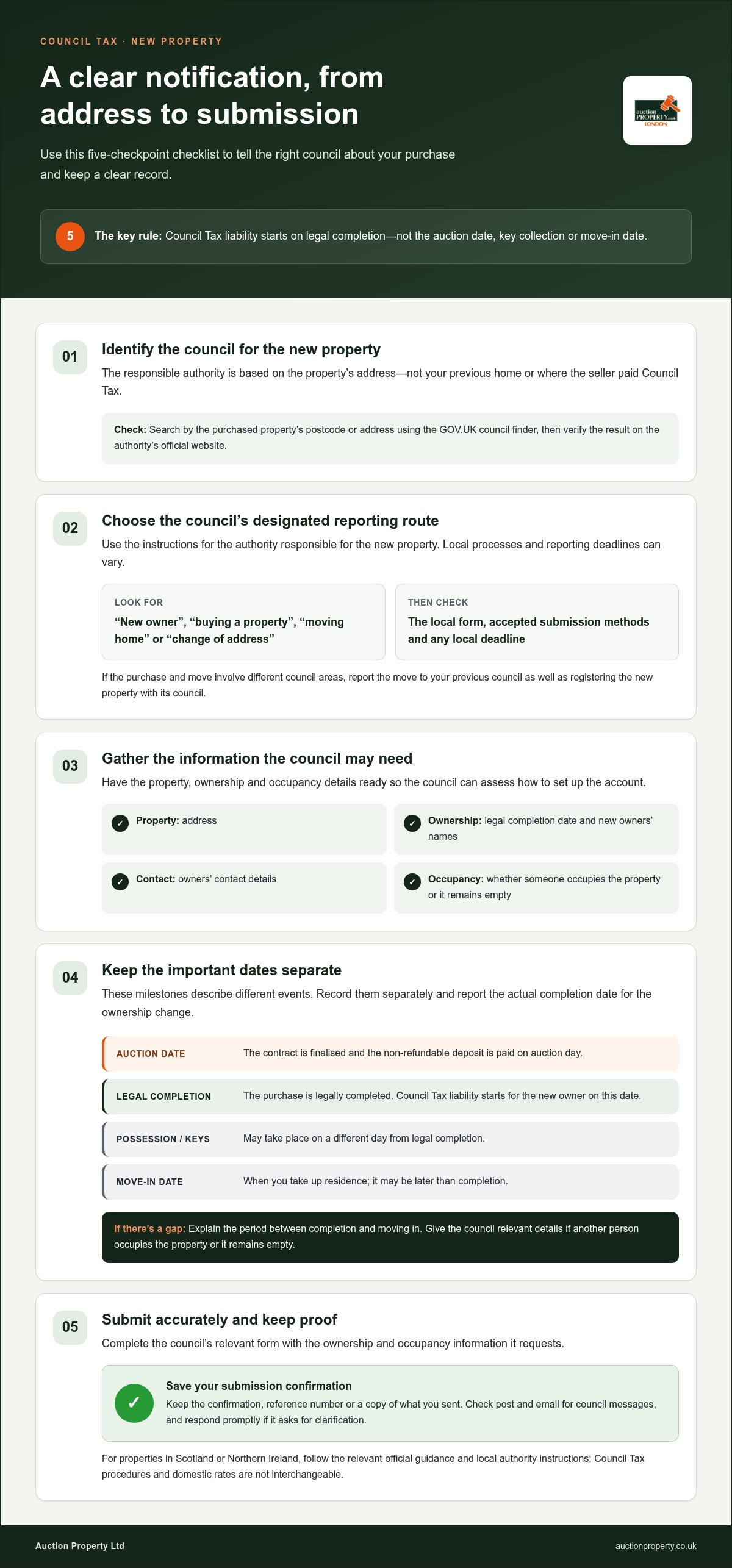
For a clear record, follow these steps:
- Identify the authority. Search using the purchased property’s address, not your previous one.
- Open its Council Tax change page. Read the guidance for new owners and note the local reporting deadline.
- Choose the right route. Use the designated purchase, new-owner or change-of-address form that best fits your circumstances.
- Submit accurate details. Enter the completion date and ownership or occupancy information requested by the council.
- Keep proof of submission. Save the confirmation, reference number or a copy of what you sent, so you can refer to it if you need to follow up.
This sequence makes informing the council tax office of your purchase easier to track, but it doesn’t guarantee a particular response time or billing outcome. Check your post and email for messages from the council, and respond promptly if it asks for clarification. If your purchase is through auction, include this task in your completion checklist alongside reviewing the relevant property auction listings.
What information should you prepare before notifying the council?
Gather the core facts before opening the council’s form. Having the property address, completion date, owners’ names and contact details to hand helps you give a clear account of the change. The form may ask for additional details, so treat this list as a starting point and answer the relevant authority’s questions.
Buyer details and property dates to have ready
Start with the information that identifies the property and the people responsible for it. Use the full address, including the postcode, and the actual legal completion date. Add the full names of everyone who acquired the property, then provide your contact details so the council can reach you about the account.
- Property: Full address and postcode.
- Purchase: Legal completion date.
- Owners: Full names of the new owners.
- Contact: Current phone number, email and correspondence address, if requested.
The council may also ask who lives at the property, when anyone moved in or whether it is currently occupied. Give the facts as they stand. If you own the property but haven’t moved in, or nobody is living there, state that accurately instead of implying normal residential occupancy. The local authority uses the details it requests to assess how to set up the account.
You may not yet have a Council Tax reference number for the new address. A new account may not have one when you first report the purchase, and a reference number isn’t a universal prerequisite. If you already have a reference relating to the property or a previous account, enter it only where the form asks for it. For practical background on Council Tax accounts and circumstances that can affect them, consult the Citizens Advice guide to Council Tax.
Records that can help resolve a Council Tax account query
Keep a simple file for the notification. Save the council’s confirmation page, email or reference number, and retain copies of any messages you send or receive. If you later need to correct a date or explain when the property became occupied, you’ll have a reliable record of what you reported and when.
- Keep Council Tax bills and correspondence for the property with your notification record.
- Retain transaction documents that show the completion details, in case the council asks for supporting evidence.
- Submit sensitive documents only if the council’s official process requests them, and use its stated submission method.
When informing the council tax office of your purchase, accuracy matters more than sending a large bundle of paperwork. Complete the required fields, check names and dates before submission, and keep supporting records available rather than attaching documents the form doesn’t request. This gives you a clear trail if a later bill or account detail needs to be queried.
Avoid common Council Tax notification mistakes after a purchase
A completed purchase doesn’t mean every Council Tax detail is automatically settled. The council still needs accurate information about the property and the people connected with it to assess the account. Don’t assume the seller’s account has transferred to you, or that a transaction notification has recorded your move, occupancy or eligibility for a discount or exemption.
Separate general guidance from the rules that apply to your address. Councils set their own reporting processes, and forms, deadlines and decisions about discounts, exemptions or liability can depend on local requirements and your circumstances. Follow the responsible authority’s current instructions rather than borrowing another council’s deadline. A deadline shown on one council’s website is not automatically a UK-wide rule.
Do not assume every council uses the same deadline or form
Use the relevant council’s official Council Tax page and follow its current instructions for a property purchase. The form may be labelled for new owners, a change of address or a household change, and another council may use a different route. Don’t rely on a deadline or form described for a different area, even if the situation sounds similar. If the guidance doesn’t clearly cover your circumstances, contact the authority using its listed Council Tax channel and keep a record of the advice.
This matters if your purchase crosses a council boundary or involves a change beyond a straightforward move. A local process may ask for information in a particular format or require you to report more than one change. Use the authority’s instructions to determine what to submit and when; avoid assuming the same process applies throughout the UK.
Report the actual occupancy and ownership situation
Give a factual account of who owns, occupies or lets the property. An owner who hasn’t moved in should say so. If the property is rented, vacant or shared with other people, include accurate details if the form asks for them, or explain the situation to the council. These circumstances can raise different questions, so don’t select an answer simply because it seems closest to a typical homeowner’s account.
Ownership alone doesn’t tell you how the council will assess every case. The relevant rules and the facts about occupation may matter, so let the authority determine how the account should be treated. Don’t assume a vacant property automatically qualifies for an exemption or discount, or that another person’s occupancy has no effect. Check the council’s decision and explain any error if the account doesn’t reflect what you reported.
When the first bill arrives, check the property address, named account holders, dates and any discount or exemption shown. If something appears wrong, contact the council through its stated route, explain the specific error and provide supporting information if requested. Keep the bill and your earlier notification confirmation together, and don’t ignore a bill while waiting for clarification.
For an auction purchase, property auction listings can help you review opportunities while keeping Council Tax reporting on your completion checklist.
After an auction purchase: keep Council Tax dates and next steps clear
An auction purchase has distinct milestones. The auction date is when the bidding takes place; legal completion happens later, within the timeframe set for the purchase. Don’t use the auction date as a substitute for completion when reporting the purchase to the council. Keep both dates in your records, then use the actual completion date in your Council Tax notification.
Separate auction day from the completion date
On auction day, the highest bidder secures the property, finalises the contract and pays a non-refundable deposit. That marks an important point in the transaction, but it isn’t the same as legal completion. Auction purchases have a predetermined, non-negotiable completion timeframe, so note the completion date stated for your transaction and update your records if it changes. Council Tax notification and liability shouldn’t be treated as automatically beginning on auction day.
Possession and moving in are separate details, too. You may not occupy the property as soon as completion takes place. Keep an accurate record of when you complete, take possession and move in, then provide the dates and occupancy information requested by the relevant council. This helps the authority assess the account using your actual circumstances rather than an assumed timeline.
Keep the purchase process and council notification organised
Make post-purchase admin part of your transaction checklist. Once completion is confirmed, work through these steps:
- Record completion. Save the actual legal completion date separately from the auction date and any move-in date.
- Identify the council. Find the authority responsible for the property’s address and open its Council Tax reporting instructions.
- Submit the change. Use the council’s designated route and provide accurate ownership, date and occupancy details.
- Save the evidence. Keep the submission confirmation and any Council Tax correspondence with your purchase records.
- Review the account. Check the first bill when it arrives and contact the council if a date or detail appears incorrect.
Keeping the auction and completion milestones distinct makes informing the council tax office of your purchase more straightforward. It also gives you a clear record to refer to if the council asks a follow-up question. For a fuller overview of the transaction stages, read the complete guide to buying and selling through property auctions.
If you’re considering an auction purchase, explore property auctions with Auction Property Ltd and plan your completion administration alongside the transaction.
Make confident property decisions from the outset
Buying a property is also the start of new ownership responsibilities. Build Council Tax administration into your plans, keep your purchase records accessible and review correspondence as it arrives. That practical discipline can help you respond promptly if the council needs more information or your circumstances change.
For buyers considering an auction, preparation matters before you bid as well as after the purchase. Auction listings have a set date and time. The winning bidder finalises the contract and pays a non-refundable deposit on the day, and the completion timeframe is predetermined and non-negotiable. Factor those commitments into your wider planning so you have a clear view of the steps ahead.
Whether you’re buying your first property or adding to an investment portfolio, make informing the council tax office of your purchase part of an organised ownership plan. When you’re ready to explore an auction purchase, view property auctions with Auction Property.
Frequently Asked Questions
Is the council automatically notified when I buy a property?
No. Don’t rely on the purchase transaction to update the Council Tax account. Contact the council responsible for the property and report the ownership change using its official process. When informing the council tax office of your purchase, save the confirmation or reference number, if provided. If you’re unsure whether an account already exists for the address, tell the council you’re a new owner and ask how it wants you to proceed.
Can I tell the council about my purchase before legal completion?
You can check the council’s process before completion and ask whether it accepts advance notice, but don’t assume every authority allows it. If you submit details early, make clear that completion is planned rather than final and update the council if the date changes. The council needs accurate information about what has happened, not just the anticipated transaction date. Follow its instructions on when to submit or confirm the change.
What should I do if the Council Tax bill is still addressed to the previous owner?
Contact the council promptly and explain that you’ve bought the property. Give the address and completion date, and include the bill or its account reference if available. Ask the authority to confirm what information it needs to update the account and whether it will issue a bill in your name. Don’t assume the previous owner’s account applies to you, and keep a copy of your message and any reply.
Does the Land Registry notify the Council Tax office when ownership changes?
Don’t rely on Land Registry registration to notify the council or set up your Council Tax account. They’re separate administrative processes, and you should report the purchase directly to the authority responsible for the property. If your registration is still being processed, you can still contact the council with your completion details and explain the status. Provide further information if the council requests it through its official process.
Do I need to notify the council if I bought the property but have not moved in?
Yes, report the purchase and explain that you haven’t moved in. Give the council the actual completion date and accurate details about whether anyone lives at the property or whether it’s empty. Don’t assume that an unoccupied home automatically qualifies for a discount or exemption. The council will assess the account under the applicable rules and may ask for more information about the property’s use or occupancy.
Is Council Tax handled the same way throughout the UK?
No. Council Tax applies in England, Wales and Scotland, but local procedures and rules can differ. Northern Ireland uses domestic rates rather than Council Tax, so don’t use a Council Tax form for a property there. Follow the official guidance for the nation and local authority where the property is located. If you’re moving between different systems, follow the relevant instructions for each address rather than assuming one notification covers both.
What if the completion date changes after I have contacted the council?
Tell the council as soon as you know the revised completion date. Refer to your earlier submission or account number, explain which date has changed, and provide the confirmed date once available. Keep a record of the update and any acknowledgement. If you haven’t completed yet, make clear that the purchase is still pending. This helps the council avoid relying on an outdated date when setting up or reviewing your account.