

In the high-stakes environment of a property auction, the fall of the hammer is legally binding. There’s no cooling-off period and no room for second-guessing once that contract is formed. You likely understand that the potential for high returns comes with the inherent risk of inheriting a “money pit” or a complex legal nightmare. It’s natural to feel anxious about structural defects or hidden encumbrances that aren’t immediately visible. This guide will show you exactly how to research a property’s history before auction to mitigate these risks and bid with absolute certainty.
Mastering due diligence is about transforming historical data into a predictive tool for future liquidity. We’ll provide a clear checklist to help you spot “red flag” properties that have failed at auction before. You’ll learn to navigate HM Land Registry records efficiently and understand how the Digital Markets, Competition and Consumers Act 2024 has shifted the burden of disclosure onto the seller. By the end of this 2026 guide, you’ll have the hard data needed to set a maximum bid and walk into the auction room with total clarity.
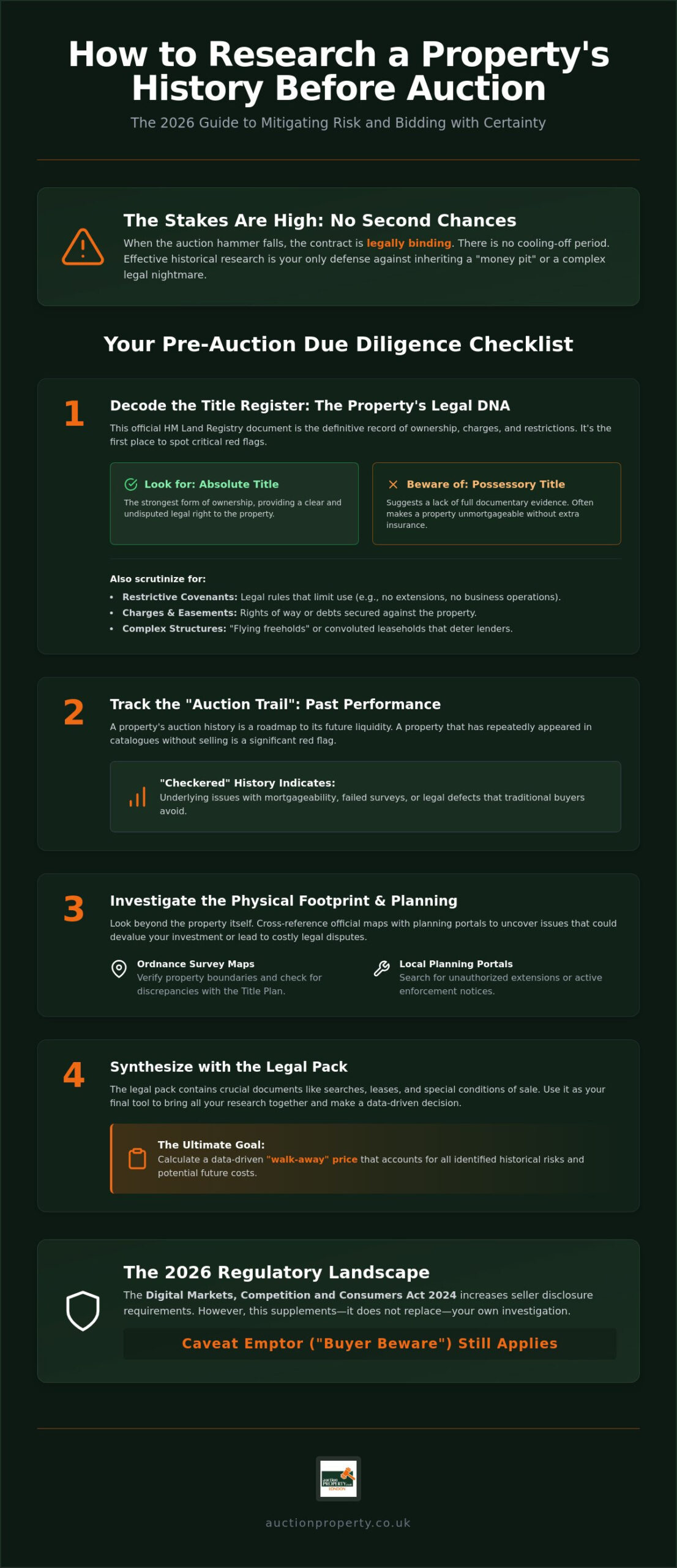
Key Takeaways
- Identify the Title Register as the property’s legal DNA to verify ownership and uncover restrictive covenants before you commit.
- Learn how to research a property’s history before auction by tracking the “Auction Trail” to identify if a lot has repeatedly failed to sell due to underlying issues.
- Cross-reference Ordnance Survey maps with local planning portals to detect unauthorized extensions or enforcement notices that could devalue your investment.
- Use the Legal Pack as your final synthesis tool to calculate a data-driven “walk-away” price that accounts for all historical risks.
- Navigate the 2026 regulatory landscape by understanding how new disclosure mandates supplement, but don’t replace, your own rigorous due diligence.
The Strategic Importance of Historical Research in Property Auctions
In the 2026 property market, historical research is not a luxury; it’s a defensive necessity. While the Digital Markets, Competition and Consumers Act 2024 has increased seller disclosure requirements, the core principle of caveat emptor remains. You’re purchasing the property as it stands, including any legal or structural baggage it carries. Professional investors know that learning how to research a property’s history before auction is the difference between a high-yield asset and a capital-depleting liability. Speed is your primary advantage. The moment a catalogue is released, the clock starts ticking. You must identify which properties deserve your attention and which should be discarded immediately based on their past performance.
Risk Mitigation in a Non-Refundable Environment
When the gavel falls, you enter a legally binding contract. There’s no “subject to survey” or “subject to finance” clause in a traditional auction. If you discover a restrictive covenant or an undisclosed easement after the fact, you can’t simply walk away without losing your 10% deposit. A comprehensive Title search is the first step in uncovering these invisible legal hurdles. It’s about identifying critical financial red flags, such as structural fatigue or historical subsidence, rather than focusing on interesting but irrelevant historical trivia. This level of due diligence ensures your capital is protected from day one. You’re not just buying bricks and mortar; you’re buying the legal history attached to them.
Predicting Future Liquidity Through Past Performance
A property’s past is often a roadmap for its future liquidity. Properties that have appeared in multiple auction catalogues over several years without selling are clear red flags. This “checkered” history often indicates issues with mortgageability or failed surveys that traditional buyers won’t touch. By mastering the property auction, you can use this data to inform your maximum bid and exit strategy. If a property has failed to sell three times, you must adjust your bid to account for the risk of a difficult future resale. Understanding how to research a property’s history before auction allows you to spot these patterns before you ever step into the room. This foresight allows you to set a “walk-away” price based on hard data rather than emotion or auction-room momentum.
Investigating the Legal and Ownership Timeline
Understanding a property’s legal pedigree is the cornerstone of effective due diligence. When you’re learning how to research a property’s history before auction, the legal timeline acts as a roadmap of potential liabilities. You need to look beyond the current owner to see how the land has been subdivided, charged, or restricted over decades. This isn’t just about who owns the bricks. It’s about who has rights over the land those bricks sit on. Discrepancies here can derail your financing or prevent a future sale, making this investigative phase non-negotiable for serious investors.
Decoding the Title Register and Plan
The Title Register is the definitive record of UK land ownership, charges, and easements. Think of it as the property’s DNA. In an auction context, you must distinguish between “Absolute Title,” which is the strongest form of ownership, and “Possessory Title,” which suggests the owner lacks the full documentary evidence of their right to the land. The latter often makes a property unmortgageable without specific indemnity insurance. You should also scrutinize the register for restrictive covenants. These are legal “don’ts” that might prevent you from building an extension or running a business from the premises. If you find complex leasehold histories or “flying freeholds,” where part of the property overhangs another person’s land, proceed with caution. These structural-legal overlaps frequently deter traditional lenders and require specialized bridging finance.
Tracing Ownership Through Probate and Deeds
Probate records are a goldmine for understanding seller motivation. If a property is being sold following a grant of probate, it’s often a “distressed” sale or a long-term family asset being liquidated to pay inheritance tax. This history tells you why the property is at auction and how quickly the sellers need to complete. For exceptionally old estates, you might even need to consult the 1862 Act register to find documents that pre-date modern digital records. While modern UK searches are centralized, looking at historical National Archives Land Records can provide a broader context for how land usage and documentation have evolved over centuries. Learning how to research a property’s history before auction involves connecting these ownership dots to the sell house fast at auction uk methodology, where transparency and speed are prioritized to ensure a guaranteed outcome. If you need assistance navigating these documents, reviewing a professionally prepared legal pack is the most efficient way to verify these details before the bidding starts.
Analyzing Past Auction Performance and Market Data
A property’s market history is just as telling as its legal deeds. When you understand how to research a property’s history before auction, you start to see the “Auction Trail”—a digital footprint left by properties that have cycled through various catalogues over several years. You’re looking for patterns of failure or indecision. If a property was offered in 2024 and again in 2025 without selling, there’s a reason. It wasn’t just “bad luck”; it was likely a failed survey or a reserve price that ignored market reality. Identifying these patterns allows you to bid with a level of insight that most casual bidders lack.
Red Flags in Auction History
Frequent withdrawals are a major warning sign. They often indicate that a seller received a survey report so damaging they’d rather pull the lot than face a public failure. Watch for these specific red flags in the archives:
- Consistent failure to meet reserve: Signals the seller’s expectations are detached from the property’s actual condition.
- Sudden changes in tenure: A property switching from freehold to leasehold mid-cycle suggests a legal complication was recently discovered.
- Price Reduction trends: If the guide price has dropped significantly across three auction cycles, the market is actively rejecting the asset at its current valuation.
You should also evaluate the “Guide Price vs. Hammer Price” delta for similar properties on the same street. If everything else sells at 20% over the guide but your target lot struggles to hit the minimum, you’ve found a problem property that requires deeper investigation.
Using EIG and Third-Party Data Aggregators
Data aggregators allow you to search by address to find historical lot numbers and images. This is where you spot “Auction Flippers”—investors who bought a property six months ago and are re-listing it today. You must ask why they’re exiting so fast. Compare old auction photos to current ones. If you see a brand-new kitchen but no corresponding building regulations certificate in the legal pack, you’re looking at a “quick-fix” renovation that might be hiding structural issues. You can also use broader resources to research the history of a property through historical maps and archives to see if the building’s footprint matches its current state. Analyzing seller motivation is easier when you know they’ve failed to exit via auction multiple times already. This data gives you the leverage to set a lower maximum bid based on their clear, documented need for liquidity.
Architectural Evolution and Planning History
The physical structure of a building often tells a story that the title deeds miss. Comparing modern Ordnance Survey (OS) maps with historical versions allows you to identify undocumented footprint changes or extensions. If the map from ten years ago shows a smaller perimeter than the one you see today, you’ve found a structural modification that requires legal verification. This is a vital stage in learning how to research a property’s history before auction. You aren’t just looking for what’s there; you’re looking for what shouldn’t be there. Use historic photographs to distinguish between original period features and modern additions that might not comply with the building’s original character or safety standards.
In 2026, the Building Safety Act 2022 history is a critical data point for any high-rise or complex residential lot. You must verify if the property has a history of fire safety remediation or cladding issues. This data is now a mandatory part of material disclosure, but your own research into the building’s safety record provides an extra layer of security. Scrutinizing these details ensures you don’t inherit a liability that requires significant capital expenditure to rectify.
Planning Permissions and Enforcement
Don’t take a seller’s word that an extension is “fully compliant.” Scrutinize the local planning portal for every application linked to the address. You’re looking for refused applications or, more importantly, active enforcement notices. An enforcement notice means the council has already identified an illegal structure and has the power to demand its demolition at your expense. If you’re investigating commercial-to-residential conversions, verify the “Change of Use” history. Ensure the developer followed the correct permitted development rights or obtained full planning consent. Expired planning permissions can also be a goldmine. They suggest a property has development potential that the current owner failed to execute, providing you with a ready-made exit strategy if you can reactivate the consent.
Environmental and Structural History
Historical land use determines your risk of soil contamination and structural instability. Research whether the property was built on “brownfield” land or a former industrial site. This history impacts your ability to secure standard residential mortgages and can lead to expensive environmental clean-up requirements. Check the local area’s flood risk history and subsidence records. A property with a history of movement is often uninsurable, which immediately kills its resale value. When evaluating urban assets, consult our guide on property auctions london to understand how specific development patterns in the capital affect historical risk profiles. Secure a comprehensive legal pack provision to verify all planning and environmental searches before you commit your capital at the fall of the hammer.
Converting Research into a Winning Bidding Strategy
Data becomes a strategic asset only when you translate it into a firm financial limit. You’ve completed the heavy lifting of learning how to research a property’s history before auction; now you must apply those findings to the bidding floor. Every historical defect, legal ambiguity, or failed auction attempt has a specific price. If your research uncovered a history of structural movement or an unresolved enforcement notice, these aren’t just reasons to worry. They’re concrete figures you must deduct from the property’s potential market value to arrive at a realistic maximum bid. This data-driven approach strips away the emotion of the auction room and replaces it with a calculated “walk-away” price.
Using historical data to negotiate pre-auction or post-auction offers is a hallmark of the seasoned investor. If a seller knows you’ve identified a “checkered” auction trail or a recurring survey failure, they’re often more amenable to a realistic offer that guarantees them a certain exit. Transparency about the property’s past allows you to position yourself as a serious, informed buyer who understands the risks. This leverage is essential in the fast-paced 2026 market, where speed and certainty are the primary currencies of a successful transaction. For those looking to replicate this strategic approach in the Australian market, partnering with a buyer’s agent Brisbane can provide the necessary local expertise to secure properties with confidence.
Similarly, for those targeting the Melbourne market, Your Australian Property Buyers Agents offers boutique independent representation to help navigate the complexities of local property auctions with data-driven confidence.
Integrating History into the Legal Pack Review
The Legal Pack is the ultimate synthesis of the property’s history provided by the auctioneer. You must cross-reference your independent research with the “Office Copy Entries” found within this document. Look for discrepancies. If the “Seller’s Property Information Form” claims there are no ongoing disputes, but your research found a refused planning application for a neighbor’s extension that impacts the boundary, you’ve identified a credibility gap. Ensure all “Chancel Repair Liabilities” or ancient manorial rights are fully accounted for. These historical remnants can impose significant, unexpected costs on the owner. Verify that indemnity insurance is already in place or calculate the precise cost of obtaining it yourself before the gavel falls.
Final Bidding Preparation
Determine if the “Guide Price” is truly justified by the property’s historical performance. If similar lots in the immediate area have consistently achieved lower hammer prices than the current guide suggests, don’t let auction-room momentum push you into an overpayment. Prepare for the emotional pressure of the event by walking in with a data-backed maximum bid. This prevents “bidder’s heat” from leading to a purchase that compromises your exit strategy. If you encounter complex historical findings that are difficult to interpret, leverage our professional insight. Our team specializes in Residential Property Auctions and Commercial Property Auctions, providing the clarity needed to navigate Land and Development Site Auctions. Contact our expert team to discuss specific lots in our current catalogue and ensure your due diligence leads to a guaranteed outcome.
Secure Your Investment with Data-Driven Bidding
Successful auction outcomes are built on rigorous preparation. By analyzing the Title Register, tracking the “Auction Trail,” and scrutinizing planning portals, you move from speculation to certainty. You now possess the framework for how to research a property’s history before auction to identify red flags and calculate a precise walk-away price. This due diligence ensures that the fall of the hammer represents a guaranteed opportunity rather than an unforeseen liability. Every piece of historical data you uncover serves as a defensive shield for your capital.
Since 2019, we’ve provided a transparent online bidding infrastructure with a national reach, supported by expert legal administrative assistance for every lot in our catalogue. This structure removes traditional administrative hurdles and provides the clarity needed for high-stakes transactions. Our platform is designed to facilitate speed and security, ensuring you always know exactly where you stand before the bidding begins. Take the next step in your investment journey with total confidence in your data.
Browse our latest auction catalogue and start your research today. We look forward to helping you secure your next asset with absolute clarity and efficiency.
Frequently Asked Questions
How can I find out if a property has been to auction before?
You can identify previous auction appearances by using data aggregators like the Essential Information Group (EIG) or by searching historical digital catalogues by address. These platforms track the “Auction Trail,” showing you if a lot was previously withdrawn, unsold, or if the guide price has fluctuated across multiple cycles. This history reveals if the market has previously rejected the property due to survey failures or legal complexities.
Does the Land Registry record the exact age of a house?
No, the Land Registry records the date of the first registration or the date of a specific lease or transfer, rather than the date of construction. To find the exact age, you should consult historical Ordnance Survey maps, local census records, or architectural styles. Understanding the era of construction helps you predict common structural issues or the presence of restricted materials like asbestos.
Where can I see past auction sold prices for a specific property?
You can view past hammer prices through specialized auction portals or the HM Land Registry “Price Paid” data. Cross-referencing these sources is essential, as auction results are sometimes recorded differently than traditional private treaty sales. This data allows you to calculate the delta between historical guide prices and final sales, providing a benchmark for your own bidding strategy.
What is the most important document to check in a property’s history?
The Title Register is the most critical document when learning how to research a property’s history before auction. It acts as the property’s legal DNA, confirming current ownership and identifying any restrictive covenants or financial charges. Reviewing the Title Register alongside the Title Plan ensures that the legal boundaries and rights of way match the physical footprint you’ve inspected on the ground.
Can I get a mortgage on a property with a history of subsidence?
Securing a mortgage on a property with a history of movement is difficult but possible if you have a Certificate of Structural Adequacy. Lenders in 2026 typically require evidence of at least ten years of stability and proof that the property is currently insurable at standard rates. If these documents are missing from the legal pack, you’ll likely need to use cash or bridging finance.
How do I find out if a property is a listed building?
You can check the listed status by searching the National Heritage List for England (NHLE) database. This record identifies the grade of the listing and the specific features protected by law. Knowing the listing status is vital before you bid, as it dictates the complexity and cost of any future renovations or repairs you plan to undertake after the purchase.
What should I do if the historical records contradict the legal pack?
Raise the discrepancy with your solicitor and the auctioneer immediately. If your research into how to research a property’s history before auction reveals an extension that isn’t documented in the legal pack’s planning section, you might be facing an illegal structure. Use this information to adjust your maximum bid or request an addendum to the legal pack to clarify the situation before the auction starts.
Is it worth paying for a professional historical research service?
Paying for professional research is highly recommended for complex development sites or high-value commercial lots. Professional services can uncover deep environmental risks, ancient manorial rights, or chancel repair liabilities that standard local authority searches might overlook. For high-stakes investments, the cost of a professional report is a minor expense compared to the risk of inheriting an undisclosed legal or structural liability.