

In a 2026 survey, 43% of distressed property buyers expected local market prices to drop, marking the highest level of bearish sentiment in years. When the market is this volatile, guessing is a liability you can’t afford. You need to know exactly how to find out what a house sold for at auction to make informed bids or accurately value your own portfolio. Waiting for months for official registries to update often means missing the next big opportunity in a fast-moving environment.
We understand that the gap between a live bidding war and a recorded sale price often feels like a black box. It’s frustrating to see a property go under the hammer without knowing the final financial commitment involved. This guide promises to strip away that confusion by providing the most reliable methods for tracking auction results in real-time. We will break down how to access digital bidding logs, navigate county public records, and distinguish the raw hammer price from the total cost. You’ll gain the clarity needed to turn raw data into a decisive investment strategy.
Key Takeaways
- Access real-time auction results through digital archives and mailing lists to bypass the months-long delay in official registry updates.
- Discover how to find out what a house sold for at auction by using the HM Land Registry Price Paid tool for definitive historical research.
- Calculate your true financial outlay by learning how to adjust the hammer price for buyer’s premiums and administrative fees.
- Build an evidence-based bidding strategy by analyzing the specific delta between guide prices and final sold figures.
The Search for Auction Results: Why Timing Matters
Speed is the primary advantage in the 2026 property market. If you rely solely on public records, you’re analyzing a market that no longer exists. Auction results provide an immediate snapshot of “cash value,” offering a level of transparency that traditional estate agent listings cannot match. While an asking price is merely an aspiration, an auction sale price is a confirmed transaction. This distinction is vital for anyone looking to understand how to find out what a house sold for at auction before the data becomes stale.
The hammer price is the final, legally binding bid accepted when the gavel falls. To grasp the urgency of this data, you must understand how auctions work in a legal sense. Unlike traditional sales where a deal can collapse weeks after an offer is accepted, an auction contract is formed the moment the hammer drops. This creates a data point that is both final and immediate, providing a much more accurate indicator of market health than “sold subject to contract” notices on property portals.
Hammer Price vs. Land Registry Price
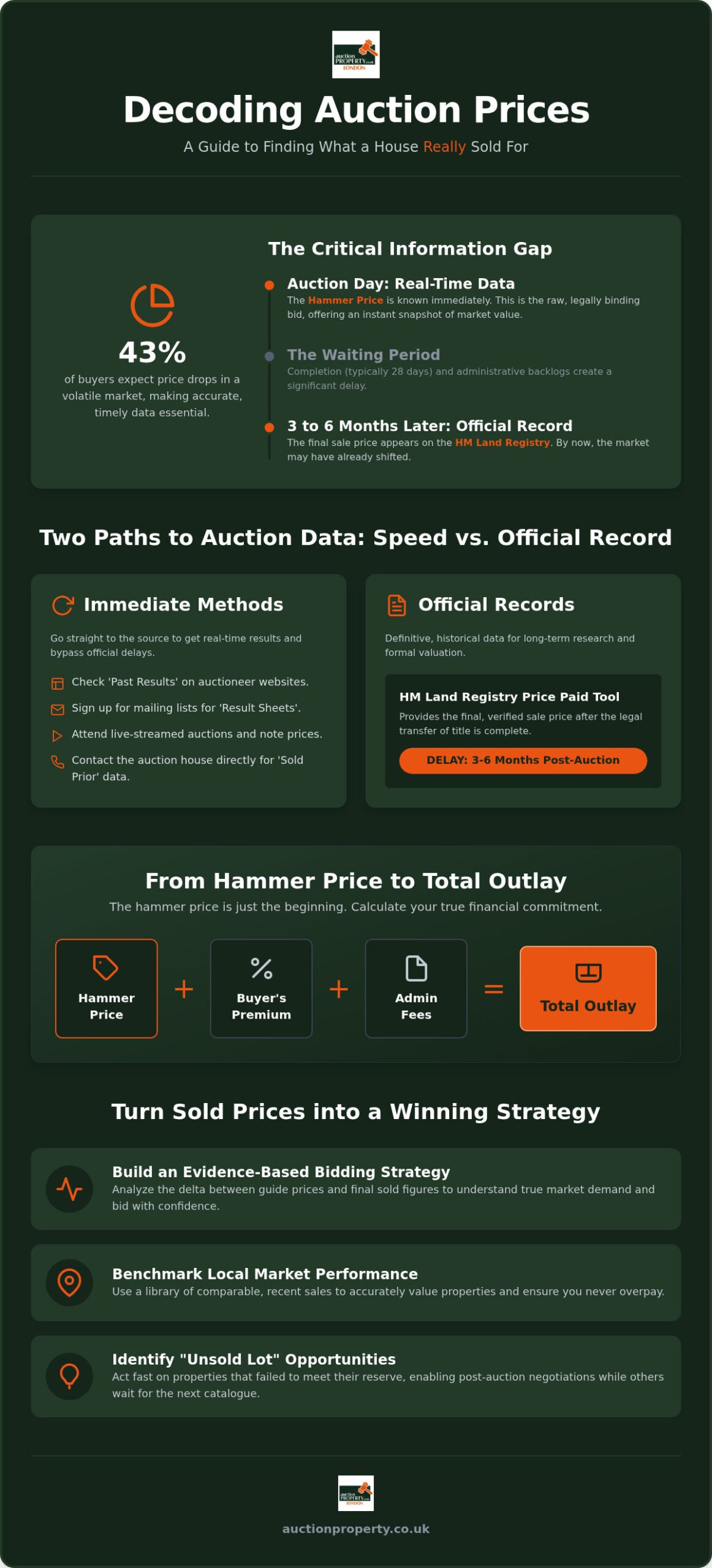
The hammer price is the contractual winning bid. In contrast, the Land Registry records the official transfer of title. This transfer only occurs after the completion period, which is typically 28 days post-auction. Current administrative backlogs in 2026 mean this data might not appear on public portals for three to six months. Professional investors don’t have time to wait for these updates. They prioritize direct auctioneer data because it reflects the market’s pulse in real-time. Learning how to find out what a house sold for at auction through these direct channels allows you to bypass official delays and act on current trends.
The Value of Real-Time Market Intelligence
Real-time data is your most powerful tool for setting accurate valuations. Use these sold prices to benchmark local market performance across residential and commercial lots. This intelligence also helps you identify “unsold” lots. When a property fails to meet its reserve price, it often remains available for post-auction negotiation. If you have the result data, you can step in with an offer while other buyers are still waiting for the next catalog to be published. Using these results to build a library of comparable sales ensures you never overpay for a lot. It also helps you set a realistic reserve price if you’re the one selling, ensuring your property doesn’t sit stagnant on the market.
Immediate Methods: How to Get Real-Time Auction Results
Speed is an investor’s greatest asset. If you want to know how to find out what a house sold for at auction without waiting for the Land Registry’s quarterly updates, you’ve got to go straight to the source. Auction houses are incentivized to publish results quickly to demonstrate their success and attract future vendors. This creates a window of opportunity for researchers to grab data long before it hits public portals.
To get these results instantly, utilize the following direct channels:
- Check the ‘Past Results’ or ‘Archives’ section of the specific auctioneer’s website.
- Sign up for auctioneer mailing lists to receive post-auction ‘Result Sheets’ via email.
- Attend live-streamed online auctions to note prices as they happen in real-time.
- Contact the auction house directly for properties listed as ‘Sold Prior’ or ‘Sold Post-Auction’.
- Use professional subscription-based auction databases for aggregated nationwide coverage.
Reviewing Auctioneer Catalogues and Archives
Modern digital platforms have streamlined the reporting process. Most reputable firms update their online catalogues within 24 hours of the final gavel. When browsing these archives, look specifically for the ‘Sold For’ column. This displays the hammer price. You’ll also encounter the ‘Sold Prior’ status. This indicates the vendor accepted an offer before the auction date. While the specific price might not always be listed for these, a quick call to the auctioneer can often reveal the figure, provided the transaction has legally exchanged. It’s a simple step that yields high-value intelligence.
Leveraging Digital Bidding Platforms
Real-time observation is the most accurate way to gauge market demand. Watching a live bidding war provides context that a static price cannot. You see the number of active bidders and the speed of their increments. Many platforms now offer a ‘Watch’ feature that sends automated result notifications directly to your inbox. This level of transparency is a core part of mastering the property auction. It allows you to build a personal database of local values with zero lag time. If you’re ready to move from research to action, you can view our current residential and commercial auction listings to see this transparency in practice.
Direct contact remains a powerful tool for post-auction sales. If a lot is marked as ‘Unsold,’ it doesn’t mean the data is useless. Contacting the auction house to ask about the highest bid received can help you establish the current ceiling for that specific property type. This proactive approach ensures you aren’t just reading the market, but actively participating in it.
Official Records: Tracking Sales via Public Databases
While the real-time methods discussed in the previous section offer the speed required for active bidding, official public databases provide the final, verified truth for long-term due diligence. HM Land Registry is the definitive source for all property transaction prices in the UK. It’s the gold standard for legal and financial research, though it requires a different approach than tracking live results. You must account for the significant data lag that persists in 2026. Administrative processing times mean a sale might not appear in these records for three to six months after the completion date. This makes official records a tool for retrospective analysis rather than a source for live market tracking.
If you’re investigating how to find out what a house sold for at auction with absolute legal certainty, these databases are your primary resource. They strip away the noise of the auction room and present the pure consideration paid for the title. This data is essential when you’re building a formal valuation or preparing a case for mortgage lending, as it represents the price recognized by the government.
Navigating HM Land Registry Data
The official “Price Paid” tool on the GOV.UK portal is highly functional if you know how to filter the results. Start by entering the specific postcode or street name of the auction lot. Because the registry includes every property transaction, you’ll need to filter by the specific month of the auction and the property type to isolate the lot you’re tracking.
Don’t be surprised if the recorded price differs slightly from the hammer price you noted on auction day. The Land Registry records the pure property consideration. This figure might exclude certain apportioned costs, VAT on commercial lots, or separate payments for chattels included in the sale. Professional investors use these discrepancies to understand the true “bricks and mortar” value of a lot versus the total transaction cost.
Third-Party Property Portals and Aggregators
Major portals like Rightmove and Zoopla act as user-friendly interfaces for Land Registry data. Their “Sold Prices” sections allow you to view auction results through a map-based lens, which is invaluable for identifying localized price trends. These platforms aggregate data nationally, making it easier to see how auction prices in one region compare to another.
For those who need to move faster than the standard registry updates allow, participating in online property auctions provides a distinct advantage. These digital-first platforms often provide more transparent access to historical data within their own ecosystems long before the public databases catch up. This bridge between live results and official records is where the most successful investors find their edge. By the time a sale is visible on a major aggregator, the market has often already moved on to the next cycle. Use these portals to confirm your long-term benchmarks, but don’t let the registry’s delay slow your current research momentum.
Interpreting the Data: Hammer Price vs. Final Outlay
Don’t mistake the hammer price for the total bill. When you look at past results to understand how to find out what a house sold for at auction, you’re seeing the contractual winning bid, but this figure rarely represents the final amount transferred. Professional investors treat the hammer price as a starting point. To truly understand the market, you must learn to calculate the hidden layers of the transaction that aren’t always visible in a standard “sold” list.
Accuracy in your research prevents costly mistakes during your own bidding process. A property that appears to have sold at a bargain price might actually have been burdened by high administrative fees or significant arrears. Before you use a past sale as a benchmark, you must account for the specific financial conditions attached to that lot.
Calculating the Total Acquisition Cost
The winning bid is only one component of the purchase. Most auction houses charge a Buyer’s Administration Fee and a Buyer’s Premium, which typically ranges from 1% to 3% of the hammer price. Additionally, the legal pack often reveals search fees and legal costs that the vendor has passed on to the buyer. For commercial auction lots, you must also verify if VAT is applicable on the purchase price, as this adds a substantial 20% to your cash requirement. The Total Outlay is the sum of the hammer price plus all contractual fees.
Why Prices Vary Between Similar Lots
If two identical houses in the same street sell for vastly different amounts, the answer usually lies in the legal pack or the physical condition. A “short lease” or significant structural issues will suppress the hammer price, even if the property looks perfect from the curb. Conversely, “Sold Prior” prices often reflect a premium; the buyer paid more to secure the property and remove it from the competition. Understanding the role of the reserve price is also critical, as it sets the floor for the entire event. A low reserve can spark a bidding war that pushes the final price well beyond the expected market value.
Review our current auction lots to see how transparent fee structures help you calculate your total outlay before the bidding begins. By analyzing the delta between the guide price and the final sold figure, you can better predict the momentum of your next target lot. This level of scrutiny ensures that your market research is grounded in financial reality, not just headline figures.
How to Use Sold Price Data for Your Next Auction
Data is the backbone of any successful property transaction. Once you’ve mastered how to find out what a house sold for at auction, you must translate those raw numbers into a definitive bidding ceiling. Build a spreadsheet of at least five comparable auction sales from the last six months within your target postcode. Focus your analysis on the total outlay rather than just the hammer price to ensure your financial comparisons are mathematically sound. This preparation moves you from a position of curiosity to one of calculated intent.
Analyze the specific delta between the ‘Guide Price’ and the ‘Sold Price’ for your target sector. In 2026, market trends show that residential lots often exceed guides by 15% to 20%, while commercial demand remains more sensitive to yield calculations and interest rate stability. This analysis reveals if a guide price is a realistic entry point or a marketing tactic designed to trigger a bidding war. If you’re on the other side of the gavel, use this evidence to justify your valuation when selling a house fast at auction. A realistic reserve price, backed by recent comparable sales, creates the competitive environment needed for a guaranteed outcome.
Setting a Competitive Strategy
Use your data to remain disciplined during the heat of a live event. Emotional bidding is the fastest way to erode your profit margins; if the bidding exceeds your pre-determined maximum based on historical data, stop. You can also use this intelligence to negotiate on unsold lots. If a property fails to meet its reserve, knowing the recent sold prices for similar lots gives you the leverage to make a firm, evidence-based post-auction offer. This strategy allows you to secure assets that others might overlook due to a lack of research.
Partnering with Transparent Auction Houses
Your success depends on the quality and accessibility of your data source. Choose a partner that prioritizes openness and provides easily accessible result archives for all past transactions. Auction Property Ltd ensures transparency for both buyers and sellers by maintaining clear, digital-first bidding logs and comprehensive result sheets. Speed and certainty are the hallmarks of a reputable auction house, and that begins with honest reporting of every transaction. By utilizing these transparent records, you can enter your next auction with the confidence of a seasoned market insider.
Master the Market with Real-Time Auction Intelligence
Success in the 2026 property sector requires moving faster than official public records. By utilizing direct auctioneer archives and mailing lists, you bypass the standard three to six month data lag associated with government registries. Always remember that the hammer price is just your baseline; you must factor in buyer’s premiums and administrative fees to calculate the true acquisition cost. Mastering how to find out what a house sold for at auction transforms you from a casual observer into a strategic investor with a clear competitive edge.
Auction Property Ltd provides the expert support you need for both residential and commercial auctions across the UK. Our specialists facilitate quick and secure transactions with nationwide reach, ensuring you have the transparency required for confident decision-making. Don’t let administrative delays hold back your investment strategy. Take the next step in your property journey by visiting our platform today. View our latest auction results and upcoming lots to see the market in action. Your next high-yield opportunity is waiting.
Frequently Asked Questions
Is the hammer price at an auction public information?
Yes, the hammer price is public information. Auction houses typically publish these results in their digital archives or post-auction “Result Sheets” within 24 hours of the event. This transparency ensures that all participants and researchers can verify the final contractual bid for any lot.
How long does it take for an auction sale to appear on the Land Registry?
In 2026, it typically takes between three and six months for an auction sale to appear on the HM Land Registry. While the legal completion of an auction purchase usually occurs 28 days after the gavel falls, administrative processing times at the registry create a significant lag before the data is visible on public portals.
Why does Rightmove show a different price than what I saw at the auction?
Rightmove displays data sourced directly from the Land Registry, which only records the “pure consideration” paid for the property title. This figure often excludes the buyer’s premium, administrative fees, or VAT on commercial lots. If you want to know how to find out what a house sold for at auction with absolute accuracy, the auctioneer’s archive is the more reliable source for the total contractual bid.
Can I find out who bought a house at auction?
You cannot usually find the name of an individual buyer through auction result sheets due to privacy regulations. However, once the sale is officially registered, you can pay a small fee to the Land Registry to download the Title Register, which lists the new owner. If the buyer is a limited company, their details will also be accessible through Companies House.
Does the sold price include the buyer’s premium?
No, the recorded sold price represents the hammer price only. It does not include the buyer’s premium, which typically ranges from 1% to 3%, or any additional administrative fees. You must review the specific legal pack for that lot to calculate the total financial commitment beyond the recorded sale figure.
What happens if a house doesn’t sell at auction – is the price recorded?
If a property fails to meet its reserve price, it’s marked as “Unsold” or “Withdrawn,” and no sale price is recorded in public databases. While the highest bid received during the auction isn’t an official sold price, it’s often available through the auctioneer and serves as a vital benchmark for post-auction negotiations.
Are commercial property auction prices recorded differently than residential ones?
Commercial auction prices are recorded in the same HM Land Registry database as residential properties, but the figures can be more complex to interpret. The recorded price often excludes VAT, even if the transaction was subject to it. This means the actual cash outlay for a commercial lot could be 20% higher than the price shown in public records.
How can I get a list of recent auction sold prices for a specific area?
The most efficient way to get a localized list is to use the HM Land Registry “Price Paid” tool and filter by postcode and property type. For real-time 2026 data, you should also monitor the “Past Results” sections of auction houses that specialize in that specific region. Combining these sources provides a complete view of both historical and current market values.