

Skip to content
Auction Property London white orange and green logo
  • Properties
  • Sold Properties
  • Auctions
    • Auction Dates
    • Past Auction Dates
  • Join Our Mailing List
  • Latest News
  • Useful Information
    • Buying and Selling at Auction
    • Bidders Information
    • Privacy Policy
    • Frequently Asked Questions
    • Cookie Policy
    • Complaints Procedure
  • Partners
  • About Us
  • Contact
  • Login/Register
  • Properties
  • Sold Properties
  • Auctions
    • Auction Dates
    • Past Auction Dates
  • Join Our Mailing List
  • Latest News
  • Useful Information
    • Buying and Selling at Auction
    • Bidders Information
    • Privacy Policy
    • Frequently Asked Questions
    • Cookie Policy
    • Complaints Procedure
  • Partners
  • About Us
  • Contact
  • Login/Register
Book Your Free Valuation
< Back to Latest News

How Properties Are Valued for Auction: 2026 Pricing Guide

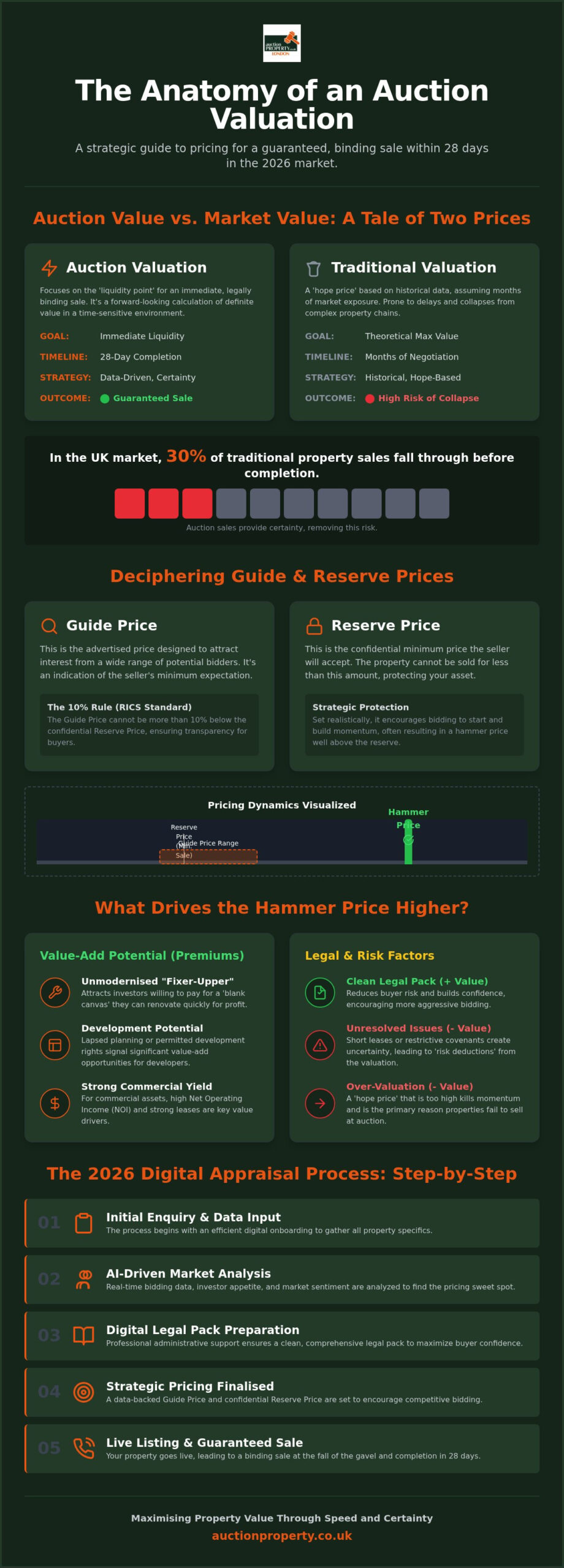
An auction valuation isn’t a static estimate of what your home is worth; it’s a strategic calculation of the ‘liquidity point’ designed to ignite a bidding war. If you’ve been frustrated by conflicting agent appraisals or fear your property failing to sell, you’re not alone. Understanding how are properties valued for auction is the critical first step to securing a binding sale within 28 days. In a UK market where 30% of traditional sales fall through before completion, the precision of your entry price determines whether you achieve a result or a redundant listing.

It’s natural to feel confused by the distinction between guide prices and reserve prices. This 2026 guide provides the clarity you need to navigate these financial hurdles with absolute confidence. You’ll learn the mechanics behind the “10% rule” for guide pricing and how to set a reserve that protects your asset while encouraging aggressive bidding. We’ll also examine how AI-driven tools and digital legal packs are now essential for driving the hammer price higher. This is your roadmap to achieving a fast, transparent, and guaranteed transaction that removes the administrative friction of traditional methods.

Key Takeaways

  • Understand the fundamental shift from historical market value to immediate liquidity to secure a binding sale within 28 days.
  • Discover how are properties valued for auction by identifying the specific physical and legal drivers that command the highest premiums from investors.
  • Learn to set strategic guide and reserve prices that comply with RICS standards while actively encouraging a competitive bidding environment.
  • Navigate the 2026 digital appraisal process to move from initial enquiry to a live listing with maximum efficiency and transactional certainty.
  • Access professional administrative support for legal pack preparation to safeguard your property’s value and ensure a successful hammer price.

Table of Contents

  • How Are Properties Valued for Auction? Liquidity vs. Market Value
  • The Anatomy of an Auction Appraisal: Key Value Drivers
  • Strategic Pricing: Deciphering Guide and Reserve Prices
  • The 2026 Auction Valuation Process: Step-by-Step
  • Why Partner with Auction Property Ltd for Your Valuation?

How Are Properties Valued for Auction? Liquidity vs. Market Value

When you ask how are properties valued for auction, you’re looking for a figure that represents immediate liquidity rather than a theoretical market ceiling. A standard Real estate appraisal often relies on historical data from the last six months to determine what a property might be worth in a perfect world. However, an auction valuation is forward-looking. It accounts for the fact that a buyer must exchange contracts immediately and complete within 28 days. This compressed timeline shifts the focus from what a property might achieve after months of negotiation to its definite value in a high-stakes, time-sensitive environment.

The core difference lies in the definition of value itself. While ‘Market Value’ assumes a property is exposed to the open market for a reasonable period, ‘Auction Value’ is a measure of what a buyer will pay for the privilege of a guaranteed, immediate transaction. This is why you’ll often see a gap between the two figures. You aren’t just selling bricks and mortar; you’re selling the certainty of a 28-day exit. Auction valuation is the strategic price point that ensures a legally binding exchange at the fall of the gavel.

Why Estate Agent Valuations Often Fail at Auction

Traditional estate agents often provide a ‘hope price’ to win your instruction. They have the luxury of testing the market for months, slowly dropping the price if interest fails to materialise. This approach is dangerous for an auction. Over-valuing a lot kills momentum and leads to unsold properties. Traditional valuations are also frequently inflated by the assumption of a property chain, which adds risk and delay. Auctions strip away this complexity. Because buyers are chain-free and ready to move, the appraisal must reflect a realistic exit price that triggers competitive bidding from the first minute.

The Science of the ‘Sold’ Price

Predicting the hammer price involves more than just looking at local sales. It requires an analysis of real-time bidding data and current investor appetite. In 2026, market sentiment moves quickly. We evaluate the number of active bidders for similar assets and the current cost of capital to find the sweet spot for your listing. This data-driven method is central to how are properties valued for auction in a modern, tech-forward market. Understanding the broader property auction environment is essential for sellers who want to move from curiosity to a confirmed sale without the usual delays of the open market.

The Anatomy of an Auction Appraisal: Key Value Drivers

The appraisal process for an auction lot is distinct from a mortgage valuation or a standard market appraisal. When assessing how are properties valued for auction, we look for specific ‘value-add’ potential that attracts cash-rich investors and professional developers. While condition, tenure, and location remain foundational, the weight given to these factors varies significantly in an auction room compared to the open market.

Unmodernised properties often command a surprising premium. This ‘fixer-upper’ appeal stems from the transparency of the auction process; investors are willing to pay more for a shell they can renovate quickly because they aren’t competing with emotional first-time buyers who might be put off by structural work. Similarly, development potential, such as lapsed planning permissions or the ability to densify a site through permitted development rights, acts as a massive value driver. For commercial assets, we pivot to yield-based metrics, focusing on Net Operating Income (NOI) and lease strength. If you want to understand the specific potential of your asset, you can request an expert auction appraisal to see where the market currently stands.

The Legal Pack’s Hidden Impact on Value

A property’s legal standing is just as important as its physical state. A clean legal pack, complete with up-to-date searches and a clear title, directly increases the valuation figure by reducing buyer risk. Conversely, unresolved issues like short leases or restrictive covenants can lead to significant ‘risk deductions’ in the initial appraisal. Transparency builds confidence; when bidders see all the data upfront, they bid more aggressively, knowing there are no hidden liabilities waiting for them after the hammer falls.

Analysing Comparables in a Digital-First Market

In 2026, relying on general ‘sold prices’ from several months ago is insufficient. We analyse specific ‘Auction Result’ data from the last 90 days to capture current market velocity. This involves monitoring demand density, which is the specific number of registered bidders active for your property type. We also adjust for the 2026 economic outlook, ensuring your valuation reflects current borrowing costs and investor sentiment. This precision is a core part of how are properties valued for auction in a modern landscape, ensuring your property enters the room with a price point that triggers immediate competition.

Strategic Pricing: Deciphering Guide and Reserve Prices

Setting the right price is a strategic move, not an emotional one. When considering how are properties valued for auction, you must distinguish between the public-facing invitation and your private bottom line. The Guide Price serves as an invitation to bid. In the 2026 UK market, industry standards dictate that a property’s reserve price cannot be more than 10% above a single-figure guide price. This rule ensures transparency and prevents buyers from being misled by artificially low entry points that don’t reflect the seller’s intent.

The Reserve Price remains entirely confidential between the seller and the auctioneer. It’s the minimum figure you’re willing to accept to trigger a binding sale. The Reserve Price is the seller’s safety net that prevents an undervalued sale. Strategically, a lower guide price often triggers a ‘Feeding Frenzy.’ By positioning the entry point attractively, you capture a wider pool of interest from the outset. This competition pushes the final price well beyond the initial guide, often exceeding what a traditional estate agent would have estimated. This is the precise answer to how are properties valued for auction: the ultimate value is created by the competition you curate through smart pricing.

The Psychology of the Low Guide Price

An attractive guide price is a powerful magnet for legal pack downloads and physical viewings. In a digital-first environment, these metrics are early indicators of a successful lot. High engagement creates vital social proof; when multiple bidders register, it signals to others that the property is a viable, high-demand investment. This momentum is necessary to avoid the ‘Unsold’ stigma. If a lot fails to meet its reserve, it can become tainted in the eyes of investors, making future sales significantly harder. Pricing correctly from day one ensures you build the urgency required for a gavel-fall finish.

Setting the Reserve for Security and Success

Your reserve must align with your actual financial requirements and the current market data we’ve discussed. While it’s a security measure, flexibility is a powerful tool. During a live event, being willing to adjust your reserve by a small margin can be the difference between a ‘sold’ sticker and a passed-in lot. Understanding these pricing nuances is the most efficient way to sell house fast at auction UK. It ensures you don’t just list your property, but actually achieve a legally binding exchange on the day.
How Properties Are Valued for Auction: 2026 Pricing Guide

The 2026 Auction Valuation Process: Step-by-Step

The modern auction process has evolved into a high-speed, data-driven operation. In 2026, the transition from your initial enquiry to a live auction listing is measured in days, not weeks. This efficiency is powered by integrated digital tools that provide a level of transparency previously unavailable to sellers. When you understand how are properties valued for auction, you see that accuracy isn’t just about the final number; it’s about the speed and reliability of the data used to reach it. Every appraisal follows strict RICS standards to protect your return on investment and ensure the final pricing strategy is defensible in a competitive room.

Desktop Appraisal and Market Sentiment Analysis

The process begins with a comprehensive digital audit. We don’t just look at local sales; we dive into the granular data that drives investor decisions. First, our systems pull real-time records from the Land Registry and major property portals to establish a baseline of historical performance. Next, we analyse ‘Demand Maps’ to identify specific investor activity in your category. Whether you’re selling a commercial unit or a residential fixer-upper, we track where the capital is currently flowing. Finally, you receive an initial Market Appraisal report detailing the liquidity of your asset before you commit to a listing.

Physical Inspection and Final Pricing Strategy

While data provides the framework, the physical nuances of a property determine the final premium. We conduct an on-site or high-definition virtual walkthrough to verify unique selling points (USPs) and condition issues that automated data might miss. Once the Legal Pack is prepared, we finalise the Guide and Reserve prices. We pay close attention to ‘Special Conditions’ within the legal pack, such as specific search results or buyer premiums, as these directly influence how are properties valued for auction by professional bidders. This ensures your property enters the market with a price point that triggers immediate competition.

Transparency throughout these steps builds immediate trust with potential buyers. When bidders see a valuation backed by RICS standards and a complete legal pack, they bid with more confidence. To start your journey, book your 2026 auction valuation today and secure a binding sale.

Why Partner with Auction Property Ltd for Your Valuation?

Auction Property Ltd operates as a nationwide authority in residential and commercial auctions, providing a level of precision that traditional estate agents cannot match. Our expert team delivers appraisals that don’t just estimate worth but ensure a 99% post-auction success rate. By focusing on the precise mechanics of how are properties valued for auction, we provide a transparent, high-speed alternative to the traditional market. Our online platform offers the security of a 28-day completion cycle, catering to everything from single-plot land development sites to high-yield commercial portfolios and mixed-use investment blocks. We provide the administrative backbone that turns a valuation into a completed contract.

A Tech-Forward Approach to Property Certainty

Our digital infrastructure is designed to remove the administrative friction that typically delays a property sale. We integrate real-time bidding history into our appraisal model, allowing us to predict the ‘liquidity point’ with expert accuracy. This data-driven strategy is central to how are properties valued for auction in a modern, digitised environment. It’s why we’re considered a leading auction house UK sellers trust for speed and transactional finality. We replace the guesswork of traditional valuations with a structured process that reflects the actual appetite of the 2026 market.

Expert Support from Valuation to Gavel

Achieving a successful hammer price requires more than just a number on a page. Our team provides comprehensive legal administrative assistance, ensuring your legal pack is auction-ready from the moment you list. We manage the intricacies of searches and title reviews so you don’t have to. This preparation protects your property’s value by removing buyer doubt before the first bid is even placed. Our professional marketing strategies then ensure your valuation is met or exceeded by a global pool of registered bidders. If you’re ready to secure a binding sale, Request your free, no-obligation auction valuation today and move toward a guaranteed exit.

Secure Your Binding Sale with Strategic Pricing

Mastering how are properties valued for auction is the difference between a stagnant listing and a successful gavel-fall. You’ve seen that liquidity, not just bricks and mortar, drives the final figure in a 28-day completion cycle. By leveraging a strategic guide price and a robust legal pack, you create the momentum required to exceed traditional market valuations. This approach strips away the administrative hurdles that cause 30% of standard UK sales to collapse, replacing uncertainty with a structured, data-driven path to completion.

Auction Property Ltd combines this strategic insight with a transparent digital-first bidding platform. We are specialists in residential and commercial lots, offering expert UK-wide property appraisals that prioritise transactional certainty. It’s time to move beyond the delays of the open market and secure a binding contract. Secure an accurate valuation for your property today to unlock the true liquidity of your asset. Our tech-forward process ensures you’re always in control, moving from initial enquiry to a guaranteed exchange with absolute clarity. Your journey toward a fast, secure, and professional exit is ready to begin.

Frequently Asked Questions

Can I buy a property auction lot with a standard mortgage?

Yes, you can buy with a mortgage, but the 28-day completion deadline makes it extremely risky for traditional lenders. Most auction buyers use bridging finance or cash to ensure they meet the contractual obligations. If you plan to use a mortgage, you must have your offer in principle and survey completed before the auction date to avoid losing your deposit.

What is the difference between a guide price and a reserve price?

The guide price is the public figure used to attract interest, while the reserve price is the confidential minimum you’ll accept. In 2026, UK regulations state the reserve cannot exceed the guide price by more than 10%. This transparency ensures bidders don’t waste time on lots with unrealistic expectations and keeps the process efficient for all parties.

Do I need a solicitor to value my property for auction?

You don’t need a solicitor for the valuation itself, as this is the role of an auctioneer or surveyor. However, your solicitor is vital for preparing the legal pack, which directly influences how are properties valued for auction. A valuation is only as strong as the legal certainty provided in your documentation, so involve your legal team early.

What happens if the highest bid is lower than my reserve price?

If the bidding doesn’t reach your reserve, the property remains unsold and is “withdrawn” from the room. Your auctioneer will typically approach the highest bidder immediately to see if a private deal can be reached. Many lots that fail under the hammer find a buyer within minutes of the auction ending through these direct negotiations.

How quickly can I get a valuation for my property?

You can receive an initial desktop appraisal within 24 to 48 hours using our digital-first infrastructure. This speed is a hallmark of the 2026 auction process. A physical inspection to finalise the strategy usually occurs within a few days of your initial enquiry, ensuring you can meet upcoming auction deadlines without unnecessary delays.

Are auction valuations lower than estate agent valuations?

Auction valuations are typically more conservative than estate agent figures because they prioritise a guaranteed sale over a theoretical maximum. While the starting price is lower, the competitive environment often pushes the final hammer price higher than a traditional sale. This is a core part of how are properties valued for auction to ensure maximum bidder engagement.

Does the condition of the property affect the auction valuation?

Yes, condition is a major driver, but poor condition isn’t always a negative. Properties requiring total modernisation often attract higher demand from developers and investors looking for a project. We value these lots based on their post-renovation potential and the current appetite for “fixer-upper” assets in your specific geographic area.

Can the guide price change after the property is listed?

The guide price can be adjusted during the marketing period if market feedback suggests the initial figure was too high or too low. Any changes must remain compliant with RICS transparency standards and the 10% rule. Keeping the guide price aligned with bidder interest is a tactical move to ensure the lot remains competitive on the day.

  • 28th July 2026
  • Joe Joshi
How Properties Are Valued for Auction: 2026 Pricing Guide

An auction valuation isn’t a static estimate of what your home is worth; it’s a strategic calculation of the ‘liquidity point’ designed to ignite a bidding war. If you’ve been frustrated by conflicting agent appraisals or fear your property failing to sell, you’re not alone. Understanding how are properties valued for auction is the critical first step to securing a binding sale within 28 days. In a UK market where 30% of traditional sales fall through before completion, the precision of your entry price determines whether you achieve a result or a redundant listing.

It’s natural to feel confused by the distinction between guide prices and reserve prices. This 2026 guide provides the clarity you need to navigate these financial hurdles with absolute confidence. You’ll learn the mechanics behind the “10% rule” for guide pricing and how to set a reserve that protects your asset while encouraging aggressive bidding. We’ll also examine how AI-driven tools and digital legal packs are now essential for driving the hammer price higher. This is your roadmap to achieving a fast, transparent, and guaranteed transaction that removes the administrative friction of traditional methods.

Key Takeaways

  • Understand the fundamental shift from historical market value to immediate liquidity to secure a binding sale within 28 days.
  • Discover how are properties valued for auction by identifying the specific physical and legal drivers that command the highest premiums from investors.
  • Learn to set strategic guide and reserve prices that comply with RICS standards while actively encouraging a competitive bidding environment.
  • Navigate the 2026 digital appraisal process to move from initial enquiry to a live listing with maximum efficiency and transactional certainty.
  • Access professional administrative support for legal pack preparation to safeguard your property’s value and ensure a successful hammer price.

Table of Contents

  • How Are Properties Valued for Auction? Liquidity vs. Market Value
  • The Anatomy of an Auction Appraisal: Key Value Drivers
  • Strategic Pricing: Deciphering Guide and Reserve Prices
  • The 2026 Auction Valuation Process: Step-by-Step
  • Why Partner with Auction Property Ltd for Your Valuation?

How Are Properties Valued for Auction? Liquidity vs. Market Value

When you ask how are properties valued for auction, you’re looking for a figure that represents immediate liquidity rather than a theoretical market ceiling. A standard Real estate appraisal often relies on historical data from the last six months to determine what a property might be worth in a perfect world. However, an auction valuation is forward-looking. It accounts for the fact that a buyer must exchange contracts immediately and complete within 28 days. This compressed timeline shifts the focus from what a property might achieve after months of negotiation to its definite value in a high-stakes, time-sensitive environment.

The core difference lies in the definition of value itself. While ‘Market Value’ assumes a property is exposed to the open market for a reasonable period, ‘Auction Value’ is a measure of what a buyer will pay for the privilege of a guaranteed, immediate transaction. This is why you’ll often see a gap between the two figures. You aren’t just selling bricks and mortar; you’re selling the certainty of a 28-day exit. Auction valuation is the strategic price point that ensures a legally binding exchange at the fall of the gavel.

Why Estate Agent Valuations Often Fail at Auction

Traditional estate agents often provide a ‘hope price’ to win your instruction. They have the luxury of testing the market for months, slowly dropping the price if interest fails to materialise. This approach is dangerous for an auction. Over-valuing a lot kills momentum and leads to unsold properties. Traditional valuations are also frequently inflated by the assumption of a property chain, which adds risk and delay. Auctions strip away this complexity. Because buyers are chain-free and ready to move, the appraisal must reflect a realistic exit price that triggers competitive bidding from the first minute.

The Science of the ‘Sold’ Price

Predicting the hammer price involves more than just looking at local sales. It requires an analysis of real-time bidding data and current investor appetite. In 2026, market sentiment moves quickly. We evaluate the number of active bidders for similar assets and the current cost of capital to find the sweet spot for your listing. This data-driven method is central to how are properties valued for auction in a modern, tech-forward market. Understanding the broader property auction environment is essential for sellers who want to move from curiosity to a confirmed sale without the usual delays of the open market.

The Anatomy of an Auction Appraisal: Key Value Drivers

The appraisal process for an auction lot is distinct from a mortgage valuation or a standard market appraisal. When assessing how are properties valued for auction, we look for specific ‘value-add’ potential that attracts cash-rich investors and professional developers. While condition, tenure, and location remain foundational, the weight given to these factors varies significantly in an auction room compared to the open market.

Unmodernised properties often command a surprising premium. This ‘fixer-upper’ appeal stems from the transparency of the auction process; investors are willing to pay more for a shell they can renovate quickly because they aren’t competing with emotional first-time buyers who might be put off by structural work. Similarly, development potential, such as lapsed planning permissions or the ability to densify a site through permitted development rights, acts as a massive value driver. For commercial assets, we pivot to yield-based metrics, focusing on Net Operating Income (NOI) and lease strength. If you want to understand the specific potential of your asset, you can request an expert auction appraisal to see where the market currently stands.

The Legal Pack’s Hidden Impact on Value

A property’s legal standing is just as important as its physical state. A clean legal pack, complete with up-to-date searches and a clear title, directly increases the valuation figure by reducing buyer risk. Conversely, unresolved issues like short leases or restrictive covenants can lead to significant ‘risk deductions’ in the initial appraisal. Transparency builds confidence; when bidders see all the data upfront, they bid more aggressively, knowing there are no hidden liabilities waiting for them after the hammer falls.

Analysing Comparables in a Digital-First Market

In 2026, relying on general ‘sold prices’ from several months ago is insufficient. We analyse specific ‘Auction Result’ data from the last 90 days to capture current market velocity. This involves monitoring demand density, which is the specific number of registered bidders active for your property type. We also adjust for the 2026 economic outlook, ensuring your valuation reflects current borrowing costs and investor sentiment. This precision is a core part of how are properties valued for auction in a modern landscape, ensuring your property enters the room with a price point that triggers immediate competition.

Strategic Pricing: Deciphering Guide and Reserve Prices

Setting the right price is a strategic move, not an emotional one. When considering how are properties valued for auction, you must distinguish between the public-facing invitation and your private bottom line. The Guide Price serves as an invitation to bid. In the 2026 UK market, industry standards dictate that a property’s reserve price cannot be more than 10% above a single-figure guide price. This rule ensures transparency and prevents buyers from being misled by artificially low entry points that don’t reflect the seller’s intent.

The Reserve Price remains entirely confidential between the seller and the auctioneer. It’s the minimum figure you’re willing to accept to trigger a binding sale. The Reserve Price is the seller’s safety net that prevents an undervalued sale. Strategically, a lower guide price often triggers a ‘Feeding Frenzy.’ By positioning the entry point attractively, you capture a wider pool of interest from the outset. This competition pushes the final price well beyond the initial guide, often exceeding what a traditional estate agent would have estimated. This is the precise answer to how are properties valued for auction: the ultimate value is created by the competition you curate through smart pricing.

The Psychology of the Low Guide Price

An attractive guide price is a powerful magnet for legal pack downloads and physical viewings. In a digital-first environment, these metrics are early indicators of a successful lot. High engagement creates vital social proof; when multiple bidders register, it signals to others that the property is a viable, high-demand investment. This momentum is necessary to avoid the ‘Unsold’ stigma. If a lot fails to meet its reserve, it can become tainted in the eyes of investors, making future sales significantly harder. Pricing correctly from day one ensures you build the urgency required for a gavel-fall finish.

Setting the Reserve for Security and Success

Your reserve must align with your actual financial requirements and the current market data we’ve discussed. While it’s a security measure, flexibility is a powerful tool. During a live event, being willing to adjust your reserve by a small margin can be the difference between a ‘sold’ sticker and a passed-in lot. Understanding these pricing nuances is the most efficient way to sell house fast at auction UK. It ensures you don’t just list your property, but actually achieve a legally binding exchange on the day.

How Properties Are Valued for Auction: 2026 Pricing Guide

The 2026 Auction Valuation Process: Step-by-Step

The modern auction process has evolved into a high-speed, data-driven operation. In 2026, the transition from your initial enquiry to a live auction listing is measured in days, not weeks. This efficiency is powered by integrated digital tools that provide a level of transparency previously unavailable to sellers. When you understand how are properties valued for auction, you see that accuracy isn’t just about the final number; it’s about the speed and reliability of the data used to reach it. Every appraisal follows strict RICS standards to protect your return on investment and ensure the final pricing strategy is defensible in a competitive room.

Desktop Appraisal and Market Sentiment Analysis

The process begins with a comprehensive digital audit. We don’t just look at local sales; we dive into the granular data that drives investor decisions. First, our systems pull real-time records from the Land Registry and major property portals to establish a baseline of historical performance. Next, we analyse ‘Demand Maps’ to identify specific investor activity in your category. Whether you’re selling a commercial unit or a residential fixer-upper, we track where the capital is currently flowing. Finally, you receive an initial Market Appraisal report detailing the liquidity of your asset before you commit to a listing.

Physical Inspection and Final Pricing Strategy

While data provides the framework, the physical nuances of a property determine the final premium. We conduct an on-site or high-definition virtual walkthrough to verify unique selling points (USPs) and condition issues that automated data might miss. Once the Legal Pack is prepared, we finalise the Guide and Reserve prices. We pay close attention to ‘Special Conditions’ within the legal pack, such as specific search results or buyer premiums, as these directly influence how are properties valued for auction by professional bidders. This ensures your property enters the market with a price point that triggers immediate competition.

Transparency throughout these steps builds immediate trust with potential buyers. When bidders see a valuation backed by RICS standards and a complete legal pack, they bid with more confidence. To start your journey, book your 2026 auction valuation today and secure a binding sale.

Why Partner with Auction Property Ltd for Your Valuation?

Auction Property Ltd operates as a nationwide authority in residential and commercial auctions, providing a level of precision that traditional estate agents cannot match. Our expert team delivers appraisals that don’t just estimate worth but ensure a 99% post-auction success rate. By focusing on the precise mechanics of how are properties valued for auction, we provide a transparent, high-speed alternative to the traditional market. Our online platform offers the security of a 28-day completion cycle, catering to everything from single-plot land development sites to high-yield commercial portfolios and mixed-use investment blocks. We provide the administrative backbone that turns a valuation into a completed contract.

A Tech-Forward Approach to Property Certainty

Our digital infrastructure is designed to remove the administrative friction that typically delays a property sale. We integrate real-time bidding history into our appraisal model, allowing us to predict the ‘liquidity point’ with expert accuracy. This data-driven strategy is central to how are properties valued for auction in a modern, digitised environment. It’s why we’re considered a leading auction house UK sellers trust for speed and transactional finality. We replace the guesswork of traditional valuations with a structured process that reflects the actual appetite of the 2026 market.

Expert Support from Valuation to Gavel

Achieving a successful hammer price requires more than just a number on a page. Our team provides comprehensive legal administrative assistance, ensuring your legal pack is auction-ready from the moment you list. We manage the intricacies of searches and title reviews so you don’t have to. This preparation protects your property’s value by removing buyer doubt before the first bid is even placed. Our professional marketing strategies then ensure your valuation is met or exceeded by a global pool of registered bidders. If you’re ready to secure a binding sale, Request your free, no-obligation auction valuation today and move toward a guaranteed exit.

Secure Your Binding Sale with Strategic Pricing

Mastering how are properties valued for auction is the difference between a stagnant listing and a successful gavel-fall. You’ve seen that liquidity, not just bricks and mortar, drives the final figure in a 28-day completion cycle. By leveraging a strategic guide price and a robust legal pack, you create the momentum required to exceed traditional market valuations. This approach strips away the administrative hurdles that cause 30% of standard UK sales to collapse, replacing uncertainty with a structured, data-driven path to completion.

Auction Property Ltd combines this strategic insight with a transparent digital-first bidding platform. We are specialists in residential and commercial lots, offering expert UK-wide property appraisals that prioritise transactional certainty. It’s time to move beyond the delays of the open market and secure a binding contract. Secure an accurate valuation for your property today to unlock the true liquidity of your asset. Our tech-forward process ensures you’re always in control, moving from initial enquiry to a guaranteed exchange with absolute clarity. Your journey toward a fast, secure, and professional exit is ready to begin.

Frequently Asked Questions

Can I buy a property auction lot with a standard mortgage?

Yes, you can buy with a mortgage, but the 28-day completion deadline makes it extremely risky for traditional lenders. Most auction buyers use bridging finance or cash to ensure they meet the contractual obligations. If you plan to use a mortgage, you must have your offer in principle and survey completed before the auction date to avoid losing your deposit.

What is the difference between a guide price and a reserve price?

The guide price is the public figure used to attract interest, while the reserve price is the confidential minimum you’ll accept. In 2026, UK regulations state the reserve cannot exceed the guide price by more than 10%. This transparency ensures bidders don’t waste time on lots with unrealistic expectations and keeps the process efficient for all parties.

Do I need a solicitor to value my property for auction?

You don’t need a solicitor for the valuation itself, as this is the role of an auctioneer or surveyor. However, your solicitor is vital for preparing the legal pack, which directly influences how are properties valued for auction. A valuation is only as strong as the legal certainty provided in your documentation, so involve your legal team early.

What happens if the highest bid is lower than my reserve price?

If the bidding doesn’t reach your reserve, the property remains unsold and is “withdrawn” from the room. Your auctioneer will typically approach the highest bidder immediately to see if a private deal can be reached. Many lots that fail under the hammer find a buyer within minutes of the auction ending through these direct negotiations.

How quickly can I get a valuation for my property?

You can receive an initial desktop appraisal within 24 to 48 hours using our digital-first infrastructure. This speed is a hallmark of the 2026 auction process. A physical inspection to finalise the strategy usually occurs within a few days of your initial enquiry, ensuring you can meet upcoming auction deadlines without unnecessary delays.

Are auction valuations lower than estate agent valuations?

Auction valuations are typically more conservative than estate agent figures because they prioritise a guaranteed sale over a theoretical maximum. While the starting price is lower, the competitive environment often pushes the final hammer price higher than a traditional sale. This is a core part of how are properties valued for auction to ensure maximum bidder engagement.

Does the condition of the property affect the auction valuation?

Yes, condition is a major driver, but poor condition isn’t always a negative. Properties requiring total modernisation often attract higher demand from developers and investors looking for a project. We value these lots based on their post-renovation potential and the current appetite for “fixer-upper” assets in your specific geographic area.

Can the guide price change after the property is listed?

The guide price can be adjusted during the marketing period if market feedback suggests the initial figure was too high or too low. Any changes must remain compliant with RICS transparency standards and the 10% rule. Keeping the guide price aligned with bidder interest is a tactical move to ensure the lot remains competitive on the day.

Auction Property London logo with white background

Sitemap

Follow us on social media and keep up-to-date

Facebook Icon X-twitter Instagram Linkedin
© Copyright 2026 Auction Property Ltd (Company number: 12828051).
BUILD auction property real estate awards 2024

7 Bell Yard
London
WC2A 2JR

Ready to step into the world of property auctions and stay ahead of the game? By subscribing to our newsletter, you’re opening the door to a treasure trove of auction lots, dates and insider insights.

Here’s what you’ll receive:- 

  • Early access to our electronic catalogue
  • Breaking auction and property news delivered straight to your inbox.
  • Exclusive lot updates as they happen.

Join the Auction Property family today.  Just fill out the form below, hit send and you’re in. 

Together, let’s make your property dreams a reality!

We understand that you would like to be added to our mailing list.  By signing up you are agreeing that Auction Property London can use your email address to send you copies of our electronic catalogue and other relevant auction news.  Please complete the form below and then press submit to complete the process.

You can unsubscribe from this list at any time by clicking the link in the footer of our emails. For information about our privacy practices please read our Privacy Policy