

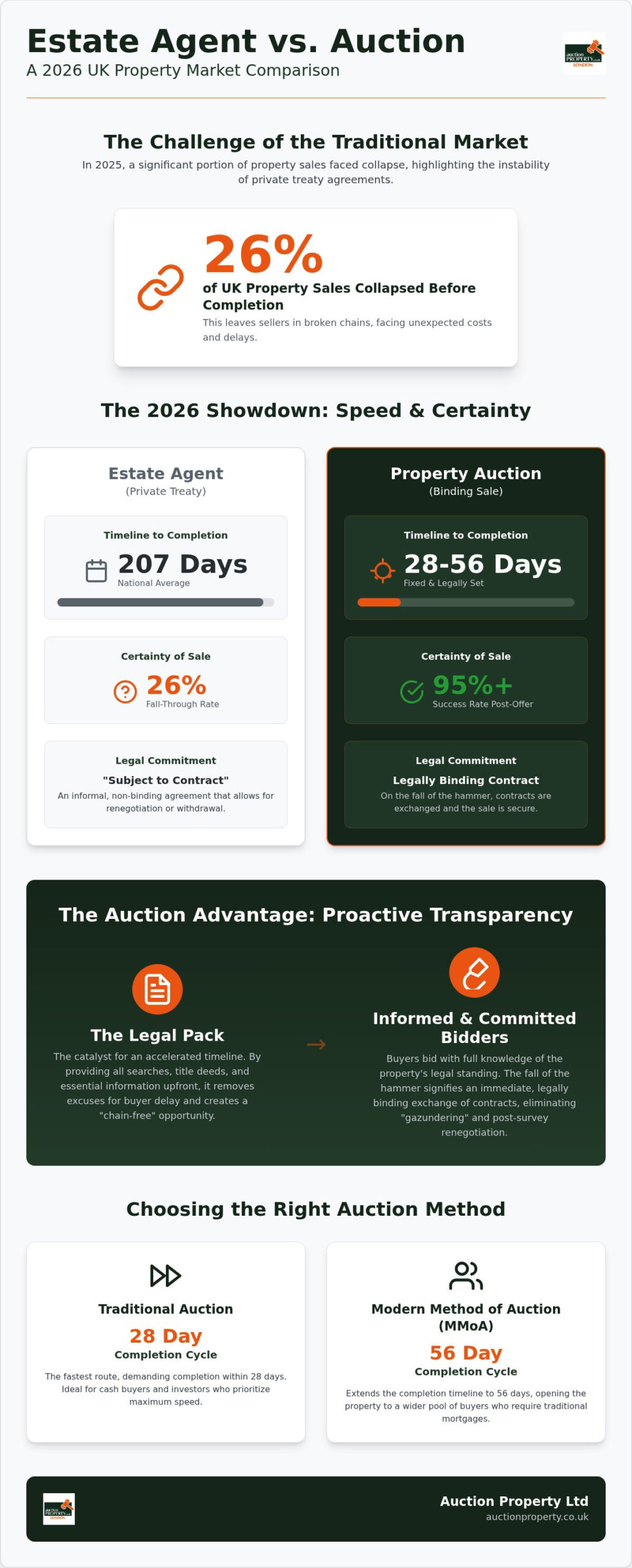
In 2025, 26% of property sales in the UK collapsed before completion, leaving thousands of sellers stranded in broken chains. This statistic highlights the inherent instability of the traditional market. When weighing up the choice of an estate agent vs auction, you aren’t just comparing commission rates; you’re choosing between a binding legal commitment and a fragile, informal promise.
You likely feel the frustration of indefinite waiting periods and the lack of transparency that often plagues private treaty sales. It’s a high-stakes environment where the average time to complete can stretch to approximately 207 days. You deserve a process that prioritizes efficiency and provides a clear, guaranteed path to the finish line without the administrative hurdles.
This definitive 2026 comparison reveals the critical differences in speed, certainty, and final sale price to determine the most efficient route for your transaction. We examine how the latest legislative reforms and digital platforms have shifted the landscape. This guide provides the clarity you need to move from curiosity to a successful, finalized sale with maximum market exposure.
Key Takeaways
- Understand why the legally binding nature of a hammer fall eliminates the 26% fall-through rate commonly seen in traditional private treaty sales.
- Compare the 28-day completion cycle of an auction against the six-month national average when deciding between an estate agent vs auction.
- Learn how utilizing Buyer’s Administration and Premium Fees can effectively reduce your direct commission burden while maximizing competitive bidding.
- Discover how preparing a comprehensive Legal Pack upfront accelerates due diligence and ensures a frictionless transaction for residential and commercial assets.
- Identify the specific property types and conditions that benefit most from the transparency and speed of a national online auction platform.
Estate Agent vs Auction: Understanding the Fundamental Mechanisms
Choosing between an estate agent vs auction requires a fundamental shift in how you view a property transaction. One model relies on open-ended negotiations while the other operates within a rigid, time-bound legal framework. In the 2026 UK market, where proposed government reforms emphasize upfront transparency, the distinction between these two paths has never been more critical for your financial security.
The reserve price serves as your primary safeguard in the auction environment. It’s the confidential minimum figure you’re willing to accept. If the bidding doesn’t reach this threshold, the property remains yours. This mechanism ensures you maintain absolute control over the asset’s value, preventing a sale at an unsatisfactory price while still benefiting from the upward pressure of competitive bidding.
The Estate Agent Route: The Private Treaty Process
Traditional sales via an estate agent use the private treaty model. Properties are marketed to a broad audience, but these potential buyers are often unvetted. The process is characterized by the “Subject to Contract” phase. This status is essentially an informal agreement that carries no legal weight. It’s the primary reason why more than a quarter of agreed sales in 2025 collapsed before completion. You’re frequently tethered to complex property chains and the unpredictable timelines of external mortgage approvals, which can stall progress for months.
The Auction Route: Competitive Bidding and Immediate Exchange
The auction model replaces “marketing for views” with “marketing for a specific sale date.” This creates an environment of intense momentum and urgency. Understanding the auction process means recognizing that the fall of the hammer signifies a legally binding exchange of contracts. There’s no room for post-survey renegotiation or “gazundering.” The buyer is committed, a deposit is paid immediately, and the completion date is set in stone.
It’s vital to distinguish between the Traditional Auction and the Modern Method of Auction (MMoA), a gap many guides overlook. Traditional auctions typically demand completion within 28 days. The Modern Method extends this to 56 days, allowing buyers more time to secure traditional lending. Both methods provide the same legal certainty at the point of the bid, but the MMoA opens your property to a wider pool of buyers who require mortgages rather than just cash investors. This choice allows you to tailor the level of speed to your specific needs.
Speed and Certainty: The 2026 Timeline Showdown
Speed is the most significant differentiator when comparing an estate agent vs auction. While the national average for a private treaty sale now sits at approximately 207 days, the auction model delivers a legally binding result in a fraction of that time. This disparity stems from the structural differences in how due diligence is handled and how buyer commitment is secured. In a market where time equals money, the efficiency of the auction cycle provides a distinct financial advantage.
The “Legal Pack” is the catalyst for this accelerated timeline. By providing all necessary searches, title deeds, and lease information upfront, you remove the primary excuses for buyer delay. It transforms your property into a “chain-free” opportunity, which is the gold standard for certainty in 2026. Buyers bid with full knowledge of the property’s legal standing, ensuring the transaction moves toward a frictionless finish. This upfront transparency is why auctions enjoy a 95% certainty of sale once the hammer falls.
Why Traditional Sales Fall Through
In 2025, 26% of agreed sales in the UK collapsed before completion. These fall-throughs often occur because the traditional process allows for a “change of heart” or renegotiation after a survey. Every failed transaction costs the seller time and money. Administrative friction between solicitors and the endless back-and-forth of enquiries create a vacuum where deals die. You can find official government guidance on selling your home that outlines these standard steps, but it rarely accounts for the emotional and financial toll of a broken chain or the risk of “gazundering” late in the process.
The Auction Timeline: From Instruction to Completion
The auction timeline is designed for momentum. It begins with an intensive three-week marketing period that peaks interest just as the bidding opens. Unlike the open-ended nature of an estate agent’s listing, auctions provide a fixed completion date, typically set for 28 days after the auction. This allows you to plan your next move with total confidence. Once the hammer falls, the contract is exchanged immediately, and the winning bid becomes a final commitment. For a deeper look at this process, read our guide on how to Sell House Fast at Auction UK. If you’re ready to bypass the six-month wait, you can view our upcoming auction lots to see how we maintain this brisk pace.
Financial Analysis: Commissions, Premiums, and Net Returns
Evaluating the financial outcome of an estate agent vs auction requires a look at the net return rather than just the headline commission. While a traditional agent’s fee might seem lower on paper, the true cost of a sale includes the “holding costs” incurred during the 207-day average completion period. Every month a property remains unsold, you’re responsible for mortgage interest, council tax, utilities, and insurance. These figures can quickly erode the perceived savings of a lower commission rate.
The auction model prioritizes immediate liquidity and financial finality. It replaces the uncertainty of a private treaty with a binding commitment backed by a non-refundable buyer deposit. This deposit, usually 10% of the hammer price, acts as a powerful deterrent against withdrawal. It ensures the buyer has “skin in the game” from the moment the contract is formed, providing you with a level of security that an informal offer cannot provide.
Comparing Fee Structures
Standard estate agent fees for sole agency agreements in 2026 average 1.42% inclusive of VAT. This is typically a “no sale, no fee” model, but it offers no protection against the 26% fall-through rate previously discussed. In contrast, auctioneer commissions generally range between 1.5% and 2.5% plus VAT. However, the auction model allows for the use of Buyer’s Administration and Premium Fees. This structure can significantly reduce your direct commission burden by shifting a portion of the transaction costs to the purchaser. The Buyer Premium is a mandatory fee paid by the successful bidder that ensures only serious, funded participants enter the arena.
The Impact of Competitive Momentum on Price
The “market value” of a property isn’t a static number; it’s what a buyer is willing to pay under competitive pressure. Traditional agents often use a “best and final” offer system that lacks transparency and can leave money on the table. Auctions use a strategic guide price to generate maximum interest and momentum. This public bidding process often results in a final price that exceeds initial valuations. You can find detailed professional standards on these practices in the RICS guide to property auctions, which highlights how transparency benefits both parties.
Choosing the right framework is about balancing upfront costs against the certainty of the result. If you want to understand how to leverage these dynamics for your specific asset, take the time for Mastering the Property Auction. By opting for a binding legal framework, you secure your equity and eliminate the risk of late-stage price renegotiations common in the private treaty market.
Property Suitability: When to Choose Auction over an Agent
Determining the right path depends on the specific nature of your asset and your timeline requirements. Choosing between an estate agent vs auction isn’t just about the property’s value; it’s about the buyer profile you need to attract. While traditional guides often pigeonhole auctions as a destination for distressed sales, the 2026 market shows a significant shift. Sellers of high-quality residential homes now use the gavel to bypass the 207-day national average wait time. You must evaluate whether your priority is the highest theoretical price or the highest guaranteed net return within a fixed window.
Property condition plays a pivotal role in your strategy. Homes with structural issues or those requiring significant modernization often struggle in the private treaty market. Traditional buyers are frequently deterred by survey results, leading to renegotiations or withdrawals late in the process. Auction buyers are typically seasoned investors who factor these conditions into their initial bids. This eliminates the risk of post-survey price chips that often plague traditional sales.
Properties That Thrive at Auction
Properties requiring renovation or those with structural queries perform exceptionally well in a competitive bidding environment. Professional investors and developers seek these opportunities. They’re prepared to move quickly with cash or pre-approved finance, which removes the mortgage-related delays common with estate agents. Commercial assets and land with development potential also benefit from the auction’s transparency. The public nature of the bid ensures you achieve true market value through visible competition.
Probate and inherited properties are ideal candidates for this route. The finality of the hammer fall provides a clean break. It prevents the administrative drag of a private treaty chain that often lasts over six months. This method offers a transparent audit trail for executors. This transparency is essential for fulfilling fiduciary duties to beneficiaries and ensuring the estate is settled efficiently.
When the Traditional Agent Might Be Preferred
Some properties require a more patient approach. If your home has a very niche appeal, it might benefit from a longer marketing period. This allows you to find that specific buyer who values its unique features. Traditional agents can provide this “wait and see” strategy if you’re comfortable with the risk of a fall-through. If you’re under no time pressure and are prepared to navigate the 26% collapse rate seen in 2025, the private treaty route remains an option. However, always secure a professional valuation before committing to a six-month listing. If your property fits the profile for a swift, secure transaction, contact us for a professional appraisal to see how we can maximize your results.
Maximising Results with Auction Property Ltd
Auction Property Ltd provides a modern, tech-forward solution to the frustrations inherent in the traditional property market. Our 2026 digital infrastructure is designed to strip away the administrative hurdles that typically slow down a sale. By utilizing real-time bidding and an encrypted online platform, we provide a level of transparency and speed that traditional methods cannot match. When deciding between an estate agent vs auction, the choice often comes down to who possesses the most robust network. We connect your asset to thousands of vetted national buyers, ensuring your property receives maximum exposure without the geographical limitations of a local high-street office.
Our platform operates on a foundation of absolute clarity. Every bid is visible in real-time, creating the competitive momentum necessary to drive prices upward. This digital-first approach ensures that the finality of the hammer fall is backed by a secure, frictionless legal process. We handle the complexities of the transaction so you can focus on your next move. By utilizing our Buyer’s Administration and Premium Fees, you can effectively reduce your direct commission burden while still benefiting from a professional, national marketing campaign.
Our Professional Marketing and Appraisal Process
We don’t just list properties; we strategically position them for success. Our expert team conducts professional appraisals to set a guide price that generates interest while protecting your confidential reserve. This balance is vital for ensuring the property sells at a price you’re satisfied with. Our national marketing strategy utilizes extensive online catalogues and targeted digital campaigns to reach serious investors and first-time buyers alike. To understand how our approach compares to others in the industry, read our guide on Choosing the Right Auction House UK.
Getting Started: Your Path to a Secure Sale
Taking control of your property transaction begins with a clear, sequential plan. First, request a professional valuation through our platform to establish your property’s market potential. Our team then provides comprehensive legal administrative assistance to prepare your Legal Pack. This pack is the cornerstone of a secure sale, as it allows buyers to complete their due diligence before the auction begins. By removing these hurdles early, we ensure that once the hammer falls, the sale is final. We specialize in all property types, including residential, commercial, and land, providing a tailored service that prioritizes your timeline. Don’t leave your equity to the chance of a traditional chain. Take control of your property sale today by contacting our expert team for an appraisal.
Secure Your Equity with a Definitive Sale Date
Deciding between an estate agent vs auction is a choice between an open-ended promise and a legally binding result. Don’t settle for the 207-day national average or the constant risk of late-stage renegotiations. By moving to a binding legal framework, you secure your equity and gain the certainty of a fixed completion date. This modern approach replaces the fragility of the traditional chain with a robust, time-bound transaction that puts you in control.
We provide the digital infrastructure and expert support needed to move your asset quickly. Our team offers comprehensive Legal Pack support and a transparent online bidding platform to ensure a frictionless experience from instruction to completion. With our national reach for residential and commercial assets, we connect you to a vast network of vetted buyers ready to commit immediately. Instruct Auction Property Ltd for a Secure, National Sale and experience the efficiency of a guaranteed outcome. Your path to a successful, finalized sale starts today.
Frequently Asked Questions
Is it cheaper to sell through an estate agent or an auction?
Net return determines the true cost. Traditional agent fees average 1.42% including VAT, but you must factor in six months of mortgage and maintenance costs during the wait. Auctions often utilize Buyer’s Administration Fees to lower your direct commission. When evaluating an estate agent vs auction, remember that the speed of a 28-day completion cycle saves significant holding costs that a long-term listing ignores.
Can I set a minimum price for my property at auction?
You maintain absolute control through the reserve price. This is a confidential minimum figure agreed upon before the auction begins. If the highest bid doesn’t reach this threshold, the property isn’t sold. This mechanism protects your equity while allowing competitive bidding to push the price beyond your expectations. It ensures you never sell for less than your asset’s worth.
How long does it take to get my money after an auction sale?
Funds are typically released upon completion, which occurs 28 days after the hammer falls. The buyer pays a non-refundable 10% deposit immediately at the point of exchange. This immediate financial commitment provides a level of security that traditional sales lack. The structured timeline allows you to plan your next investment with total confidence in the settlement date.
What happens if my property doesn’t sell at auction?
If the bidding doesn’t meet your reserve, the property is withdrawn. However, the process doesn’t end there. Many sales are agreed post-auction by negotiating with the highest bidders who were active during the session. Our team continues to market the property to our national database of vetted buyers to secure a successful outcome outside the live bidding environment.
Do I need a solicitor to sell my house at auction?
Legal representation is mandatory for a secure transaction. Your solicitor is responsible for preparing the comprehensive Legal Pack, which includes title deeds, searches, and special conditions of sale. This pack must be available for buyers to review before the auction starts. Our expert team provides administrative assistance to streamline this process, ensuring your documentation is robust and ready for a frictionless exchange.
Can buyers use a mortgage for an auction property?
Mortgage-backed buyers participate frequently in modern auctions. While traditional auctions require completion in 28 days, the Modern Method of Auction extends this to 56 days to accommodate standard lending timelines. Buyers should secure an Agreement in Principle before bidding. This accessibility expands the pool of potential purchasers beyond cash investors, increasing the likelihood of a high final hammer price.
What is the difference between a guide price and a reserve price?
The guide price is a public marketing tool used to generate interest and momentum. It represents the range within which the property is expected to sell. The reserve price is the secret minimum figure you are willing to accept. By law, the reserve cannot be more than 10% above a single-figure guide price. This transparency ensures buyers know the entry point while protecting your bottom line.
Why do so many traditional house sales fall through in the UK?
The primary cause is the lack of legal commitment during the Subject to Contract phase. In 2025, 26% of agreed sales collapsed because buyers could withdraw without penalty. Broken property chains and failed surveys often trigger these failures. When comparing an estate agent vs auction, the latter eliminates this risk by creating a legally binding contract the moment the bidding concludes.