

Buying sight unseen isn’t automatically unsafe, but it requires more than trust in listing photos or a virtual tour. The practical answer to how to manage risk when buying sight unseen is to verify the property independently, assess the local market and set a budget that allows for potential problems. Consider it only if you’re prepared to decide without a physical viewing.
Caution is sensible: a remote viewing can’t reveal everything about a property or its surroundings. In the UK, caveat emptor, or buyer beware, remains the legal position, so due diligence matters before you commit. This guide explains how to compare local sales, review council and planning information, estimate rental potential and account for survey findings when setting your maximum purchase budget.
You’ll also learn how surveys, independent inspections and legal packs inform the decision, and how to judge whether a property’s risks suit your experience and tolerance for uncertainty. The aim is to make an evidence-led decision about whether to proceed, renegotiate or walk away.
Key Takeaways
- Photos and virtual tours can conceal defects and neighbourhood issues, so build independent inspections into your decision.
- Compare similar local sales and council information to test whether the asking price and area suit your investment plan.
- Research planned infrastructure and development to understand how changes nearby could affect demand and property value.
- Estimate rent using local evidence, then set a purchase limit that accounts for costs, risks and potential repairs.
- Decide whether buying without an in-person viewing fits your experience, risk tolerance and ability to verify the property.
Is Buying Property Sight Unseen Risky, or Is That a Myth?
Buying without a physical viewing isn’t automatically unsafe; the quality of your due diligence determines how much you can verify. Listing images and virtual tours have limits, so treat them as evidence to investigate, not proof of the property’s condition.
Unknown Property Conditions
Unknown property conditions are defects or practical problems you haven’t identified before committing to buy. A virtual tour may show rooms clearly but miss damp, structural movement, unusual odours, traffic noise or disruptive neighbours. These details can affect repair costs and the property’s appeal to future tenants.
Arrange a survey suited to the property’s age, construction and condition. Before exchange of contracts, have it carried out by a surveyor registered with the Royal Institution of Chartered Surveyors. A mortgage valuation is different: it’s for the lender and may not involve an in-person visit.
Misleading Listings and Missing Information
A misleading listing presents a selective picture, while missing material information leaves key facts unclear. UK property listings must include the council tax band or rate, price and tenure information. Compare these details with the legal documents instead of relying on photographs or the seller’s statements.
Ask for floorplans, room dimensions and close-up images of windows, ceilings and visible damage. Check that the photos show the property being sold. A discrepancy between the listing and legal pack is a reason to investigate before proceeding, not something to leave until after exchange.
Remote Property Condition Checks
Remote checks combine professional inspection with direct observation. Ask a trusted local representative to view the property, take close-up photographs and join a live video call from each room. A friend can describe what the camera misses, but a qualified inspector is better placed to assess structural or hidden building concerns.
A sound way to manage risk when buying sight unseen is to keep the survey and legal review independent of the seller’s presentation. New-build properties may offer more safeguards because their specifications are known and they may have builder’s warranty insurance. For a remote investment, a property management company can help manage the property after purchase.
Legal Checks and Cooling-Off Rights
Legal checks establish what you’re buying, including the title, tenure and matters raised in searches or contract documents. In the UK, caveat emptor means buyer beware, and the seller gives no implied warranty about the property’s condition. Conveyancing law and estate agency practices differ between England and Wales, Scotland and Northern Ireland.
Don’t assume you can change your mind after exchange or rely on a cooling-off period. The research facts state no general cooling-off right; check the contract and applicable jurisdiction with your conveyancer before committing. Discuss contingencies before finalising the deal, since sellers don’t have to accept them. After receiving the survey, review its findings and raise concerns before exchange.
Checking comparable sales and local council information
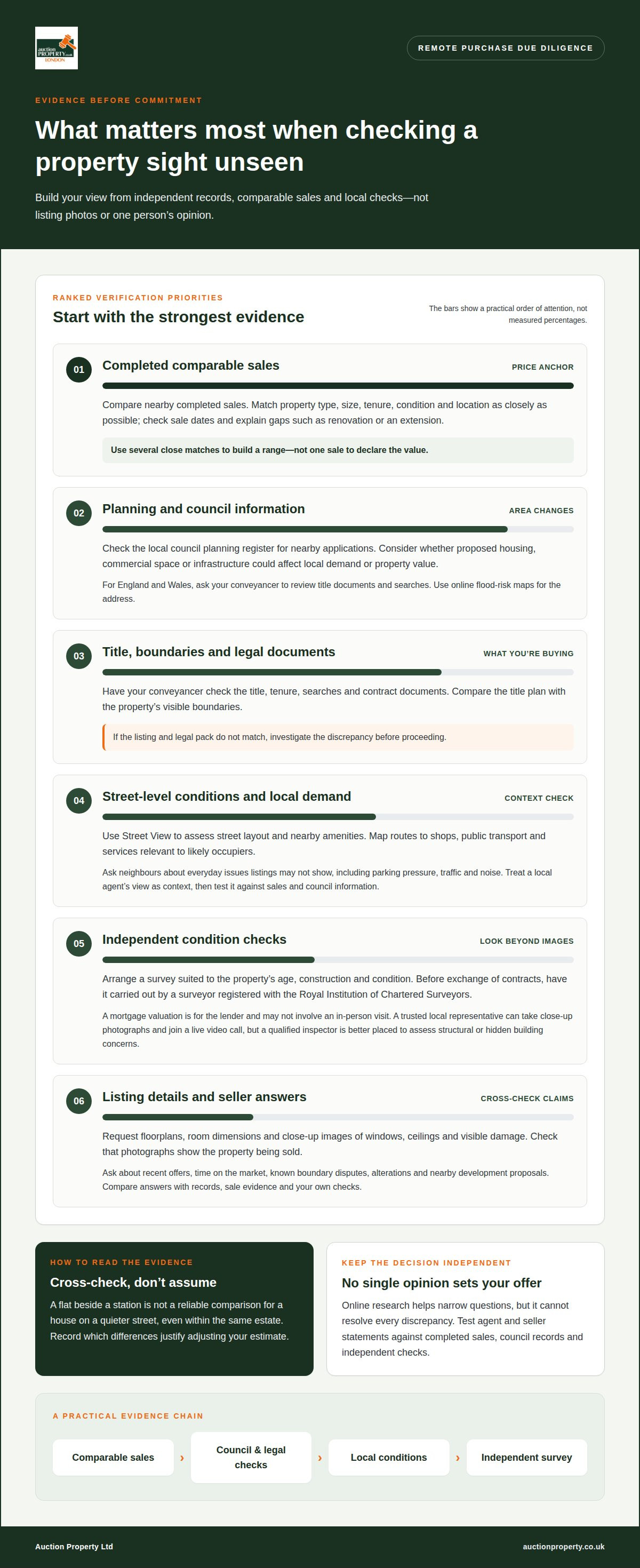
Comparable sales help test whether an asking price fits the local market, while council records can reveal changes that affect demand. For a remote purchase, combine transaction evidence, planning information and local knowledge rather than relying on one agent’s view.
To check a property’s title, boundaries, planning history and flood risk in England and Wales, ask your conveyancer to review the title documents and searches. Compare the title plan with the property’s visible boundaries. Search the local council’s planning register and use online flood-risk maps for the address.
Start with completed sales of similar properties nearby. Match property type, size, tenure, condition and location as closely as possible. A flat beside a station is not a reliable comparison for a house on a quieter street, even within the same estate. Check sale dates and whether major differences, such as renovation or an extension, explain a price gap.
Use the comparison to build a range, not to assume one sale sets the value. If similar homes sold for different amounts, investigate why: condition, layout, parking and proximity to amenities can all affect appeal. Compare the asking price with the closest matches and record which differences justify adjusting your estimate.
To assess local growth drivers, examine supply and demand alongside upcoming development. Review council planning applications near the address, then consider whether proposed housing, commercial space or infrastructure could change the area. Google Street View can help you assess street layout and nearby amenities. Map routes to shops, public transport and services relevant to likely occupiers.
Ask the estate agent and seller about recent offers, time on the market, known boundary disputes, alterations and nearby development proposals. Ask neighbours about everyday conditions listings rarely describe, such as parking pressure, traffic and noise. Compare each answer with council records, sale evidence and your own online checks.
A local estate agent can explain which streets attract buyers or tenants and how property features affect demand. Choose an agent with practical knowledge of the immediate area, then test their opinion against completed sales and council information. Agents represent different interests, so don’t let one recommendation replace independent due diligence or determine your offer.
Online research can help narrow your questions, but it cannot resolve every discrepancy. Keep a simple record of comparable sales, planning applications, mapped amenities and unanswered questions. Share relevant findings with your conveyancer before committing, and use them to assess whether the contract and proposed price reflect the property’s location and the available evidence.
If you’re comparing properties offered at auction, include residential property auctions in your market research and assess each listing against the same local evidence.
Checking upcoming infrastructure and development
Planned development can change a property’s outlook after purchase. A new transport link may improve access, while construction, extra housing or altered traffic can affect the immediate setting. If you’re considering a property sight unseen, review council planning applications around the address and distinguish approved work from proposals still under consideration.
Map each relevant application against the property, not just the wider town. Note the project’s location, proposed use and likely effect on nearby homes. A housing scheme could add future supply and competition for tenants; commercial development might bring services or activity but also more traffic. Assess these effects against your intended investment rather than assuming every project is an advantage.
Check whether development could change access, views, noise levels or the character of the street. A planned road scheme, for example, may shorten journeys while increasing traffic near a home. Use council documents to understand the proposal and compare the plans with the listing’s description. If the seller highlights a future project, establish whether it’s approved or only expected.
Photographs can leave out features that matter to daily life. A wide-angle room image may not show the view from every window, a nearby road or activity outside the property. Compare listing images with a map and street-level imagery. Ask a local representative to check sightlines, traffic and surrounding uses from the entrance and windows, then report what the camera cannot capture.
Also consider environmental exposure. Natural-disaster impacts are part of property risk assessment. Review relevant local information for the address and consider how exposure could affect the building, access, insurance arrangements and tenant demand. Bright listing photographs cannot establish a property’s exposure or resilience.
Remote buyers should prepare for financial checks as carefully as location checks. Keep a clear record of where the deposit and other purchase funds came from. Organise relevant bank records and documents relating to savings, a property sale, inheritance or investments. If you’re using a mortgage, keep lender correspondence and the mortgage offer together so the transaction team can follow the funding plan.
Source-of-funds and source-of-wealth checks concern where money came from and, where relevant, how wealth was accumulated. Give consistent information across your solicitor, lender and transaction documents; unexplained gaps can raise questions and slow progress. Don’t transfer funds based only on changed payment instructions in an email. Verify new account details through a trusted, previously established contact method before sending money.
Bring the evidence together before making an offer: planning records, street-level observations, environmental information and a documented funding route. This helps you assess development risks alongside the property’s condition and financial viability, rather than letting an attractive listing or promised future improvement dominate your decision.
Estimating rent and setting a purchase budget
Set your purchase ceiling using realistic rental income, not the most optimistic listing estimate. Compare similar homes in the same area, matching property type, bedrooms, condition, furnishing and access to local amenities. Check achieved rents where available, then test whether advertised rents reflect properties tenants can actually occupy. Google Street View can add context about the street, but it can’t verify rental demand or property condition.
Build a rental estimate around the likely tenant and the property’s actual features. A family home near schools serves a different market from a flat suited to commuters. Compare competing rentals, note their condition and facilities, and account for the time needed to find a tenant. Treat rent as income before costs, not as the amount available for your mortgage or other commitments.
Your purchase budget should include the deposit and transaction costs, plus a reserve for repairs and ongoing ownership. Allow for conveyancing, searches, survey work, relevant property taxes, mortgage costs, insurance, maintenance and management. The total depends on the property, financing, location and work required. For a remote purchase, include travel or local inspection costs where relevant, and avoid committing all your available funds to the purchase price.
Set a maximum offer by subtracting expected costs and a repair allowance from the funds available. Test the result against a lower rent estimate and higher maintenance costs. If the property only works with full rent from the outset, the budget leaves little room for delays or unexpected findings. Keep your assumptions in writing so you can revise the offer when new evidence changes the calculation.
Red flags include photos that omit kitchens, bathrooms or exterior views; inconsistent room sizes; unexplained differences between the listing and legal documents; and pressure to commit before due diligence. Ask for missing details and compare the answers with the survey, contract and inspection evidence. A seller’s reassurance doesn’t replace resolving a material discrepancy before exchange.
Pre-construction purchases need a different budget structure because the completed home cannot be inspected as an existing property. Compare the contract specifications with the plans, consider how changes to delivery could affect your finances, and understand the completion terms and remedies. New properties may offer safeguards because their specifications are known and builder’s warranty insurance may apply. Treat projected rent as an estimate, not proof of future income.
For remote UK purchases, budget for legal work, searches, surveys, financing, relevant taxes, insurance, repairs and property management. Which costs apply depends on the property, purchase structure, UK jurisdiction and funding arrangements. Record each expected cost separately, then compare the total commitment with conservative rent assumptions before making an offer.
Meaning of buying sight unseen
Buying sight unseen means agreeing to purchase a property without physically viewing it beforehand. The decision relies on other evidence, such as listing photographs, a virtual tour, documents and inspections arranged by people involved locally. A buyer may later visit, or may first see the property after completion. The defining point is that the buyer commits without their own in-person viewing.
A virtual tour is not the same as walking through a home. A camera can show the layout, but may not capture noise from a nearby road, smells, restricted access or how rooms feel in person. Strong listing photos can generate interest, but they cannot establish a property’s condition or suitability.
For a remote investor, the choice can be practical: distance, work or a fast-moving sale may prevent travel. But the purchase price still needs to reflect evidence, not urgency. Treat the process as a decision based on independent checks. A surveyor assesses condition, a conveyancer reviews legal documents, and local observations help explain the setting.
Buying sight unseen doesn’t mean buying without due diligence. It describes the absence of your own physical viewing, not the absence of inspection or professional review. For example, a representative might walk through the property on a live video call while a qualified surveyor examines it separately. Each source answers different questions, so one cannot replace the others.
Buying in person also cannot remove every risk. A short viewing may miss defects, and an attractive interior can distract from weak local demand or costly repairs. Sight unseen changes how evidence is gathered; it doesn’t change the need to assess condition, location, legal terms and affordability together. A sound decision process gives each factor a defined role.
Understanding how to manage risk when buying sight unseen starts with knowing what you can and cannot verify remotely. Set a maximum purchase price using comparable evidence and your budget, then identify findings that would change your decision. If a survey reveals major work or legal documents conflict with the listing, pause and reassess before committing.
Use a simple decision record: list the evidence, its source and any unresolved concerns. For example, note whether a room dimension came from a floorplan, an inspection or the seller. This makes assumptions visible and helps prevent a positive virtual tour from outweighing contradictory evidence. Proceed only when the facts support your intended investment.
Once your criteria are clear, explore property auction opportunities and assess each property against the same evidence-led decision process.
Auction Property: Residential Property Auctions
Auction Property Ltd offers Residential Property Auctions for buyers assessing homes through listing details and legal documents. Before pursuing a property sight unseen, compare its evidence with your survey, budget and investment criteria. Review the legal pack carefully to understand the available information about the property and transaction before deciding whether to proceed. Auction Property Ltd also provides Commercial Property Auctions, Land and Development Site Auctions, and Legal Pack Provision for buyers considering different property types. An auction may suit buyers who have completed their due diligence and are ready to assess a specific opportunity against a clear maximum price. Contact Auction Property Ltd to discuss your next step or visit auctionproperty.co.uk.
Make your next decision evidence-led
Set your decision threshold before the next property catches your interest. Decide what evidence you need, which findings would change your view and what purchase price still fits your investment plan. This framework helps keep urgency, appealing photographs or competition from setting your limit.
A clear approach to how to manage risk when buying sight unseen means being ready to pause when evidence conflicts. Treat unresolved condition, legal or funding questions as decision points, not administrative details. If the property no longer meets your criteria after further review, walking away preserves your ability to consider a better-supported opportunity.
For your next step, assess whether an auction property fits your plans and review its information against your due diligence and budget. Contact Auction Property Ltd to discuss your property search, without treating an auction as a substitute for independent checks.
Contact Auction Property Ltd for help as you plan your next move. Build your decision on evidence, keep your limits clear and proceed with confidence.
Frequently Asked Questions
Is “If I Inspect It Myself, It’s Safer” True?
No. A personal viewing provides useful observations, but it doesn’t guarantee a sound purchase. A rushed visit can miss defects, and emotional reactions may distract from repair needs or weak resale appeal. Check the property in daylight and note visible damage, access and surrounding activity. Pair your observations with independent professional advice rather than treating your inspection as a substitute.
Thinking of buying blind?
Consider it only if an in-person viewing is your only option and you’re prepared to rely on independent evidence. A sensible way to manage risk when buying sight unseen is to decide in advance what would make you withdraw, such as an adverse survey finding or a major gap between the listing and inspection. Make sure your funding, adviser team and plan for managing the property are ready before committing.
What does buying a property sight unseen mean in the UK?
It means committing to buy before you’ve personally visited the property. You might still use a local representative, surveyor, solicitor and documents to evaluate it. For example, watching a live video call from a friend doesn’t count as an in-person viewing by you. The key distinction is whether you physically visited before agreeing to purchase, not whether other people inspected the home.
What are the main risks of buying a house without viewing it in person?
The main risks are hidden defects, incomplete or misleading presentation, and missing context about the surroundings. A listing may show a renovated living room but not an unfinished loft, a noisy road or poor access. Financial risk follows if repairs, lower rental demand or other findings make the purchase less viable. Legal documents and an independent survey help test different aspects, but each answers its own questions.
Should I hire a RICS surveyor for a property I haven’t viewed in person?
Yes, arrange an appropriate survey before exchange of contracts, using a surveyor registered with the Royal Institution of Chartered Surveyors. Choose a survey suited to the property’s age, construction and condition rather than relying on a mortgage valuation. Read the report closely and ask the surveyor to explain urgent defects, further investigations and likely implications. This gives you clearer evidence to decide whether to proceed.
Can someone view a property on my behalf, and what should they check?
Yes. Ask a trusted local representative to walk through every room and the outside, checking the layout against the floorplan. Have them note visible damage, signs of damp, access issues, smells and noise, then take close-up photos and live video. Their observations can reveal practical issues, but they don’t replace a qualified surveyor’s assessment of structural or hidden defects.
How can I reduce financial risk with a conditional offer, deposit protection or contract clauses?
Ask your conveyancer to explain the contract, deposit terms and any proposed conditions before making a binding commitment. Don’t assume a conditional offer or deposit protection applies automatically; the seller must agree to relevant contingencies, and the written terms determine their effect. For an auction, understand the legal pack and payment obligations before bidding. Set a firm spending limit that includes repairs and ownership costs.
What should I do if a survey or later visit reveals problems after I’ve committed to buy?
Act according to the stage of the transaction. Before exchange, send the report to your conveyancer, discuss the findings and ask whether the contract allows time to renegotiate or withdraw. After exchange, defects may leave you without recourse against the seller, so seek prompt legal advice and document the condition. Keep the survey, photographs and any repair assessments together to support clear decisions.