

Why are seasoned investors securing average yields of 7.1% across the market while most buyers are still trapped in a six-month property chain? To buy a flat at auction in 2026 requires more than just a high bid; it demands a clinical approach to due diligence and a total mastery of the current regulatory landscape. You probably recognize that the auction room offers unmatched speed and transparency, yet the anxiety surrounding immediate contract exchanges and hidden structural issues is entirely valid. It’s a high-stakes environment where a single overlooked clause in a legal pack can lead to significant financial friction and unexpected costs.
This guide provides a professional framework designed to strip away the intimidation factor and replace it with a clear, secure path to property acquisition. We’ll outline the precise 28-day timeline for 2026, explain how to audit legal packs with expert precision, and detail the exact costs you’ll face; from updated SDLT rates to buyer premiums. You’ll gain the confidence to navigate the bidding process and secure a legally binding purchase without the administrative hurdles and delays associated with traditional sales methods.
Key Takeaways
- Understand why high-velocity online platforms are the 2026 standard for achieving transactional speed and certainty.
- Learn how to dissect a legal pack effectively, focusing on title deeds and special conditions to mitigate legal risks before you bid.
- Calculate your total investment accurately by distinguishing between guide prices and reserve prices while accounting for administrative fees.
- Execute a disciplined strategy when you buy flat at auction london, including completing AML checks and setting a firm walk-away price.
- Master the 28-day post-auction timeline to ensure a seamless completion and efficient coordination with your legal team.
The Framework of Modern Property Auctions in London and the UK
To understand The Framework of Modern Property Auctions, you must first recognise that the 2026 landscape has evolved into a high-velocity digital environment. Gone are the days of crowded, intimidating physical rooms. Today, the decision to buy flat at auction london is executed through sophisticated online platforms and real-time livestreaming. This shift isn’t just about convenience; it’s about transparency. Bidding logs are visible, data is instant, and the role of the auctioneer has transitioned into a tech-forward facilitator of true market value. They ensure the process remains secure while maintaining the momentum required for rapid capital deployment.
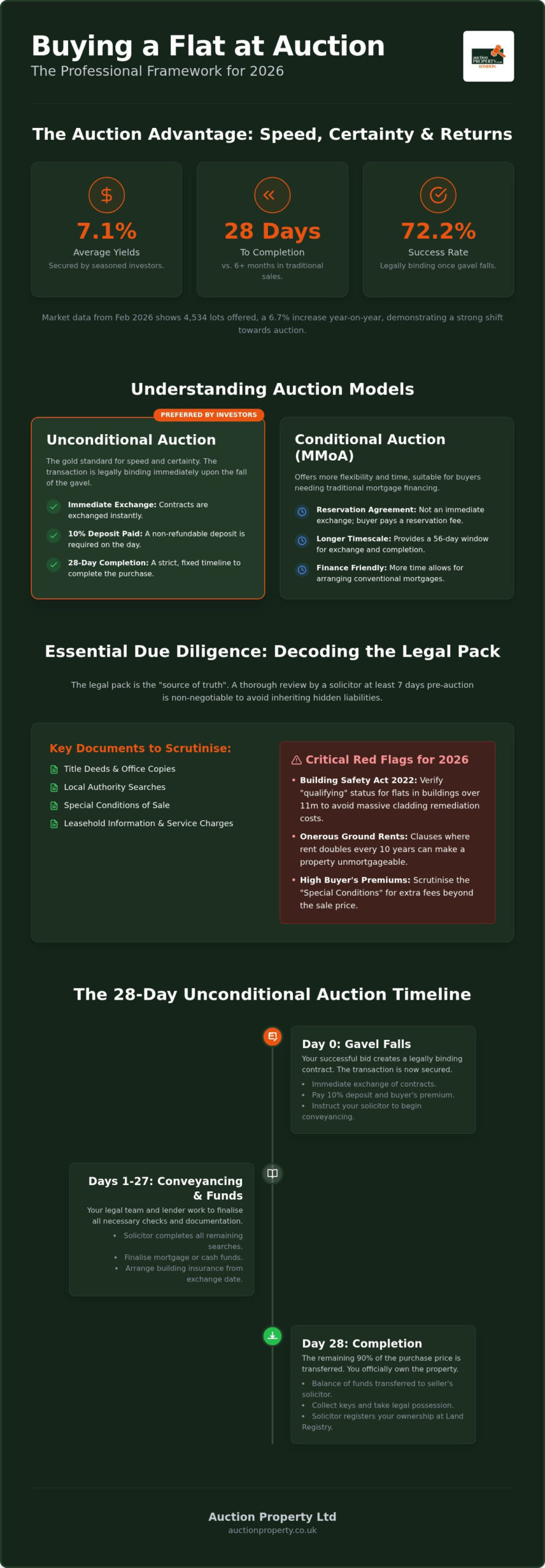
In 2026, the auction market has seen significant growth. Data from the Essential Information Group shows that 4,534 lots were offered nationally in February 2026 alone, a 6.7% increase year-on-year. With a success rate of 72.2%, the market’s efficiency is clear. This momentum is driven by a desire for certainty. Unlike the traditional private treaty market, which is often plagued by delays and gazumping, the auction model provides a guaranteed outcome. Once the gavel falls, the transaction is legally binding. This speed is essential for maintaining investment momentum and securing assets before market shifts occur.
Unconditional vs. Conditional Auction Models
The unconditional model remains the gold standard for professional investors. It requires an immediate exchange of contracts and a 10% deposit the moment the gavel falls. You then face a strict 28-day completion window. This finality is why it’s the preferred method for those who want to buy flat at auction london without the risk of a chain collapsing. Conversely, the Modern Method of Auction (MMoA) or conditional model offers a longer 56-day window. While this allows more time for traditional mortgage financing, it lacks the absolute speed of the unconditional route. Most high-yield London opportunities reside in the unconditional sector because it guarantees the sale and protects your timeline.
The 2026 Digital Auction Experience
Digitization has democratised the process. You can now access high-value UK property from any location. Livestreams provide the same urgency as a physical room but remove the administrative friction. Real-time bidding logs ensure you know exactly where you stand against the competition. This transparency strips away the intimidation factor. You aren’t guessing; you’re reacting to verified data. By leveraging these modern platforms, you ensure your capital is deployed with maximum efficiency. The digital-first approach provides a clear audit trail and ensures that every participant operates on a level playing field, which is vital for maintaining market integrity.
Essential Due Diligence: Decoding the Auction Legal Pack
If you intend to buy flat at auction london, the legal pack is your most critical asset. It represents the “source of truth” for the property, containing the title deeds, office copies, and local authority searches that define your purchase. In an unconditional auction, you are legally buying the contents of the legal pack the moment the gavel falls. Because there is no cooling-off period, you must complete your Essential Due Diligence: Decoding the Auction Legal Pack well in advance. Always instruct a solicitor to review these documents at least seven days before the bidding starts. This timeframe allows for technical clarifications that could prevent you from inheriting significant post-completion liabilities.
For 2026 acquisitions, the Building Safety Act 2022 is a non-negotiable focus. This legislation dictates financial responsibility for cladding remediation and structural safety in buildings over 11 metres. Your solicitor must verify the “landlord certificate” and “leaseholder deed of certificate” within the pack. If a flat is classified as “non-qualifying” under the Act, you could be liable for massive remedial costs that aren’t covered by the government’s safety fund. Don’t assume every lot is protected; verify the status before you commit your capital.
Identifying “Red Flags” in Auction Documents
Look beyond the guide price to find the true cost of acquisition. Onerous ground rent clauses, such as those that double every ten years, can make a property unmortgageable and difficult to resell. You should also scrutinise the “Special Conditions of Sale.” Sellers often use these to shift their own costs onto the buyer. It’s common to find clauses requiring you to reimburse the seller’s legal fees, search costs, or even a 1.5% “contribution fee.” These hidden figures can add £3,000 to £7,000 to your final bill. You can view current auction legal packs online to start identifying these costs early in your search.
The Role of Professional Appraisals
Digital tours and high-resolution photos are excellent for initial screening, but a physical viewing is essential. You need to assess structural integrity versus cosmetic potential. While a dated bathroom is a simple fix, signs of subsidence or failing communal infrastructure are major risks. A physical inspection allows you to estimate renovation costs accurately using 2026 labour and material rates. For a deeper dive into the technical preparation required for a successful bid, see our comprehensive guide on Mastering the Property Auction.
Calculating the Total Investment: Fees, Premiums, and Hidden Costs
Transparency is your strongest asset when you prepare to buy flat at auction london. You must distinguish between the guide price and the reserve price to avoid financial miscalculation. The guide price is an indication of the seller’s current minimum acceptable price at auction, while the reserve price is the confidential figure below which the auctioneer cannot sell. Typically, the reserve is set within 10% of the guide price. Budgeting solely for the hammer price is a common error that leads to administrative friction. You must account for the Buyer’s Administration Fee, which covers the auction house’s overheads and is due immediately upon the fall of the gavel.
Your financial plan must also include Stamp Duty Land Tax (SDLT) and legal disbursements. For 2026, standard SDLT rates in England start at 0% for the first £125,000, rising to 2% on the portion up to £250,000 and 5% up to £925,000. If you’re purchasing an additional residential property, a 5% surcharge applies on top of these standard rates. Additionally, buyers often reimburse the seller for search fees, which typically range from £300 to £900. Totaling these figures before the auction ensures your “walk-away” price is grounded in reality rather than emotion.
The Financial Mechanics of the Gavel
Success at auction requires immediate liquidity. You must have a 10% deposit ready for transfer the moment you win the bid. Most auction houses require a minimum deposit of £5,000 to £6,000 if the 10% calculation falls below that threshold. Alongside this, you’ll pay the Buyer’s Premium. We define the Buyer’s Premium as a non-refundable professional fee paid upon exchange of contracts. This fee is often a percentage of the hammer price, typically ranging from 1% to 5% plus VAT, or a fixed fee between £600 and £2,500. These are professional costs that secure your right to the asset and must be factored into your gross development value (GDV) calculations.
Funding Your Auction Purchase
Speed is the primary constraint of the auction market. Traditional mortgages rarely meet the strict 28-day completion window because their underwriting processes often take eight to twelve weeks. This is why many lots are listed as “Cash Buyers Only.” If you aren’t using cash, specialist auction finance or bridging loans are the industry standard. These facilities can be arranged within days, providing the capital required to meet the 10,000 GBP Anti-Money Laundering (AML) threshold and finalise the purchase. For those looking to diversify their portfolio beyond residential assets, our guide on Buying Commercial Property at Auction in the South East provides a detailed breakdown of commercial funding structures.
Mastering the Bidding Strategy: Online and Livestream Protocols
Bidding is the execution phase where your forensic research meets the reality of the market. To buy flat at auction london, you must complete your registration at least 24 to 48 hours before the auction starts. This process involves mandatory Anti-Money Laundering (AML) checks, which as of June 30, 2026, require customer due diligence for transactions reaching the £10,000 threshold. You’ll also need to provide a deposit authorisation, typically via a remote debit card hold or a pre-authorised bank transfer. Without these administrative steps, the digital platform won’t grant you bidding access.
Discipline is the hallmark of a professional investor. You must establish a strict “Walk-Away” price before the first lot opens. The high-velocity nature of a livestreamed auction can easily trigger emotional overbidding, especially when the timer is counting down. If you can’t participate live, use proxy bidding or telephone bidding as tactical alternatives. Proxy bidding allows you to set your maximum limit in the system, which then bids on your behalf in increments. This removes the emotional pressure and ensures you don’t exceed your pre-calculated investment ceiling.
Technical Readiness for Online Bidding
Technical failure is a risk you can’t afford. Ensure you have a high-speed, stable internet connection and familiarise yourself with the bidding interface well in advance. We recommend the “Three-Bid” rule: enter the fray early with a confident bid to signal your intent and authority to other participants. If a property is “Unsold” because it didn’t meet the reserve, don’t walk away. The highest bidder often has the immediate right to negotiate with the seller via the auctioneer. This is a prime opportunity to secure the asset at the reserve price or slightly above before it returns to the open market. You can register for upcoming auctions to test your readiness on our platform.
The Legal Moment of Exchange
The digital gavel is final. The second the timer hits zero or the auctioneer’s hammer falls, a legally binding contract is formed. There is no further negotiation. You’ll immediately receive the Memorandum of Sale for digital signature, and your pre-authorised deposit will be processed. This moment marks the exchange of contracts, and you’re now legally obligated to complete the purchase within the timeframe specified in the legal pack, usually 28 days. For a deeper understanding of the entire lifecycle of a sale, consult our Property Auctions London: The Complete 2026 Guide to ensure every step of your strategy is professional and compliant.
Post-Auction Logistics: Achieving Completion with Speed and Certainty
Securing the winning bid is a significant milestone, but the 28 days following the auction are the most critical for your capital. When you buy flat at auction london, the legal responsibility for the property shifts to you the moment the gavel falls. This includes the immediate requirement for building insurance. Do not wait for the completion date to arrange cover; the risk of damage or loss is yours from the point of exchange. Your solicitor must immediately receive the signed Memorandum of Sale to begin the final conveyancing phase. This 28-day sprint requires total coordination between your legal team and your funding providers to ensure the balance of the purchase price is ready for transfer.
Managing the Completion Window
Success in the post-auction phase depends on a structured approach to the 28-day countdown. Use the following milestones to maintain momentum and avoid administrative friction:
- Day 1 to 3: Confirm insurance is in place and provide your solicitor with the full legal pack and signed contract.
- Day 4 to 14: Finalise your funding. If you aren’t using cash, ensure your bridging provider has completed their valuation and is ready for drawdown.
- Day 21: Request a final completion statement from your solicitor, including all disbursements, SDLT, and outstanding fees.
- Day 27: Ensure funds are sitting in your solicitor’s client account to prevent same-day transfer delays.
- Day 28: Completion. The funds are transferred, and you collect the keys.
Failure to meet this deadline carries severe penalties. You will forfeit your 10% deposit and the Buyer’s Premium. Additionally, the seller may sue for damages if the property resells for a lower price in a subsequent auction. Once completion is achieved, your focus should shift immediately to property management, ensuring utilities are transferred and any planned renovations begin without delay to maximise your yield.
Why Choose Auction Property Ltd?
Auction Property Ltd operates as a high-velocity facilitator for residential and commercial auctions across the UK. We understand that speed and certainty are the primary drivers for 2026 property acquisitions. Our platform is designed to remove the traditional hurdles of the auction process through a transparent, online-first bidding infrastructure. We provide expert support for legal administration, ensuring that both seasoned investors and first-time buyers have the clarity needed to execute high-stakes transactions with confidence. Whether you are looking for investment property, land, or development sites, our team ensures a secure and efficient route to ownership. Browse our latest national auction catalogue to identify your next acquisition and join a marketplace defined by professional rigour and guaranteed outcomes.
Securing Your Competitive Edge in the 2026 Auction Market
The decision to buy flat at auction london represents a commitment to speed, certainty, and market transparency. Success hinges on your ability to execute forensic due diligence before the first bid is cast. You’ve learned that mastering the legal pack and preparing your 10% deposit are non-negotiable steps for any professional investor. By navigating the 28-day completion window with a structured timeline, you eliminate the administrative friction that often plagues traditional property transactions. The 2026 market rewards those who replace emotional bidding with technical readiness and disciplined financial planning.
At Auction Property Ltd, we provide the professional administrative support and secure online bidding infrastructure needed to turn your strategy into a final, successful exchange. Our national reach and transparent fee structures ensure you operate with total clarity from the initial valuation to the final fall of the gavel. Don’t let traditional market delays hold back your portfolio growth; leverage our modern platform to achieve rapid, reliable results. We bring expert market knowledge to every lot, ensuring you have the data required for a confident bid.
View our current residential and commercial auction lots today and take the first step toward your next secure acquisition. The London market is moving fast; make sure you’re positioned to lead the bidding.
Frequently Asked Questions
Can I buy a house at auction with a mortgage in 2026?
You can use a mortgage, but the traditional 28-day completion window makes this difficult for standard lenders. Most high-street banks require eight to twelve weeks to process an application, which exceeds the auction deadline. If you need a mortgage, look for properties sold via the Modern Method of Auction, which offers a 56-day completion period. Alternatively, many professional investors use bridging finance to complete the purchase before switching to a long-term mortgage later.
What is the difference between a guide price and a reserve price?
The guide price is a public indication of the seller’s minimum acceptable price, while the reserve price is a private, confidential minimum. The reserve is the actual figure the bidding must reach for the property to sell. Usually, the reserve is set within 10% of the guide price. If the bidding doesn’t reach the reserve, the auctioneer will withdraw the lot, though the highest bidder can often negotiate a deal immediately after the event.
How much is the deposit when buying at a property auction?
A 10% deposit of the final hammer price is required immediately after the auction ends. Most auction houses also enforce a minimum deposit threshold, typically between £5,000 and £6,000, if the 10% calculation is lower. You must have these funds cleared and ready for transfer the moment the gavel falls. This deposit is held as security and forms part of the final purchase price upon completion.
What happens if I win an auction but cannot complete the purchase?
Failing to complete is a serious breach of a legally binding contract. You will forfeit your 10% deposit and any non-refundable buyer’s premiums or administrative fees. The seller also has the legal right to sue you for any losses incurred, including the cost of re-listing the property. If the property eventually sells for a lower price than your winning bid, you may be liable to pay the difference to the seller.
Are auction properties always cheaper than those on the open market?
Auction properties aren’t always cheaper; they represent the fair market value determined by competitive bidding. While many people look to buy flat at auction london to find a bargain, the final price depends on demand and the property’s potential. Auctions are often used for properties that are difficult to value or require renovation, which can lead to lower starting prices compared to move-in-ready homes on the open market.
Can I view an auction property before the bidding starts?
Physical viewings are essential and are usually organised as block viewing sessions in the weeks leading up to the auction. You should never bid on a property without inspecting it first or sending a surveyor to assess its condition. While digital packs and photos provide a baseline, they don’t reveal structural issues or environmental factors. Contact the auctioneer early to book a slot, as these sessions fill up quickly.
What is included in a property auction legal pack?
The legal pack contains all the documents your solicitor needs to verify the property’s status. It typically includes the Title Deeds, local authority searches, office copies, and the leasehold agreement for flats. It also contains the “Special Conditions of Sale,” which outline any additional fees or unique legal obligations. In 2026, you’ll also find crucial Building Safety Act 2022 compliance documents, such as landlord certificates and safety reports.
What is a Buyer’s Premium and why is it charged?
A Buyer’s Premium is a non-refundable administrative fee paid by the winner to the auction house. This fee covers the costs of marketing the lot, managing the bidding platform, and facilitating the secure exchange of contracts. It’s charged in addition to the purchase price and the 10% deposit. You must factor this cost into your initial budget calculations to ensure you don’t exceed your total investment limit when the bidding intensifies.