

The fall of the auctioneer’s gavel creates a legally binding contract that the traditional open market simply cannot match for speed or certainty. While conventional buyers lose months to broken chains and the persistent threat of gazumping, savvy investors are securing high-yield assets in minutes. Finding lucrative buy-to-let property auction opportunities in 2026 requires a shift from chasing “perfect” listings to identifying “fixable” friction within the legal pack. You likely already know the frustration of seeing a promising deal collapse at the eleventh hour due to a seller’s change of heart or a slow solicitor.
This guide will show you how to bypass those administrative hurdles and build your portfolio with confidence. We’ll provide a roadmap for identifying off-market style deals and conducting rapid due diligence that strips away the fear of hidden structural or legal issues. You’ll learn how to evaluate regional yield potentials, which are currently reaching 7% to 9% in major cities, and how to use the immediate exchange process to your advantage. We are going to break down the technical legal requirements into manageable steps, ensuring you can move from curiosity to a successful transaction without the typical friction of the housing market.
Key Takeaways
- Learn why the 2026 market prioritizes the auction model to eliminate gazumping and secure immediate contract exchange on distressed or tenanted assets.
- Identify high-yield buy-to-let property auction opportunities by analyzing the specific advantages of tenanted properties versus unmodernised refurbishment projects.
- Implement a rigorous due diligence process to evaluate legal packs for easements and covenants while setting a firm ceiling price to protect your margins.
- Discover how to meet the 28-day completion deadline through bridging finance and strategic liquidity management for competitive lots.
- Access a nationwide inventory of residential and commercial investment properties through a secure, transparent online bidding infrastructure.
What are Buy-to-Let Property Auction Opportunities?
Identifying buy-to-let property auction opportunities involves sourcing specific asset types that the traditional market often overlooks. These typically include distressed properties, tenanted units with immediate cash flow, or unmodernised homes requiring refurbishment. Before diving into the mechanics, it’s helpful to understand the foundational concept of What is Buy-to-Let? as it applies to the UK market. In 2026, the auction model has become the preferred route for professional investors due to its inherent transparency and the total elimination of gazumping.
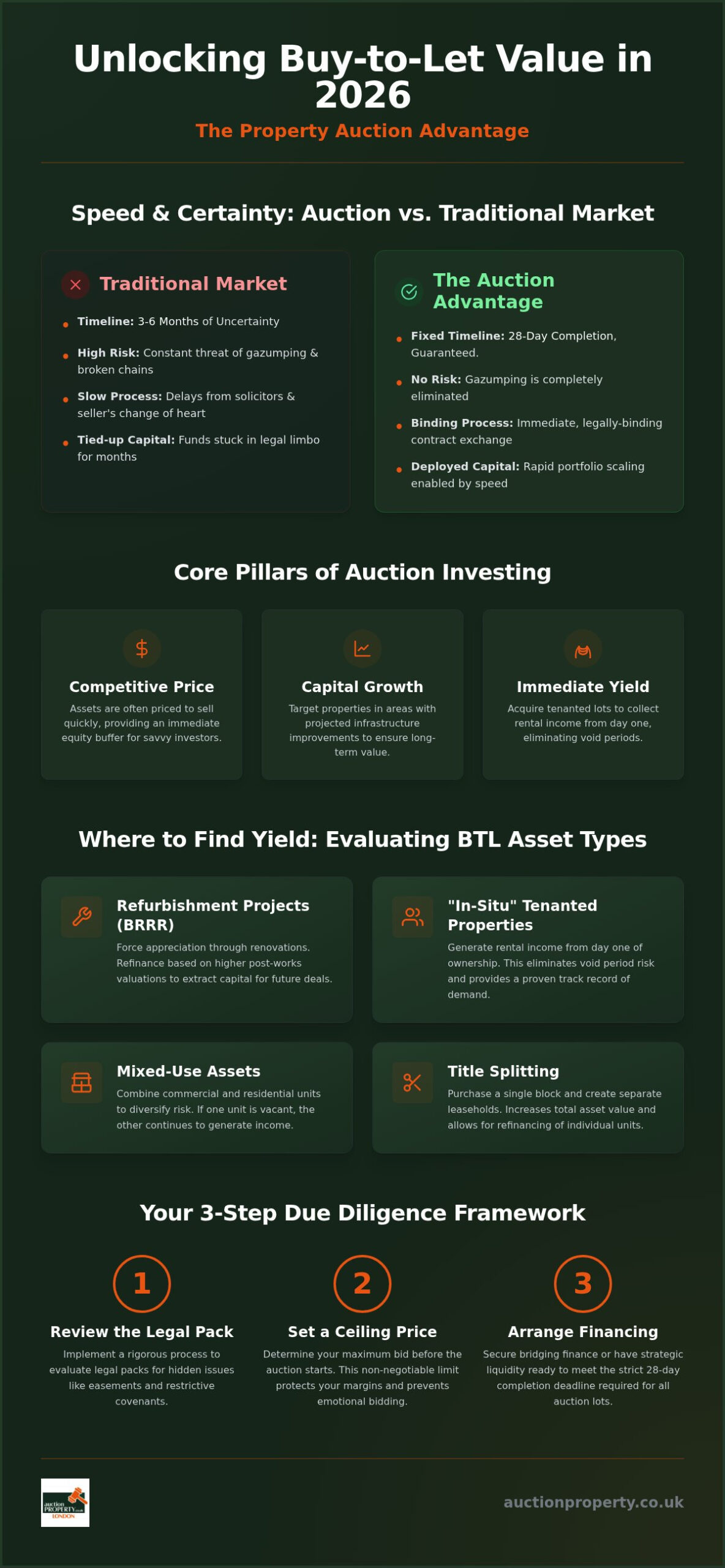
The traditional open market often suffers from delays of three to six months, leaving capital tied up in legal limbo. In contrast, the auction timeline is fixed at 28 days from the fall of the hammer to completion. This speed allows for rapid portfolio scaling. These pillars are essential when filtering for buy-to-let property auction opportunities that match your specific risk profile:
- Price: Assets are often priced competitively to encourage a quick sale, providing an immediate equity buffer.
- Capital Growth: Selecting properties in areas with projected infrastructure improvements ensures long-term value appreciation.
- Immediate Yield: Tenanted lots allow you to collect rental income from day one of ownership.
The Shift to Online Auction Platforms in 2026
Digital bidding environments have removed geographic barriers, allowing you to secure national opportunities from any location. Investors now use these platforms to manage acquisitions through a single, secure interface. Access to real-time bidding data and comprehensive digital legal packs allows for faster decision-making without the need for physical travel. This transparency ensures that the price you pay is determined by open competition, stripping away the ambiguity and frustration of private treaty negotiations.
Why Certainty is the Investors Greatest Asset
The legal finality of a successful bid is the most powerful tool in an investor’s arsenal. Unlike the open market, where deals can collapse months into the process, the auction room mandates an immediate exchange of contracts. This removes the risk of broken chains and seller cold feet. Auction Certainty is a legally binding commitment at the point of sale that guarantees the transaction will proceed to completion. This finality allows you to plan your financing and renovation schedules with absolute precision, knowing your acquisition is secure.
Evaluating BTL Asset Types: Where the Yield is Found
Spotting lucrative buy-to-let property auction opportunities requires a clinical approach to asset selection. Investors must weigh the high-growth potential of refurbishment projects against the immediate stability of tenanted units. While many buyers focus on standard residential stock, the most resilient portfolios in 2026 often utilize a mix of strategies to balance risk and cash flow. You should evaluate each lot based on its ability to meet your specific financial milestones, whether that is immediate yield or long-term equity growth.
- Refurbishment Projects (BRRR): Buying unmodernised lots allows you to force appreciation through renovations. The primary advantage is the ability to refinance based on a higher post-works valuation. However, the 28-day completion deadline requires you to have your contractor team and bridge funding ready to move instantly.
- “In-Situ” Tenanted Properties: These assets provide rental income from the day you complete. This eliminates the “void period” risk and provides a proven track record of rental demand. You must verify that the current rent is at market rate and that all safety certificates are present in the legal pack.
- Mixed-Use Assets: Combining commercial ground floors with residential upper parts provides diversified risk. If one unit becomes vacant, the other continues to generate income. This structure is increasingly popular for investors seeking yields that often exceed pure residential returns.
- Title Splitting: This involves purchasing a single block of flats or a large house and creating separate leasehold interests. By splitting the title, you can often increase the total value of the asset and refinance individual units to extract capital for your next acquisition.
Residential Houses and Flats
Success in residential auctions hinges on finding properties with cosmetic issues that discourage owner-occupiers but are simple for professionals to fix. Look for lots with outdated interiors or minor structural snags that can be resolved quickly. Always check for Article 4 directions in local planning registers; these can restrict your ability to convert properties into Houses in Multiple Occupation (HMOs) without specific permission. Truly mastering the property auction requires you to confirm local rental demand and ceiling prices before you ever raise your paddle. You can view our latest residential listings to identify properties with significant uplift potential.
Commercial and Mixed-Use Assets
Commercial and mixed-use lots often yield 7% to 9% in regional hubs, consistently outperforming standard residential investments. While these require more complex management, the strength of the commercial lease determines your long-term security. Many investors are now utilizing Permitted Development rights to convert vacant shops or offices into high-spec residential units. When considering these buy-to-let property auction opportunities, refer to the UK government guidance on rental auctions to understand the latest procedural standards for high-street assets. Ensure you scrutinize the existing lease terms for break clauses or upward-only rent reviews that could impact your long-term yield.
The Investor Due Diligence Framework
Securing profitable buy-to-let property auction opportunities requires a clinical, five-step approach to preparation. In the high-velocity environment of a 2026 auction, you don’t have time for hesitation once the bidding starts. Your success depends on the work you complete before the auctioneer opens the lot. Follow this structured framework to mitigate risk and protect your capital:
- Step 1: Scrutinise the Legal Pack. Review every document for easements, restrictive covenants, and “buyer beware” clauses. These can limit your ability to develop the site or impact its future resale value.
- Step 2: Determine Your Ceiling Price. Conduct a professional valuation to establish the property’s true market worth. Set a strict maximum bid that preserves your target yield and don’t exceed it under the pressure of the room.
- Step 3: Assess Physical Integrity. Arrange a viewing to inspect the structural condition and current EPC rating. If a physical visit isn’t possible, utilize high-definition virtual tours and surveyor reports to identify potential damp, subsidence, or roof issues.
- Step 4: Verify Rental Yield. Compare recent “let agreed” prices for similar properties in the immediate vicinity. Ensure the projected rent covers your financing costs while leaving a sufficient margin for maintenance and management.
- Step 5: Finalise Funding. Confirm your mortgage offer or bridging facility is in place. You must be ready to pay the 10% deposit and administrative fees immediately upon the fall of the hammer.
While the process is intensive, modern digital tools have simplified the research phase. Referencing a Forbes guide to buying at auction can provide additional perspective on managing the risks associated with online bidding and sight-unseen acquisitions.
Red Flags in the Auction Legal Pack
Legal packs often contain “hidden” issues that explain why a property is being sold via auction rather than the open market. Look specifically for short leases; anything under 80 years becomes difficult to mortgage and expensive to extend. Check for outstanding enforcement notices or planning breaches that could result in significant fines or required remedial works. If you are targeting assets in high-density areas, consult our comprehensive guide to urban property auctions to understand the specific requirements and local authority regulations that impact high-yield lots.
Assessing Modern Compliance Standards
The regulatory landscape for buy-to-let property auction opportunities has tightened significantly. You must ensure any high-rise residential investment complies with the Building Safety Act 2022, particularly regarding cladding and external wall systems. By 2026, rental properties are subject to stricter EPC requirements; buying a property with a low rating may necessitate immediate, costly upgrades to remain legally lettable. Always review fire safety certificates and EICR reports within the legal pack to avoid unforeseen compliance expenses after completion.
Financing and Scaling Your Auction Portfolio
Securing buy-to-let property auction opportunities requires a financial setup that matches the 28-day completion window. Traditional mortgage lenders often struggle to meet this pace; this makes bridging finance the primary tool for auction investors. These short-term loans typically carry interest rates between 0.7% and 1.2% per month. They provide the immediate liquidity needed to finalize the purchase while you arrange long-term buy-to-let mortgage financing or prepare the property for refurbishment.
Balancing cash reserves against leverage is a strategic decision. While financing allows you to acquire multiple properties, “cash-only” lots often present the highest potential for profit. These are properties that lenders won’t touch due to structural issues or a lack of functioning utilities. If a lot remains unsold at the end of the day, you can often maximize your ROI by making a post-auction offer. This allows you to negotiate directly with the seller through the auction house, sometimes securing a deal below the reserve price.
Scaling your portfolio effectively depends on the “refurbish and refinance” model. Once you’ve improved the asset, you can pull your initial capital back out through a standard BTL mortgage based on the new, higher value. This recycled capital then funds your next acquisition, creating a repeatable cycle for growth. It’s a high-momentum strategy that prioritizes speed and equity creation over the slow pace of traditional house hunting.
Preparing Your Funding Strategy
You must have a “Decision in Principle” (DIP) ready before the first lot opens. This document should explicitly account for the fast-tracked auction timelines. Remember that you must pay the 10% deposit and any administrative fees immediately upon the fall of the gavel. When planning your long-term hold, consider the sell house fast at auction uk principles to ensure you have a viable exit strategy if you need to liquidate assets quickly. You can browse our national catalogue to find lots that fit your specific funding capacity.
Accounting for Fees and Premiums
Your “walk-away price” must include every associated cost to ensure the yield remains viable. Calculate the Buyer’s Premium, which varies by lot, and factor in the 5% Stamp Duty Land Tax (SDLT) surcharge applied to additional properties. In England and Northern Ireland, the rates for buy-to-let properties start at 5% for the first £125,000 and rise to 10% for the portion between £250,001 and £925,000. Forgetting these figures can instantly erode your profit margins. Set a strict limit and stick to it; emotion has no place in the auction room.
Why Source BTL Opportunities via Auction Property Ltd?
Choosing the right partner is as critical as choosing the right asset. Auction Property Ltd provides a streamlined entry point for investors seeking buy-to-let property auction opportunities across the UK. We specialize in residential and commercial property, offering a platform where transparency isn’t just a buzzword; it’s the foundation of every transaction. Our nationwide catalogue ensures you’re never restricted by geography, giving you access to land, development sites, and tenanted residential lots from a single interface. By consolidating these opportunities into one secure environment, we allow you to focus on yield analysis rather than administrative searching.
A Tech-Forward Approach to Property Investment
Our tech-forward approach removes the traditional hurdles of property acquisition. You can utilize our online bidding infrastructure to make data-driven decisions in real-time. Accessing legal packs and professional property appraisals requires only a single click, which is essential for the rapid due diligence required in a 28-day completion cycle. The benefit of working with a national auction house UK is the removal of regional barriers to entry. You can secure a high-yield commercial unit or a residential refurbishment project in any corner of the country without leaving your desk. This digital-first model ensures that the bidding process remains open, fair, and efficient for every participant.
Support Throughout the Transaction
We understand that the speed of the auction room can be intimidating for some. That’s why our team provides expert support throughout the entire transaction process. We offer comprehensive marketing and legal administrative assistance to ensure the exchange of contracts is as smooth as possible. This support is vital for professional investors who need to manage multiple buy-to-let property auction opportunities simultaneously without getting bogged down in paperwork. Our professional property valuations help you benchmark your bids against realistic market figures, protecting your margins from the start. Auction Property Ltd acts as a vital resource for navigating the 2026 real estate market. We strip away the administrative friction and provide the secure infrastructure you need to scale your portfolio with confidence and speed.
Accelerate Your Portfolio Growth Today
The 2026 property market rewards investors who prioritize speed and legal certainty over the slow, traditional open market. By utilizing a clinical due diligence framework and securing the right bridging finance, you can bypass the delays of broken chains and gazumping. Accessing high-yield buy-to-let property auction opportunities requires a shift toward tech-forward platforms that offer nationwide reach and transparent bidding environments. You’ve seen how the 28-day completion window allows for rapid capital recycling through the refurbish and refinance model.
Success in this high-stakes environment is a direct result of preparation and the right infrastructure. Auction Property Ltd provides the professional valuations and legal administrative support you need to bid with total confidence. Our secure online platform connects you to a diverse national catalogue of residential and commercial assets, ensuring you aren’t limited by regional market fluctuations. Browse our latest BTL auction opportunities and register to bid today to take control of your investment timeline and eliminate administrative friction. Your next high-performing asset is just a gavel fall away; it’s time to move with the speed of the modern market.
Frequently Asked Questions
Can I get a mortgage on a buy-to-let property bought at auction?
Yes, you can obtain a mortgage, but traditional lenders often struggle with the 28-day completion deadline. You must have a mortgage offer in principle specifically for auction purchases before you bid. Many investors use bridging finance to bridge the gap between the auction win and the mortgage completion. Check the legal pack carefully; lenders won’t provide funds for properties with serious structural defects or extremely short leases.
How much deposit do I need for a property auction purchase?
You must pay a 10% deposit of the final purchase price the moment the auctioneer’s gavel falls. This payment is mandatory and forms part of the legally binding contract exchange. You also need to cover the buyer’s premium and any administrative fees stated in the legal pack. Ensure these funds are available in a cleared account to avoid immediate default and the associated legal penalties for non-payment.
What happens if I win the bid but cannot complete within 28 days?
Missing the 28-day completion deadline carries severe financial consequences. You will lose your 10% deposit and any administrative fees paid at the point of exchange. The seller also has the legal right to sue you for breach of contract and any financial losses they incur during a resale. Always finalize your funding facility before bidding to ensure you can meet this non-negotiable legal commitment without delay.
Are there specific red flags I should look for in a BTL legal pack?
Scrutinize the legal pack for short leases under 80 years, as these are difficult to mortgage. Look for restrictive covenants that might prohibit use as a rental or Houses in Multiple Occupation (HMO). Check for outstanding planning breaches or council enforcement notices that could lead to heavy fines. Identifying these issues in buy-to-let property auction opportunities allows you to factor remedial costs into your maximum bid price before the auction starts.
Is it better to buy a vacant property or one with tenants already in place?
Tenanted properties provide immediate cash flow and remove the risk of initial void periods. You start earning rent from the day you complete. Vacant properties are better if you plan to refurbish the asset to increase its value or change the tenant profile. If buying with tenants, you must review the existing tenancy agreement and check that all safety certificates, like gas and electricity, are current and legally compliant.
How do I calculate the potential yield for an auction property?
Calculate gross yield by dividing the annual rental income by the total acquisition cost. Your acquisition cost must include the hammer price, buyer’s premium, stamp duty, and renovation expenses. For instance, a property with a £120,000 total cost and £1,000 monthly rent produces a 10% gross yield. Always verify local “let agreed” prices to ensure your rental projections are realistic and reflect the current 2026 market demand in that specific area.
What is the difference between a guide price and a reserve price?
The guide price is a public figure that indicates the range where the bidding will start. It isn’t a guarantee of the final sale price. The reserve price is a private minimum figure agreed between the seller and the auctioneer. If bidding fails to reach the reserve, the lot is withdrawn. Monitoring these figures helps you spot buy-to-let property auction opportunities that might be negotiable if they remain unsold post-auction.
Can I view an auction property before the bidding starts?
You should always view the property before the auction begins. Most lots have designated block viewing times where you can bring a surveyor or builder to assess the condition. If a physical visit isn’t possible, utilize high-definition virtual tours and the digital appraisals provided in the legal pack. Bidding without a viewing increases your risk of encountering hidden structural issues that could instantly erode your projected rental margins.