

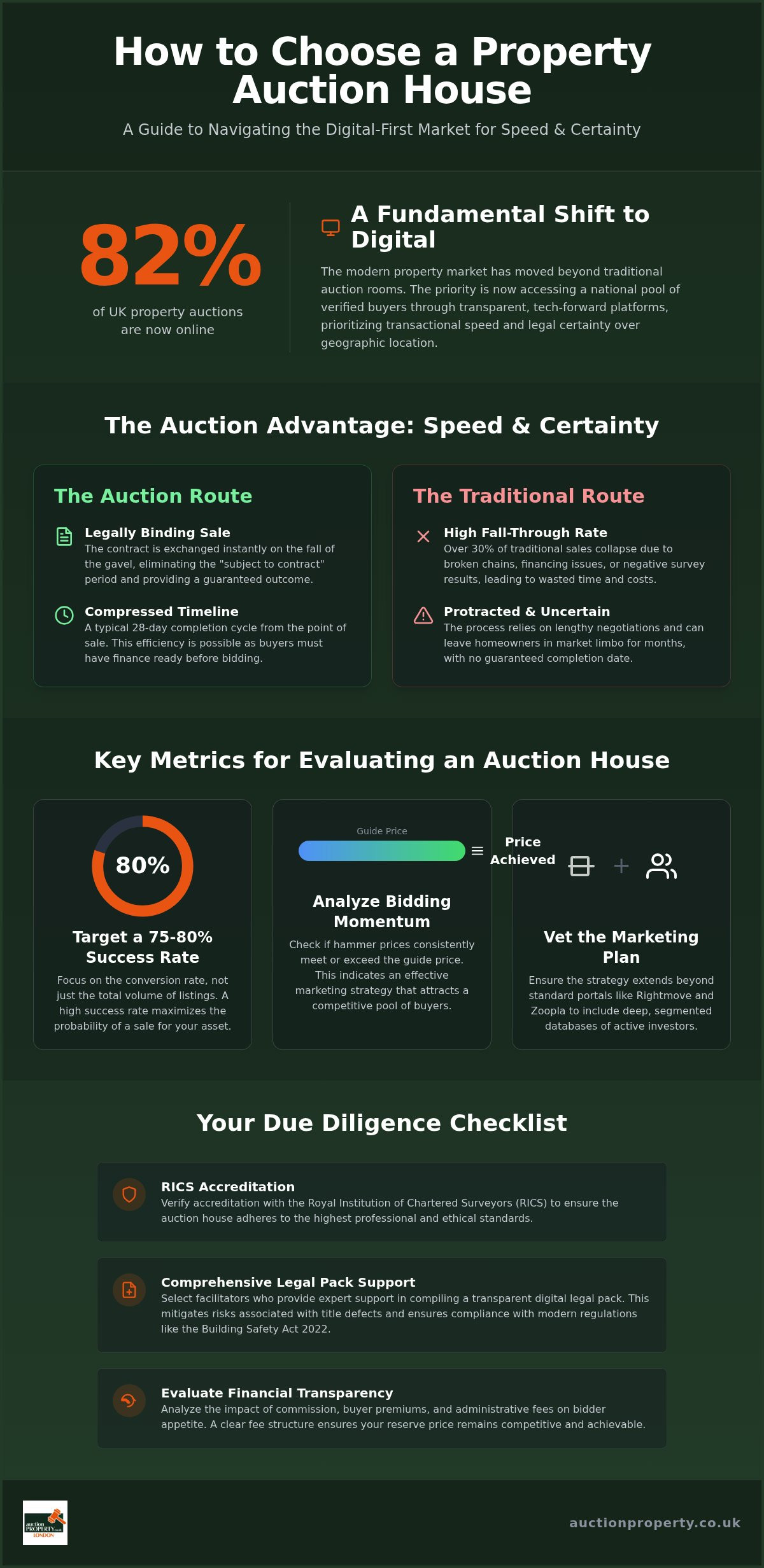
82% of all UK property auction transactions are now facilitated through online bidding platforms, signaling a permanent move away from the traditional physical auction room. If you’re wondering how to choose a property auction house in this digital-first market, you’re likely prioritizing speed and certainty above all else. It’s natural to feel concerned about complex fee structures or the transparency of a legal pack. You want a result that’s final, not a deal that collapses at the last minute because of a hidden title defect or a nervous buyer.
This guide provides the framework to master the selection process for a secure and rapid transaction. You’ll learn how to identify platforms that guarantee a sale on the fall of the gavel and provide expert support with administrative hurdles. We will examine the impact of the Digital Markets, Competition and Consumers Act 2024 on disclosure and how to vet an auctioneer’s ability to handle modern requirements like the Building Safety Act 2022. It’s time to replace industry intimidation with a sense of clarity and professional momentum.
Key Takeaways
- Identify the shift toward national, online-first platforms that prioritize transactional speed and legal certainty over traditional geographic constraints.
- Target auction houses maintaining a 75-80% success rate to maximize the probability of a binding sale on the fall of the gavel.
- Master how to choose a property auction house by vetting for RICS accreditation and a robust marketing plan that reaches beyond standard portal listings.
- Evaluate the impact of buyer premiums and administrative fees on bidder appetite to ensure your reserve price remains competitive and achievable.
- Streamline the sales process by selecting facilitators who offer comprehensive legal pack support to mitigate risks associated with title defects and compliance.
Understanding the Role of a Property Auction House in 2026
A property auction house functions as a high-velocity transaction engine. Unlike traditional methods that rely on protracted negotiations, an auction house facilitates an immediate, legally binding exchange. By 2026, the landscape has fundamentally shifted. 82% of all UK property auction transactions now occur via online bidding platforms. This digital evolution means that understanding the auction process is no longer about attending a local ballroom; it’s about accessing a national pool of verified buyers through a transparent, tech-forward interface.
When researching how to choose a property auction house, you must prioritize speed and certainty. Traditional estate agent sales are notorious for high fall-through rates, which often exceed 30% due to broken chains or surveyor issues. In contrast, the auction model provides a guaranteed outcome. Once the hammer falls, the contract is exchanged instantly. This eliminates the “subject to contract” period where most traditional deals collapse. It’s a streamlined alternative for those who value efficiency over the slow, uncertain pace of the open market.
The Auction Advantage: Speed vs. Traditional Sales
The primary draw of the auction route is the compressed timeline. A traditional unconditional auction typically targets a 28-day completion cycle from the point of sale. This efficiency is possible because auctions remove the complexities of residential chains. Buyers must have their financing and due diligence ready before they bid. This structure ensures that the transaction moves with momentum, providing a level of administrative clarity that traditional private treaty sales cannot match. In the first quarter of 2026, data showed a 14% increase in private homeowners choosing auctions over traditional agents, largely to avoid market limbo. Understanding how to choose a property auction house involves evaluating their ability to maintain this momentum and hit these strict completion deadlines.
Certainty of Sale: Why the Gavel Matters
The fall of the gavel represents a point of no return. In the UK, the winning bid is a legally binding commitment. To protect your asset, the auction house uses a reserve price. This is the minimum figure you’re willing to accept. If bidding doesn’t reach this threshold, the property isn’t sold, ensuring you never undersell. This mechanism, combined with Mastering the Property Auction strategies, allows sellers to maintain control while benefiting from competitive bidding. Transparency is the foundation here. Auction houses now provide digital legal packs that disclose title details and compliance with the Building Safety Act 2022 upfront. While some auctions see success rates dip due to last-minute addendum changes, a professional house ensures all data is clear before the first bid is placed.
Key Metrics for Evaluating Auction House Performance
Evaluating raw data is the most reliable way to strip away industry marketing and find a partner that delivers. When learning how to choose a property auction house, you must look past the total volume of listings and focus on the conversion rate. High market share doesn’t always translate to a high probability of sale for your specific asset. A house listing 500 properties but selling only 50% presents a significantly higher risk than a specialist house selling 80% of its 50 lots. Momentum is built on successful outcomes, not just a crowded catalogue.
Analyze the ratio of ‘Price Achieved’ versus ‘Guide Price’ across recent auctions. This metric reveals an auctioneer’s ability to generate genuine bidding momentum. If the hammer prices consistently sit near the bottom of the guide range, the marketing strategy likely failed to attract a competitive pool of buyers. Effective auctioneers leverage major portals like Rightmove and Zoopla, but they also maintain deep, segmented internal databases of active investors ready to deploy capital. If you’re ready to see how these performance metrics apply to your specific asset, you can request a professional valuation to benchmark your expectations.
Success Rates vs. Market Share
Success rates in 2026 hover around 76.1% for traditional room formats and approximately 73.9% for online platforms. When vetting a provider, aim for those hitting the 75-80% mark. It’s essential to interpret “unsold lots” data with precision. Ask the auctioneer why specific properties failed to move. Often, it’s a result of unrealistic reserve prices or a lack of transparency in the legal pack. A transparent auction house will provide a clear track record of properties similar to yours, proving they have the specific buyer reach required to close the deal under the hammer.
Specialist Knowledge: Residential, Commercial, and Land
Different property types require distinct legal and marketing expertise. Land auctions involve complex planning considerations and title issues that differ fundamentally from residential flat sales. Similarly, Buying Commercial Property at Auction requires an auctioneer who understands VAT elections, occupational leases, and the Building Safety Act 2022. You need a facilitator capable of marketing “problem properties” such as those with short leases or structural defects. Their ability to explain these nuances to nervous bidders is often the difference between a failed lot and a successful exchange of contracts. Understanding how to choose a property auction house means matching your property’s unique profile to the auctioneer’s proven specialized experience.
Online vs. Traditional Ballroom Auctions: Which Platform Serves You Best?
By 2026, the choice between a physical room and a digital platform has become a strategic decision about reach and momentum. Traditional ballroom auctions rely on the “theatre” of the room to drive prices, but they impose logistical constraints on national buyers. If an investor in London wants to bid on a site in Manchester, a physical event requires travel or a complex proxy arrangement. Online auctions eliminate this geographic friction. When evaluating how to choose a property auction house, you must consider whether the platform prioritizes accessibility. Online models offer 24/7 visibility and real-time data transparency, ensuring that every potential bidder has the same information at the same time.
Security is another critical differentiator. Modern digital platforms handle Anti-Money Laundering (AML) checks and bidder registration with automated precision. This vetting process ensures that only serious, qualified buyers enter the bidding arena, protecting the integrity of the transaction. Seeing the bidding history online builds trust for both parties. It proves that the momentum is genuine and the price is market-driven, rather than relying on the opaque atmosphere of a crowded room. It’s about replacing the intimidation factor with a sense of clarity and professional opportunity.
The Rise of National Online Auctions
Digital platforms have democratized property investment across the UK. You’ll typically encounter two models: the “eBay-style” timed countdown or the live-streamed auctioneer. Both versions provide a wider national reach than any local ballroom could hope to achieve. This lack of geographic friction is particularly evident in auction house online uk transactions, where properties in high-demand hubs are sold to investors located hundreds of miles away. Maximizing the eyes on your lot is the fastest way to drive the highest possible hammer price.
Technology as a Transparency Tool
Technology serves as the ultimate facilitator for due diligence. Digital legal packs allow for faster review by solicitors, reducing the friction that often stops a bid before it starts. Automated bidding notifications keep the momentum high, alerting participants the moment they’ve been outbid. This creates a rhythmic sense of progress that mirrors the fast-paced flow of a live transaction. Once the hammer falls, digital systems handle the immediate deposit transfer, securing the deal instantly and moving you toward that 28-day completion target without administrative delays.
Financial Transparency: Navigating Commission, Premiums, and Admin Fees
Transparency is the antidote to transaction anxiety. When determining how to choose a property auction house, you must scrutinize the total cost of the transaction for both sides of the gavel. A low seller commission might look attractive on paper, but if the buyer’s premium is excessively high, it will suppress bidding appetite and lower the final hammer price. You need a partner that balances these figures to create a competitive environment where bidders feel confident deploying capital. Financial clarity ensures that the momentum generated during the auction isn’t lost to last-minute fee disputes.
Administrative fees are the engine room of the modern auction. These charges cover the online infrastructure, AML checks, and the legal processing required for a 28-day completion. While these costs are standard, their application varies. Some houses include marketing in their commission, while others require an upfront entry fee. Always check the “Special Conditions of Sale” in the legal pack. This section often contains hidden costs like search fee reimbursements or contributions toward the seller’s legal expenses. If you want to see a clear breakdown of how these structures apply to your asset, contact us for a transparent fee consultation.
The Seller’s Cost Breakdown
Marketing isn’t an expense; it’s an investment in the final sale price. Auction houses typically charge an upfront entry or catalogue fee to secure your lot’s position and fund national promotion. This ensures your property reaches a verified audience beyond standard portal listings. If you aim to Sell House Fast at Auction UK, these fees are what drive the necessary speed and visibility. Use this checklist to compare providers:
- Compare percentage-based commissions against fixed flat-fee models.
- Verify if the entry fee includes enhanced marketing on major portals.
- Check if the auctioneer offers in-house legal pack provision or requires external solicitors.
- Confirm if any fees are payable if the property fails to meet the reserve.
Buyer Fees and Premiums
The buyer’s premium is a strategic tool that can be used to reduce the seller’s direct costs. Some auctioneers offer a “zero-fee” model for sellers by shifting the commission to the purchaser. A Buyer’s Premium is a non-refundable percentage of the hammer price paid by the purchaser. Bidders factor this cost into their maximum bid, so it directly impacts the final price you receive. Additionally, purchasers are usually charged a fixed Buyer’s Administration Fee upon the exchange of contracts. This fee supports the digital security and real-time data transparency that modern investors demand. Understanding these dynamics is a critical part of how to choose a property auction house that maximizes your net return.
Due Diligence Checklist: Finalising Your Choice for a Guaranteed Outcome
The final stage of selecting a partner requires a rigorous vetting process. You’ve analyzed the fees and compared platforms; now you must verify the operational substance behind the marketing claims. When finalizing how to choose a property auction house, use this five step framework to ensure your asset is in capable hands. This checklist prioritizes accountability and proven performance over surface level promises.
- Step 1: Verify Professional Accreditation. Confirm the auction house holds RICS accreditation or membership in professional bodies like Propertymark. These affiliations mandate strict adherence to codes of conduct and financial transparency.
- Step 2: Scrutinize the Marketing Strategy. Demand a detailed plan that extends beyond a basic Rightmove listing. Ask how they target their internal database of active investors and what specific digital channels they use to drive national momentum.
- Step 3: Audit Digital Legal Packs. Quality and accessibility are vital. Evaluate their platform to ensure legal documents are easy for solicitors to download and review. A clunky interface creates friction that scares off serious bidders.
- Step 4: Interview the Consultancy Team. Assess their approach. You need a no-nonsense consultant who provides realistic valuations based on current 2026 market data rather than inflated figures designed just to win your instruction.
- Step 5: Calculate the Certainty Ratio. Move beyond general success rates. Compare the number of lots listed against those that successfully exchanged. This ratio is the ultimate measure of an auctioneer’s ability to close a deal.
Assessing Professional Credibility
Professional indemnity insurance and regulated status are non-negotiable requirements. These safeguards protect your interests during high stakes real estate transactions. Use independent review platforms to gauge performance specifically regarding speed and certainty. Look for feedback that mentions the efficiency of the completion process and the clarity of communication. A transparent Choosing the Right Auction House UK case study can provide valuable insight into how a facilitator handles complex titles or tight deadlines. Credibility is built on a track record of reliability, not just high volume.
The Final Selection: Speed, Tech, and Trust
Selecting the right facilitator is the difference between a failed lot and a guaranteed sale. Auction Property Ltd fits the modern requirement for national efficiency by combining a tech forward online platform with deep industry expertise. We remove the administrative hurdles and geographic friction that slow down traditional sales. If you’re ready to secure a binding contract on the fall of the gavel, it’s time to move from curiosity to action. How to choose a property auction house comes down to finding a partner that values your time as much as your result. Contact Auction Property Ltd for a professional auction appraisal and take the first step toward a secure, high speed transaction.
Secure Your Transactional Momentum in the 2026 Market
Success in today’s real estate environment requires moving beyond the slow, unpredictable methods of the past. You’ve learned that digital efficiency and national reach are now the primary drivers of high-value outcomes. By focusing on success rates, verified accreditations, and transparent fee structures, you can strip away the uncertainty that often plagues property sales. Mastering how to choose a property auction house allows you to leverage a platform built for speed and legal finality.
Auction Property Ltd provides the infrastructure needed for a guaranteed exchange. Our expert team delivers precise valuations and strategic marketing, ensuring your asset reaches a national audience of qualified bidders. We utilize a transparent online bidding platform to eliminate geographic friction and administrative delays for residential, commercial, and land lots. It’s time to replace market anxiety with the confidence of a binding result.
Secure a fast and certain sale with Auction Property Ltd
Take the next step toward a seamless transaction. With the right partner, you can move from listing to a successful exchange of contracts with total clarity and professional support.
Frequently Asked Questions
How do I know if an auction house is reputable?
Verify that the provider holds RICS accreditation or is a member of Propertymark. These professional bodies mandate strict financial transparency and adherence to a regulated code of conduct. You should also evaluate their “Certainty Ratio,” which measures the number of lots listed against those that successfully exchange contracts, to gauge their actual market performance.
What is the difference between a guide price and a reserve price?
The guide price is a marketing figure used to attract bidders, while the reserve price is the confidential minimum amount you are willing to accept. Under UK law, the reserve price cannot exceed the guide price or the top end of a guide range. This structure protects your asset while ensuring the bidding process remains competitive and transparent.
Can I sell a property with a sitting tenant through an auction house?
Yes, properties with sitting tenants are highly sought after by investors looking for immediate rental yield. You must provide the tenancy agreement and a clear rent statement within the legal pack. This transparency allows buyers to calculate their return on investment accurately before the bidding begins, often leading to a faster exchange.
How much are typical auction house fees for sellers in 2026?
Sellers generally encounter two primary costs: an upfront entry fee and a percentage-based commission upon a successful sale. According to 2026 industry data, entry fees typically range from £300 to £1,500 to cover marketing and catalogue placement. Commissions generally fall between 1.5% and 3.5% of the final hammer price, depending on the property type and service level.
Do I need a solicitor before I choose an auction house?
It’s advisable to have a solicitor ready to act, though you can select your auctioneer first. Early legal instruction is vital because the legal pack must be completed before marketing begins. Understanding how to choose a property auction house involves finding a partner that can coordinate effectively with your solicitor to ensure all documents, including Building Safety Act compliance, are ready for the first bidder.
What happens if my property doesn’t sell at the auction?
If the reserve price isn’t met, the auctioneer will often negotiate with the highest bidder immediately after the lot ends to see if a deal can be reached. Many platforms also offer a “post-auction” listing service. If a sale isn’t secured, you can re-evaluate your reserve price and re-list the property for the next auction cycle to maintain your transactional momentum.
Are online property auctions as secure as traditional ones?
Online platforms are often more secure because they utilize automated Anti-Money Laundering (AML) checks and digital bidder registration. Every participant must be verified and provide a deposit or payment card details before they can bid. This rigorous vetting process ensures that only serious, qualified buyers can participate, which significantly reduces the risk of a deal collapsing after the hammer falls.
How long does the whole auction process take from start to finish?
The entire timeline from initial valuation to completion usually spans 6 to 10 weeks. This includes a 3 to 4-week intensive marketing period followed by the auction itself. Once the contract is exchanged at the end of the bidding, the standard completion period is 28 days, making it the most efficient method for those who need a rapid and certain outcome.