

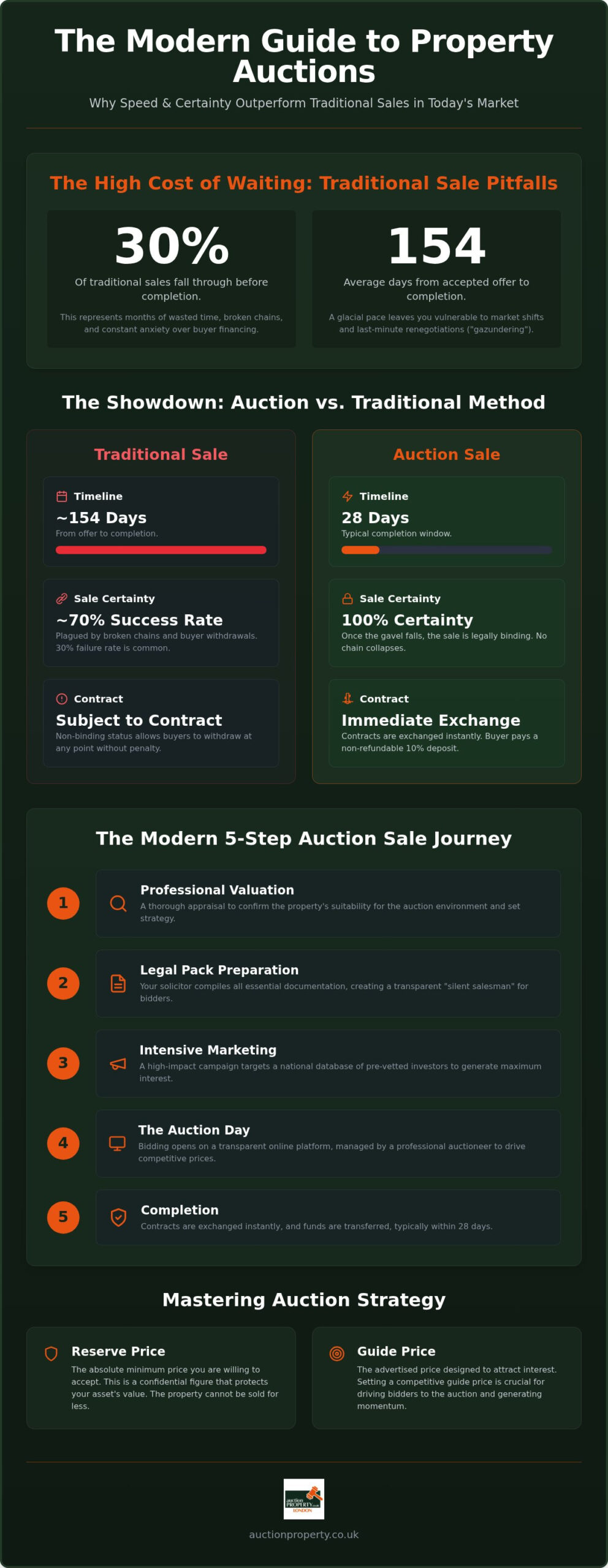
Approximately 30% of traditional property sales fall through before they ever reach completion. For most sellers, this represents months of wasted time, broken chains, and the constant anxiety of buyer finance falling apart at the eleventh hour. You likely already know that the traditional market moves at a glacial pace, often leaving you at the mercy of vague estate agent valuations and administrative friction.
This guide proves that an auction property sale is no longer a niche option for distressed assets; it’s a high-performance financial tool designed for speed and absolute certainty. We’ll show you how to secure a legally binding contract on the day of the auction, moving from listing to completion in as little as 28 days. We will break down the 2026 market landscape, including the impact of the Renters Rights Act and the shift toward transparent online bidding, giving you a clear roadmap to maximize your ROI without the typical market delays.
Key Takeaways
- Understand why an auction property sale creates an immediate legally binding contract at the fall of the hammer, eliminating the risk of chain collapses.
- Learn how modern online platforms have digitized the bidding process to provide real-time transparency and accelerated transaction speeds.
- Discover how to navigate seller commissions and buyer premiums to protect your return on investment and potentially offset transaction costs.
- Master the strategic balance between a competitive guide price to drive interest and a secure reserve price to protect your asset’s value.
- Leverage national investor reach and professional legal administrative support to streamline your transition from valuation to final sale.
The Reality of an Auction Property Sale: Speed vs. Traditional Methods
An auction property sale is a decisive exit strategy. Unlike the open market, where “sold” often means “maybe,” an auction produces a legally binding result the moment the gavel falls. In the current 2026 market, the average traditional sale takes approximately 154 days from an accepted offer to completion. By contrast, a traditional auction targets a completion window of just 20 to 28 working days. This massive reduction in lead time isn’t just a convenience; it’s a strategic advantage for those who value liquidity and momentum.
Certainty of sale has become the primary driver for modern UK sellers. Traditional methods are plagued by “chains,” where your sale depends on a stranger’s ability to sell their own home. When one link breaks, the entire structure collapses. Auctions bypass this entirely. Bidders are pre-vetted, and their financial readiness is a prerequisite for participation. This eliminates the uncertainty that causes roughly 30% of private treaty sales to fall through before they ever reach the finish line.
The Problem with Traditional Estate Agents
Traditional agents operate under the “Subject to Contract” framework. This status is a trap for sellers because it allows buyers to withdraw at any point without financial penalty, often after months of waiting. Buyers frequently use sold prices rightmove data to justify aggressive low-ball offers or attempt “gazundering” just before exchange. This process leads to viewing fatigue, where you endure endless walkthroughs with no guarantee of a result. It’s an inefficient, high-friction model that doesn’t respect your schedule or your financial goals.
How Auctions Provide Immediate Legal Certainty
The digital shift in 2026 has made the auction process even more transparent and accessible. When the virtual gavel falls, the exchange of contracts is immediate and final. There’s no room for renegotiation or second-guessing. The buyer must pay a non-refundable deposit, typically 10% of the purchase price or a minimum of £6,000, on the day of the sale. This significant financial commitment ensures that only serious, funded individuals participate in the process. Exchange on the Gavel is the ultimate risk-mitigation tool because it transforms a verbal agreement into a legally enforceable transaction instantly.
How the Modern Property Auction Sale Works in 2026
Modern property transactions have moved beyond the crowded, physical auction rooms of the past. In 2026, the digital-first auction property sale is the standard. This shift toward online platforms has transformed accessibility, allowing a wider pool of national investors to bid in real-time from any location. Digital bidding removes geographic barriers, ensuring your property is seen by the UK’s most active capital holders rather than just local buyers. This high-tech infrastructure provides total transparency; every bid is logged and visible, which builds trust and encourages aggressive, competitive participation.
While the technology handles the data, the professional auctioneer remains the engine of competitive tension. They manage the digital flow, identifying momentum and knowing exactly when to push for the next increment. This human expertise, combined with a 28-day completion cycle, creates a sense of urgency that the traditional market cannot replicate. Speed is the currency of 2026, and the streamlined digital process ensures that no time is wasted on manual paperwork or unnecessary delays.
The 5-Step Auction Sale Journey
Selling at auction is a structured, sequential process designed for maximum efficiency. It follows these five critical stages:
- Step 1: Professional Valuation. We conduct a thorough appraisal to confirm the property is suitable for the auction environment.
- Step 2: Legal Pack Preparation. Your solicitor compiles the essential documentation required for bidders to conduct due diligence.
- Step 3: Intensive Marketing. A high-impact campaign targets our national database of investors to generate pre-auction interest.
- Step 4: The Auction Day. Bidding opens on our transparent platform, where we manage the process to reach or exceed your reserve price.
- Step 5: Completion. Contracts are exchanged instantly at the gavel fall, with funds transferred typically within 28 days.
To ensure your asset is ready for this fast-paced environment, you can request a professional valuation to determine its market potential.
The Legal Pack: Your Silent Salesman
The legal pack is the most influential document in an auction property sale. It contains title deeds, local authority searches, office copy entries, and special conditions of sale. In 2026, savvy buyers expect these packs to be comprehensive and available digitally well before the auction date. A complete pack reduces buyer hesitation and eliminates the “fear of the unknown” that often suppresses bids. If a buyer can verify the legal standing of a property instantly, they are far more likely to bid with confidence. For a deeper look at what makes a legal pack effective, consult our comprehensive property auction guide to due diligence.
Analysing Auction Sale Costs: Commission, Premiums, and ROI
An auction property sale operates on a performance-based financial model that differs significantly from the passive approach of traditional estate agencies. While a high street agent might charge a lower percentage, they often lack the incentive to drive the price upward once a “Subject to Contract” offer is on the table. In the auction environment, you are paying for a compressed, high-intensity results engine. This structure ensures that every pound spent on fees is an investment in the speed and finality of the transaction.
The total cost of an auction sale typically includes a seller’s commission and an entry or catalogue fee. These entry fees are not just administrative; they fund the aggressive marketing blitz required to saturate the market in a very short window. Auction fees cover the high-intensity marketing required for a 3-week window. Additionally, many modern auction frameworks utilize a Buyer’s Premium. In this scenario, the buyer pays a significant portion of the transaction costs, which can effectively offset the seller’s expenses and preserve more of the final hammer price as pure profit.
Commission vs. Performance
A percentage-based commission aligns the auctioneer’s goals directly with your own. Unlike traditional agents who may push for a quick, low-value sale to hit monthly targets, an auctioneer thrives on competitive tension. The transparent bidding platform encourages buyers to outbid one another, often pushing the final price beyond what a private treaty sale might achieve. You aren’t just paying for a listing on a portal; you’re paying for a professional closer who manages the digital momentum to maximize your return. This service includes the vetting of bidders and the immediate collection of non-refundable deposits, providing a level of security that a standard agency fee simply cannot buy.
The ROI of a Fast Completion
When calculating the true cost of a sale, most sellers overlook the “Holding Cost” of a property. If a traditional sale takes the 2026 average of 154 days, you’re responsible for five months of mortgage interest, council tax, insurance, and utility bills. For many landlords exiting the market due to the Renters Rights Act, these monthly overheads quickly erode any perceived savings from “cheaper” traditional commissions.
- Council Tax: Saving four months of payments on an empty property can represent thousands of pounds in retained capital.
- Insurance Premiums: Unoccupied property insurance is notoriously expensive; shortening the sale window minimizes this risk.
- Capital Opportunity: Liquidating an asset in 28 days allows you to reinvest that capital into higher-yielding 2026 opportunities immediately.
The certainty of a fixed price at the gavel fall is almost always more valuable than a theoretical higher price that carries a 30% risk of falling through. By removing the months of administrative friction and “viewing fatigue,” the auction model delivers a superior net ROI when all holding costs and risks are factored into the final balance sheet.
Maximising Value: Preparing Your Property and Reserve Price
Achieving a successful auction property sale requires more than just listing an asset; it requires a calculated pricing strategy that balances attraction with protection. In the 2026 market, professional investors scan hundreds of lots weekly. To stand out, your property must present a clear value proposition from the first click. This involves a dual approach: setting a price that triggers competitive bidding and ensuring the physical and legal presentation of the property removes any reason for a buyer to hesitate.
Preparation should focus on “clean” titles and structural transparency. If there are known issues, such as short leases or minor structural defects, address them in the legal pack rather than hiding them. Transparency builds buyer confidence. Investors are often willing to overlook a “red flag” if it’s priced correctly and documented fully, but they’ll walk away instantly if they discover an undisclosed problem during their own due diligence. Focus on highlighting the “value-add” potential—whether that’s planning permission for an extension or a high rental yield—to attract the most aggressive bidders.
Guide Price vs. Reserve Price
Understanding the distinction between these two figures is vital for your success. The Guide Price is your “invitation to bid.” It’s a public figure designed to generate maximum interest and momentum. In contrast, the Reserve Price is your confidential “minimum acceptable” figure. This is the safety net that ensures your property is never undersold. If bidding doesn’t reach this level, the property is withdrawn, and you aren’t obligated to sell.
Industry standards in 2026 typically follow the 10% rule: the Reserve Price cannot exceed 10% above a single-figure Guide Price. If you set a guide of £200,000, your reserve can’t be higher than £220,000. This transparency is crucial. It prevents the frustration of “bait pricing” and ensures that the bidders who show up are genuinely capable of meeting your expectations. To ensure your pricing is both competitive and secure, consult our valuation experts to set your strategic reserve.
Targeting the Right Buyer Profile
Your marketing strategy must align with the specific asset type. Residential “fixer-uppers” attract local developers and first-time buyers looking for a project, while larger assets require a different lens. For example, if you are looking to buy commercial property auction south east opportunities, you are likely competing with institutional investors who value yield and lease length over aesthetics.
High-quality photography and accurate floorplans remain non-negotiable, even for properties in poor condition. Bidders need to visualize the footprint and potential of the site to calculate their maximum bid. By providing clear, professional data, you allow buyers to complete their financial modeling quickly, leading to higher bids and a faster path to the gavel fall.
Executing Your Sale with Auction Property Ltd
Choosing the right partner for your auction property sale is the difference between a listing that lingers and a transaction that closes. At Auction Property Ltd, we provide the national infrastructure required to ensure your asset reaches the UK’s most active capital holders. Our platform isn’t just a website; it’s a high-performance results engine that combines cutting-edge 2026 digital bidding technology with a seasoned team of property consultants. We focus on stripping away the administrative friction that traditionally slows down sales, replacing it with a streamlined, transparent path to completion.
Our expert team provides more than just a platform. We offer comprehensive support, from professional valuations to legal administrative assistance. This ensure that your legal pack is robust and your reserve price is strategically positioned. In a market where the overall auction success rate reached 72.2% in early 2026, our focus on transparency and pre-vetted buyer data ensures you are positioned in the top tier of successful transactions. We don’t believe in hidden catches or vague timelines. We believe in the finality of the gavel and the security of a non-refundable deposit.
A National Platform for Every Property Type
Our reach extends across every sector of the UK market. Whether you are selling a residential portfolio, a commercial unit, or searching for land for sale near me to bring to market, our platform handles it with equal precision. Our 2026 online infrastructure supports secure, multi-device bidding, allowing investors to participate from anywhere in the world. This accessibility is vital for driving the competitive tension needed to exceed your reserve price. Our track record is built on delivering speed and certainty, moving sellers from instruction to completion within the standard 28-day window.
Your Next Steps to a Guaranteed Sale
Getting started is a straightforward, sequential process designed to respect your time. Follow these steps to secure your exit:
- Request an Appraisal: Start with a free, no-obligation auction valuation to determine your property’s suitability and potential ROI.
- Formal Instruction: Once you decide to proceed, we formally list your property for our next scheduled auction and begin legal pack preparation.
- High-Velocity Marketing: We execute an intensive campaign across our national database to ensure maximum visibility.
- The Auction Event: Watch the bidding in real-time on our transparent platform.
- The Gavel: Experience the finality of a successful auction house uk sale, where the contract is exchanged instantly.
Stop waiting for the traditional market to catch up. Take control of your timeline and secure your capital. Contact Auction Property Ltd today to book your free appraisal and move your auction property sale from curiosity to a guaranteed outcome.
Secure Your Capital with 2026 Property Bidding Strategies
The traditional property market’s unpredictability is a choice, not an inevitability. By choosing an auction property sale, you replace the 154-day average wait and 30% fall-through risk with a legally binding exchange at the fall of the gavel. Strategic guide pricing drives competitive tension, while a 28-day completion cycle preserves your ROI by eliminating months of expensive holding costs and administrative friction.
Success in today’s landscape requires more than a digital listing; it demands a partner with a national investor database and a secure online bidding platform. Our team provides the expert legal administrative support necessary to ensure your transaction is seamless, transparent, and final. Don’t let your capital sit idle in a stagnant chain. Take the decisive step toward a guaranteed exit and leverage our expertise to maximize your asset’s value in the current market.
Request your free 2026 auction property valuation today and experience the efficiency of a modern, results-driven sale. Your certain outcome is just weeks away.
Frequently Asked Questions
How long does an auction property sale actually take from start to finish?
An auction property sale typically takes six to eight weeks from the initial instruction to the final transfer of funds. This window includes a high-intensity marketing period of three to four weeks followed by the standard 28-day completion cycle. This structured timeline is significantly more predictable than the open market’s 154-day average, providing a clear exit date for the seller.
What happens if my property does not reach the reserve price on auction day?
If the bidding doesn’t reach your confidential reserve price, the property is withdrawn from the auction as unsold. However, the process doesn’t necessarily end there. Our team often engages in immediate post-auction negotiations with the highest bidders to secure a sale under auction conditions before the day concludes. This ensures that even if the hammer doesn’t fall, a result is often still achieved.
Are auction sales only for “problem” properties or repossessions?
No, auctions aren’t restricted to distressed assets or repossessions. In 2026, sellers of high-quality residential homes, land, and commercial units use auctions to avoid the 30% fall-through rate seen in traditional sales. It’s a strategic choice for any asset where the owner values transaction security over a protracted negotiation process. High-value assets often thrive in this competitive environment.
Can I sell a property with a sitting tenant at auction?
Yes, selling a property with a sitting tenant is a common and effective strategy at auction. These lots are highly attractive to professional investors who want to receive rental income from the day of completion. You must include the tenancy agreement and rent statement in your legal pack to ensure bidders can verify the yield and the legal standing of the tenancy before they bid.
What are the main costs I need to budget for as a seller?
Sellers should budget for an entry or catalogue fee, a performance-based commission, and the cost of preparing a professional legal pack. While these upfront costs exist, they’re often offset by the elimination of several months of council tax, mortgage interest, and insurance premiums. When you factor in the auction property sale speed, the net return is often higher than a traditional sale.
Is the highest bid legally binding as soon as the auction ends?
The highest bid is legally binding the moment the virtual gavel falls, provided the reserve price has been met. This creates an immediate exchange of contracts. The buyer is then contractually obligated to pay a non-refundable deposit and complete the transaction within the specified timeframe. There’s no room for the buyer to withdraw or renegotiate after this point.
Do I need a special type of solicitor for an auction sale?
It’s essential to instruct a solicitor who specializes in auction transactions. They must be capable of producing a comprehensive legal pack within a tight timeframe and understand the nuances of unconditional contracts. A standard conveyancer may not have the resources to meet the rapid administrative demands of the auction environment, which could delay your listing.
How do online property auctions differ from traditional ballroom auctions?
Online property auctions offer greater accessibility and transparency than traditional ballroom events. Bidders participate via secure digital platforms from any location, removing the need for physical travel. This format often attracts a larger, national pool of investors, increasing competitive tension. Real-time digital logging ensures every bid is visible, creating a fair and open environment for all participants.