

Skip to content
Auction Property London white orange and green logo
  • Properties
  • Sold Properties
  • Auctions
    • Auction Dates
    • Past Auction Dates
  • Join Our Mailing List
  • Latest News
  • Useful Information
    • Buying and Selling at Auction
    • Bidders Information
    • Privacy Policy
    • Frequently Asked Questions
    • Cookie Policy
    • Complaints Procedure
  • Partners
  • About Us
  • Contact
  • Login/Register
  • Properties
  • Sold Properties
  • Auctions
    • Auction Dates
    • Past Auction Dates
  • Join Our Mailing List
  • Latest News
  • Useful Information
    • Buying and Selling at Auction
    • Bidders Information
    • Privacy Policy
    • Frequently Asked Questions
    • Cookie Policy
    • Complaints Procedure
  • Partners
  • About Us
  • Contact
  • Login/Register
Book Your Free Valuation
< Back to Latest News

Migrating from IAM Sold to a Traditional Auction: The 2026 Seller’s Guide

The “Modern Method” of auction often promises speed, yet waiting 56 days for a completion that might never happen isn’t the definition of efficiency. You likely chose a conditional model to minimize upfront costs, but you’re now facing the reality of high reservation fees deterring serious cash buyers and the constant risk of a sale falling through during the long reservation window. If you’re ready to trade “maybe” for a legal guarantee, migrating from IAM Sold to a traditional auction is the strategic move you need to make in 2026.

We understand the frustration of seeing your transaction stall while a buyer struggles with mortgage approvals or simply changes their mind. This guide provides a clear roadmap for transitioning to an unconditional sale, where the fall of the gavel results in an immediate exchange of contracts. You’ll discover how to bypass the 56-day completion cycle, adopt a transparent fee structure, and gain access to a professional investor pool ready to close in just 28 days. It is time to replace administrative hurdles with the momentum of a guaranteed outcome.

Key Takeaways

  • Transition from a 56-day completion target to an immediate, legally binding contract exchange at the fall of the gavel.
  • Master the process of migrating from IAM Sold to a traditional auction by identifying notice periods and withdrawal clauses in your current agreement.
  • Compare the technical differences between a conditional Reservation Agreement and the “gold standard” unconditional contract exchange.
  • Access a focused pool of cash-ready investors by removing the barrier of high buyer reservation fees that often deter serious bidders.
  • Learn how to instruct your solicitor to update your legal pack for an unconditional sale to ensure maximum speed and transaction certainty.

Table of Contents

  • Understanding the Shift: Why Migrate from IAM Sold to a Traditional Auction?
  • MMoA vs. Traditional Auctions: A Technical Comparison
  • Evaluating the Risks and Rewards of Switching Auction Methods
  • The Step-by-Step Migration Process: Moving Your Property Listing
  • Securing Your Sale with Auction Property Ltd: The Professional Alternative

Understanding the Shift: Why Migrate from IAM Sold to a Traditional Auction?

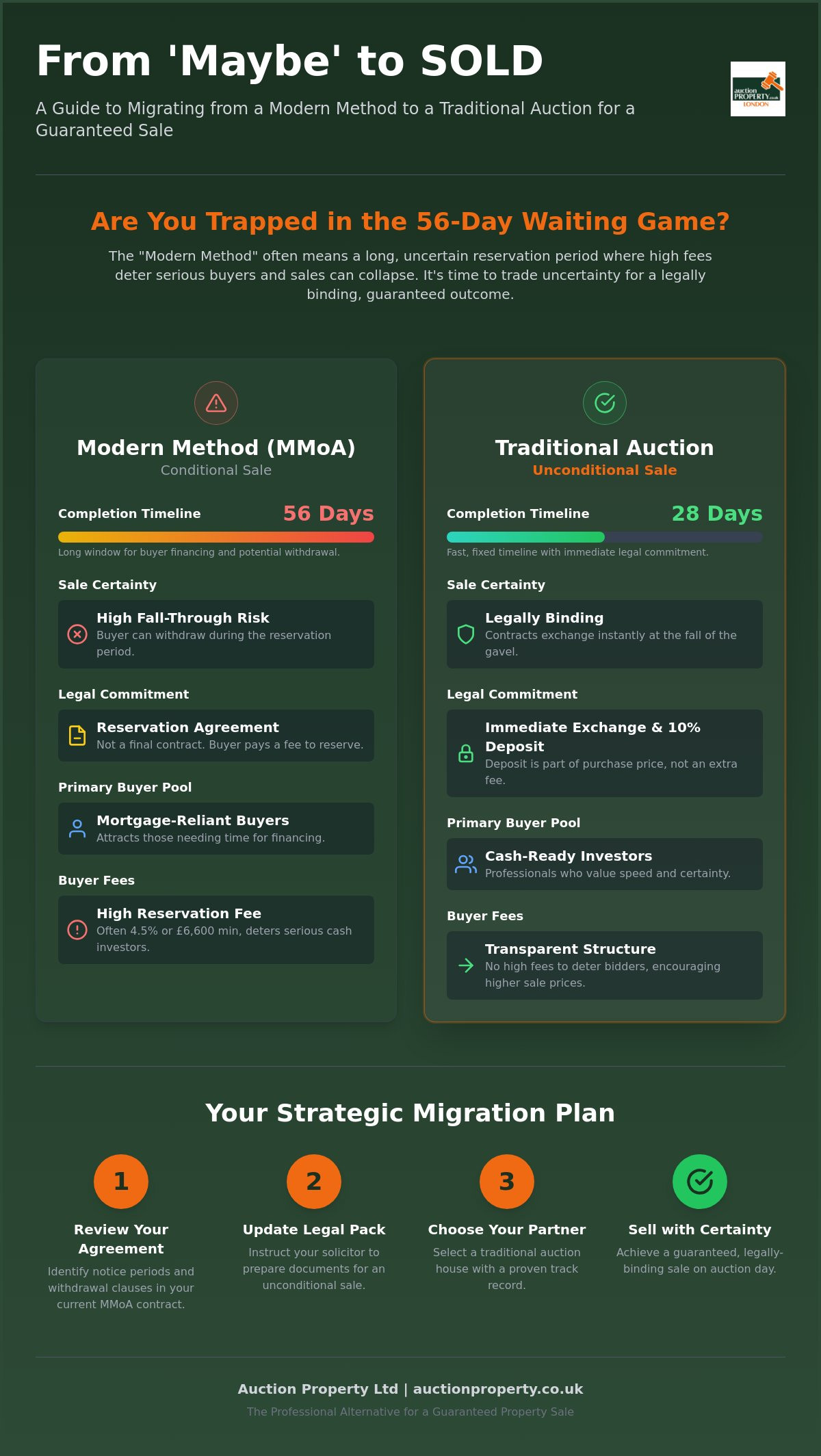
Migrating from IAM Sold to a traditional auction represents a strategic pivot from a conditional “modern” model to a binding, unconditional framework. While IAM Sold’s Modern Method of Auction (MMoA) is often marketed as a middle ground between private treaty and auctions, it lacks the immediate finality that serious sellers require. The core motivation for this shift is simple: you’re moving from a 56-day completion target to a 28-day binding contract. This difference is not just about time; it’s about the legal weight of the buyer’s commitment at the point of sale.

In the MMoA model, the “commitment gap” is a significant risk. A buyer pays a reservation fee, but they haven’t legally exchanged contracts on the property itself. This creates a window where buyers can still withdraw, often due to mortgage complications or a change of heart, leaving the seller back at square one. The traditional auction process eliminates this uncertainty. When the gavel falls, the deal is done. There’s no post-auction renegotiation phase, no gazundering, and no administrative delays. For sellers who have experienced the frustration of a buyer pulling out during a reservation period, the traditional route offers a necessary layer of security.

The Limitations of the Modern Method of Auction (MMoA)

MMoA is inherently conditional. It grants the buyer a reservation period, typically 56 days, to secure financing and complete the legal work. This cooling-off period is a double-edged sword. While it attracts buyers who need mortgages, it also introduces the same fall-through risks found in the open market. Additionally, the reservation fees in this model are substantial. Buyers often pay a non-refundable fee of 4.5% or a minimum of £6,600. This high entry cost can inflate the perceived price, often deterring professional cash investors who prefer a cleaner, more transparent transaction. For sellers with urgent financial requirements, a 56-day wait is often 28 days too long.

The Traditional Auction Advantage

The primary benefit of an unconditional auction is legal finality. The moment the auctioneer accepts the highest bid, a legal exchange of contracts occurs. The buyer must pay a 10% deposit immediately and complete the transaction, usually within 28 days. This model appeals directly to cash investors and professional buyers who value speed and transparency over the flexibility of a reservation period. If your goal is to sell house fast at auction uk, the traditional method is the gold standard. It leverages immediate buyer commitment to ensure that once a property is “sold,” it stays sold. Migrating from IAM Sold to a traditional auction puts you back in control of your timeline.

MMoA vs. Traditional Auctions: A Technical Comparison

The technical divide between these two models lies in the point of legal commitment. In a conditional MMoA setup, the winner pays a reservation fee to take the property off the market. They haven’t bought it yet; they’ve simply bought the exclusive right to try and complete the purchase over the next 56 days. By migrating from IAM Sold to a traditional auction, you bypass this period of uncertainty. The traditional model operates on an unconditional basis, meaning the fall of the hammer is the exact moment of contract exchange. This shift fundamentally changes the buyer profile from mortgage-reliant individuals to cash-ready professional investors.

Fee structures also differ. MMoA often presents a “zero-fee” lure for sellers by charging the buyer a heavy reservation fee, typically 4.5% or a minimum of £6,600. Savvy investors know this fee is effectively deducted from their maximum bid, which can lower your final hammer price. In a traditional setup, fees are transparently outlined. While the seller usually pays a commission, the lack of a massive buyer’s reservation fee often encourages more competitive bidding from professionals. When migrating from IAM Sold to a traditional auction, you must ensure your legal pack is fully prepared for an immediate exchange to satisfy these high-intent bidders.

Contractual Certainty and Deposit Structures

In a traditional auction, the buyer must pay a 10% deposit the moment the bid is accepted. This deposit isn’t just a fee; it’s a part of the purchase price that the seller’s solicitor holds as security. This requirement is anchored in the long-standing principles of the UK Sale of Land by Auction Act, which ensures that bids are binding. Contrast this with the MMoA reservation fee, which doesn’t trigger a contract exchange. A successful property auction should ideally end in a locked transaction, and the 10% deposit serves as a powerful deterrent against buyer default.

Speed of Execution and Financial Timelines

The completion window is the most visible difference. MMoA allows 56 days, catering to buyers who need time for surveys or mortgage valuations. Traditional auctions compress this to 28 days. This speed is possible because the legal pack is completed upfront. Bidders are expected to have performed their due diligence before the auction starts. This creates a legally enforceable completion date, providing you with financial clarity that conditional models cannot match. If you want to see if your asset fits this high-speed model, you can discuss your property’s suitability with our team today.

Evaluating the Risks and Rewards of Switching Auction Methods

Deciding on the right disposal method requires a cold analysis of your priorities. Migrating from IAM Sold to a traditional auction involves a trade-off between the size of the buyer pool and the absolute certainty of the result. While the conditional model casts a wider net by including mortgage-reliant buyers, it often attracts less committed parties. By switching to an unconditional framework, you signal to the market that your asset is ready for immediate transfer. This “unconditional” label acts as a quality filter, attracting professional investors who value speed over the ability to procrastinate.

The most significant reward is the elimination of price chipping. In private treaties and conditional auctions, buyers often use the survey period to renegotiate the price, a practice known as gazundering. Traditional auctions remove this leverage. The price agreed at the gavel is the price paid at completion. This allows you to plan your next investment or financial move with total confidence, knowing the transaction is legally locked. You’re no longer at the mercy of a buyer’s changing circumstances during a 56-day reservation window.

Impact on Buyer Psychology and Bidding Intensity

Buyer behavior changes when the heavy reservation fee is removed from the equation. In the MMoA model, buyers must account for a minimum reservation fee of £6,600 or 4.5% of the purchase price. This figure is effectively lost capital that doesn’t go toward the property itself, which often leads bidders to lower their maximum hammer price to compensate. Traditional auctions create a different dynamic. The transparency of the bidding process, combined with the fear of missing out in a live environment, can drive higher intensity. Professional investors prioritize these lots because they know exactly what they’re paying for without hidden administrative surcharges.

Cost Implications for the Seller

You must weigh the shift in fee responsibility. While MMoA often markets a “zero-fee” option for sellers, this is a marketing tactic that shifts the cost to the buyer and potentially lowers your final sale price. Traditional auctions typically involve a seller’s commission, but this cost buys you a guaranteed exit. You’re paying for the removal of the 30% fall-through rate commonly seen in traditional sales. The Certainty Premium is the quantifiable value a seller realizes by securing a legally binding contract and a guaranteed 28-day completion window.
Migrating from IAM Sold to a Traditional Auction: The 2026 Seller’s Guide

The Step-by-Step Migration Process: Moving Your Property Listing

Executing a successful transition requires a structured exit from your current arrangement. Start by reviewing your existing MMoA agreement for specific withdrawal clauses or notice periods. Some contracts may require a formal notice period before you can list elsewhere. Once you’re legally clear to move, migrating from IAM Sold to a traditional auction begins with a formal instruction to your solicitor. You must pivot the legal pack from “conditional” to “unconditional” status to satisfy the requirements of an immediate contract exchange.

Setting a realistic reserve price is the next critical step. Traditional auction dynamics rely on competitive bidding starting at a transparent, attractive entry point. Unlike the modern method, where a buyer might bid higher because they have 56 days to secure a mortgage, unconditional bidders need a clear financial incentive to lock in their capital the moment the gavel falls. Selecting a professional auction house uk that specializes in these high-speed transactions ensures your property is positioned correctly from day one.

Legal Pack Adjustments and Requirements

In a traditional sale, the legal pack is the bedrock of the transaction. You must include the “Special Conditions of Sale,” which dictate the 10% deposit and the strict 28-day completion window. Ensure all local authority and environmental searches are up-to-date and comprehensive. Professional investors won’t commit to an immediate exchange if the documentation is incomplete. Your solicitor must confirm that the property is “ready to exchange” to prevent any hesitation from the bidder’s side during the live auction.

Marketing Strategy for a Traditional Turnaround

Your marketing collateral needs a complete overhaul to reflect the shift in methodology. Signal the change to existing interested parties by highlighting the new 28-day completion requirement. This change in status acts as a signal to the market that you’re seeking a serious, cash-ready exit. Target investor-heavy platforms and databases that prioritize unconditional lots. Use language that emphasizes urgency and finality; this attracts professional buyers who monitor listings specifically for certain outcomes. Migrating from IAM Sold to a traditional auction is about moving from a “hopeful” marketing stance to an “authoritative” one.

Ready to secure a guaranteed 28-day exit? Instruct Auction Property Ltd to manage your unconditional sale and eliminate the risk of buyer withdrawal.

Securing Your Sale with Auction Property Ltd: The Professional Alternative

Choosing the right partner is the final, most critical step in your transition. Migrating from IAM Sold to a traditional auction is a strategic pivot that demands a specialist team. It’s about moving away from a model where your sale is a “maybe” and toward a framework where the result is a “must.” At Auction Property Ltd, we don’t treat auctions as a secondary service or a bolt-on to an estate agency branch. We are a dedicated auction house built for speed, transparency, and the absolute finality of the unconditional sale.

Our team handles the administrative heavy lifting of the migration process. We work directly with your solicitors to ensure your legal pack meets the rigorous standards required for an immediate contract exchange. Whether you’re disposing of a residential portfolio or a complex commercial site, our focus remains on providing expert support from the initial valuation through to the fall of the gavel. We strip away the administrative friction that often plagues conditional models, replacing it with a streamlined path to a guaranteed exit.

Why Our Unconditional Model Wins in 2026

In the fluctuating property landscape of 2026, speed is your greatest protection against market volatility. Our unconditional model ensures that once the price is agreed, your equity is protected from the “price chipping” common in slower, conditional transaction methods. While our roots are firmly planted in the London investment scene, our national execution capability allows us to secure results for sellers across the UK. We prioritize secure, high-speed transactions that respect your timeline and your capital, ensuring that “sold” means exactly that.

Start Your Migration Today

The path to a 28-day completion starts with a professional valuation. Our onboarding process is designed for maximum momentum. From the moment you provide instruction, we coordinate with your legal team to audit your existing documentation and identify gaps that could delay an unconditional exchange. We don’t just wait for the auction date; we actively market your lot to a curated pool of professional buyers who understand the value of an immediate, binding contract.

Don’t let your property sit in a state of conditional limbo where buyers can withdraw at the last minute. Migrating from IAM Sold to a traditional auction puts you back in the driver’s seat of your financial future. We move your property from instruction to the auction catalogue in record time, targeting cash-ready investors who are prepared to perform. Secure your sale with the certainty only a traditional auction provides and take the first step toward a guaranteed outcome today.

Secure Your 28-Day Exit Strategy Today

Transitioning from a conditional “modern” model to a traditional unconditional auction is the most effective way to eliminate the risk of buyer withdrawal. You’ve seen how the 28-day completion window provides a level of financial certainty that the Modern Method simply cannot match. By migrating from IAM Sold to a traditional auction, you move from a tentative reservation period to a legally binding contract exchange the moment the gavel falls. This shift ensures you access a dedicated pool of cash-ready investors who are prepared to perform without the delays of mortgage valuations or surveys.

Auction Property Ltd provides the authoritative support needed for both residential and commercial sellers to navigate this transition. We include professional legal administrative assistance to ensure your legal pack is auction-ready; our specialists in rapid national property transactions are committed to protecting your equity. Don’t let your asset linger in a state of uncertainty when a guaranteed outcome is within reach. Take control of your timeline and migrate your listing to a traditional auction with Auction Property Ltd today. It’s time to trade the “maybe” of conditional sales for the momentum of a successful, locked transaction.

Frequently Asked Questions

Can I switch to a traditional auction if my property is already listed with IAM Sold?

Yes, you can switch providers, but you must first verify the terms of your existing contract. Check for specific notice periods or withdrawal fees that might apply if you terminate the agreement early. Once you’ve fulfilled these legal obligations, you can begin the process of migrating from IAM Sold to a traditional auction. We recommend notifying your current provider in writing to ensure a clean break before re-listing your asset as an unconditional lot.

What is the main difference between MMoA and a traditional unconditional auction?

The primary difference is the point of legal commitment. In a Modern Method of Auction (MMoA), the buyer enters a reservation period that typically lasts 56 days before completion. In a traditional unconditional auction, the fall of the gavel triggers an immediate, legally binding exchange of contracts. This removes the “commitment gap” where a buyer could potentially withdraw, providing you with absolute transaction certainty from the moment the bid is accepted.

Will I have to pay two sets of fees if I migrate my auction listing?

You may incur a withdrawal fee from your original provider if you exit your contract before it expires. However, migrating from IAM Sold to a traditional auction often leads to more competitive bidding. Traditional models don’t burden the buyer with a heavy reservation fee, which frequently encourages professional investors to bid higher. You’ll move from a buyer-funded fee structure to a standard commission, but the increased hammer price often compensates for this shift.

Is a traditional auction only suitable for cash buyers and investors?

Yes, the traditional model is designed for cash-ready participants. Because completion is strictly required within 28 days, buyers must have their capital accessible. This naturally limits the pool to professional investors, corporate entities, and cash-rich individuals. While this excludes mortgage-reliant residential buyers, it significantly reduces the risk of the sale falling through. You’re trading a larger, less certain buyer pool for a smaller, highly committed one.

How long does it take to complete a sale after migrating to a traditional auction?

Completion is typically achieved within 28 days of the auction date. Unlike conditional models that allow for a lengthy 56-day window, the traditional route requires the buyer to pay a 10% deposit immediately. This financial commitment ensures the remaining balance is paid quickly. The entire process, from re-listing to final funds transfer, is significantly faster than the modern alternative, making it the ideal choice for sellers with urgent requirements.

What happens to the legal pack I already paid for with a modern auction provider?

Most of the documentation in your existing legal pack remains valid. Documents like title deeds, local authority searches, and environmental reports can be transferred to the new listing. However, your solicitor must draft new “Special Conditions of Sale.” These new conditions are vital as they convert the transaction from a conditional reservation to an unconditional contract exchange. This step is essential to ensure the legal framework supports an immediate, binding sale.

Can I set the same reserve price in a traditional auction as I did in MMoA?

You should re-evaluate your reserve price with a professional valuer. Traditional auction bidders are often more aggressive but also more price-sensitive regarding the “unconditional” risk they’re taking. While you might set a similar reserve, the absence of a buyer’s reservation fee means the hammer price often reflects the property’s true market value more accurately. Expert guidance ensures your reserve is high enough to protect your equity while remaining attractive to cash investors.

Is a traditional auction more expensive for the seller than the Modern Method?

Not necessarily. While the Modern Method often appears “free” for the seller because the buyer pays the fees, those costs are effectively deducted from the buyer’s maximum bid. In a traditional auction, you pay a commission, but you often achieve a higher hammer price because the buyer isn’t paying a heavy reservation fee on top. When you factor in the 30% fall-through rate of traditional sales, the certainty of an unconditional auction is often the more cost-effective choice.

  • 14th July 2026
  • Joe Joshi
Migrating from IAM Sold to a Traditional Auction: The 2026 Seller’s Guide

The “Modern Method” of auction often promises speed, yet waiting 56 days for a completion that might never happen isn’t the definition of efficiency. You likely chose a conditional model to minimize upfront costs, but you’re now facing the reality of high reservation fees deterring serious cash buyers and the constant risk of a sale falling through during the long reservation window. If you’re ready to trade “maybe” for a legal guarantee, migrating from IAM Sold to a traditional auction is the strategic move you need to make in 2026.

We understand the frustration of seeing your transaction stall while a buyer struggles with mortgage approvals or simply changes their mind. This guide provides a clear roadmap for transitioning to an unconditional sale, where the fall of the gavel results in an immediate exchange of contracts. You’ll discover how to bypass the 56-day completion cycle, adopt a transparent fee structure, and gain access to a professional investor pool ready to close in just 28 days. It is time to replace administrative hurdles with the momentum of a guaranteed outcome.

Key Takeaways

  • Transition from a 56-day completion target to an immediate, legally binding contract exchange at the fall of the gavel.
  • Master the process of migrating from IAM Sold to a traditional auction by identifying notice periods and withdrawal clauses in your current agreement.
  • Compare the technical differences between a conditional Reservation Agreement and the “gold standard” unconditional contract exchange.
  • Access a focused pool of cash-ready investors by removing the barrier of high buyer reservation fees that often deter serious bidders.
  • Learn how to instruct your solicitor to update your legal pack for an unconditional sale to ensure maximum speed and transaction certainty.

Table of Contents

  • Understanding the Shift: Why Migrate from IAM Sold to a Traditional Auction?
  • MMoA vs. Traditional Auctions: A Technical Comparison
  • Evaluating the Risks and Rewards of Switching Auction Methods
  • The Step-by-Step Migration Process: Moving Your Property Listing
  • Securing Your Sale with Auction Property Ltd: The Professional Alternative

Understanding the Shift: Why Migrate from IAM Sold to a Traditional Auction?

Migrating from IAM Sold to a traditional auction represents a strategic pivot from a conditional “modern” model to a binding, unconditional framework. While IAM Sold’s Modern Method of Auction (MMoA) is often marketed as a middle ground between private treaty and auctions, it lacks the immediate finality that serious sellers require. The core motivation for this shift is simple: you’re moving from a 56-day completion target to a 28-day binding contract. This difference is not just about time; it’s about the legal weight of the buyer’s commitment at the point of sale.

In the MMoA model, the “commitment gap” is a significant risk. A buyer pays a reservation fee, but they haven’t legally exchanged contracts on the property itself. This creates a window where buyers can still withdraw, often due to mortgage complications or a change of heart, leaving the seller back at square one. The traditional auction process eliminates this uncertainty. When the gavel falls, the deal is done. There’s no post-auction renegotiation phase, no gazundering, and no administrative delays. For sellers who have experienced the frustration of a buyer pulling out during a reservation period, the traditional route offers a necessary layer of security.

The Limitations of the Modern Method of Auction (MMoA)

MMoA is inherently conditional. It grants the buyer a reservation period, typically 56 days, to secure financing and complete the legal work. This cooling-off period is a double-edged sword. While it attracts buyers who need mortgages, it also introduces the same fall-through risks found in the open market. Additionally, the reservation fees in this model are substantial. Buyers often pay a non-refundable fee of 4.5% or a minimum of £6,600. This high entry cost can inflate the perceived price, often deterring professional cash investors who prefer a cleaner, more transparent transaction. For sellers with urgent financial requirements, a 56-day wait is often 28 days too long.

The Traditional Auction Advantage

The primary benefit of an unconditional auction is legal finality. The moment the auctioneer accepts the highest bid, a legal exchange of contracts occurs. The buyer must pay a 10% deposit immediately and complete the transaction, usually within 28 days. This model appeals directly to cash investors and professional buyers who value speed and transparency over the flexibility of a reservation period. If your goal is to sell house fast at auction uk, the traditional method is the gold standard. It leverages immediate buyer commitment to ensure that once a property is “sold,” it stays sold. Migrating from IAM Sold to a traditional auction puts you back in control of your timeline.

MMoA vs. Traditional Auctions: A Technical Comparison

The technical divide between these two models lies in the point of legal commitment. In a conditional MMoA setup, the winner pays a reservation fee to take the property off the market. They haven’t bought it yet; they’ve simply bought the exclusive right to try and complete the purchase over the next 56 days. By migrating from IAM Sold to a traditional auction, you bypass this period of uncertainty. The traditional model operates on an unconditional basis, meaning the fall of the hammer is the exact moment of contract exchange. This shift fundamentally changes the buyer profile from mortgage-reliant individuals to cash-ready professional investors.

Fee structures also differ. MMoA often presents a “zero-fee” lure for sellers by charging the buyer a heavy reservation fee, typically 4.5% or a minimum of £6,600. Savvy investors know this fee is effectively deducted from their maximum bid, which can lower your final hammer price. In a traditional setup, fees are transparently outlined. While the seller usually pays a commission, the lack of a massive buyer’s reservation fee often encourages more competitive bidding from professionals. When migrating from IAM Sold to a traditional auction, you must ensure your legal pack is fully prepared for an immediate exchange to satisfy these high-intent bidders.

Contractual Certainty and Deposit Structures

In a traditional auction, the buyer must pay a 10% deposit the moment the bid is accepted. This deposit isn’t just a fee; it’s a part of the purchase price that the seller’s solicitor holds as security. This requirement is anchored in the long-standing principles of the UK Sale of Land by Auction Act, which ensures that bids are binding. Contrast this with the MMoA reservation fee, which doesn’t trigger a contract exchange. A successful property auction should ideally end in a locked transaction, and the 10% deposit serves as a powerful deterrent against buyer default.

Speed of Execution and Financial Timelines

The completion window is the most visible difference. MMoA allows 56 days, catering to buyers who need time for surveys or mortgage valuations. Traditional auctions compress this to 28 days. This speed is possible because the legal pack is completed upfront. Bidders are expected to have performed their due diligence before the auction starts. This creates a legally enforceable completion date, providing you with financial clarity that conditional models cannot match. If you want to see if your asset fits this high-speed model, you can discuss your property’s suitability with our team today.

Evaluating the Risks and Rewards of Switching Auction Methods

Deciding on the right disposal method requires a cold analysis of your priorities. Migrating from IAM Sold to a traditional auction involves a trade-off between the size of the buyer pool and the absolute certainty of the result. While the conditional model casts a wider net by including mortgage-reliant buyers, it often attracts less committed parties. By switching to an unconditional framework, you signal to the market that your asset is ready for immediate transfer. This “unconditional” label acts as a quality filter, attracting professional investors who value speed over the ability to procrastinate.

The most significant reward is the elimination of price chipping. In private treaties and conditional auctions, buyers often use the survey period to renegotiate the price, a practice known as gazundering. Traditional auctions remove this leverage. The price agreed at the gavel is the price paid at completion. This allows you to plan your next investment or financial move with total confidence, knowing the transaction is legally locked. You’re no longer at the mercy of a buyer’s changing circumstances during a 56-day reservation window.

Impact on Buyer Psychology and Bidding Intensity

Buyer behavior changes when the heavy reservation fee is removed from the equation. In the MMoA model, buyers must account for a minimum reservation fee of £6,600 or 4.5% of the purchase price. This figure is effectively lost capital that doesn’t go toward the property itself, which often leads bidders to lower their maximum hammer price to compensate. Traditional auctions create a different dynamic. The transparency of the bidding process, combined with the fear of missing out in a live environment, can drive higher intensity. Professional investors prioritize these lots because they know exactly what they’re paying for without hidden administrative surcharges.

Cost Implications for the Seller

You must weigh the shift in fee responsibility. While MMoA often markets a “zero-fee” option for sellers, this is a marketing tactic that shifts the cost to the buyer and potentially lowers your final sale price. Traditional auctions typically involve a seller’s commission, but this cost buys you a guaranteed exit. You’re paying for the removal of the 30% fall-through rate commonly seen in traditional sales. The Certainty Premium is the quantifiable value a seller realizes by securing a legally binding contract and a guaranteed 28-day completion window.

Migrating from IAM Sold to a Traditional Auction: The 2026 Seller’s Guide

The Step-by-Step Migration Process: Moving Your Property Listing

Executing a successful transition requires a structured exit from your current arrangement. Start by reviewing your existing MMoA agreement for specific withdrawal clauses or notice periods. Some contracts may require a formal notice period before you can list elsewhere. Once you’re legally clear to move, migrating from IAM Sold to a traditional auction begins with a formal instruction to your solicitor. You must pivot the legal pack from “conditional” to “unconditional” status to satisfy the requirements of an immediate contract exchange.

Setting a realistic reserve price is the next critical step. Traditional auction dynamics rely on competitive bidding starting at a transparent, attractive entry point. Unlike the modern method, where a buyer might bid higher because they have 56 days to secure a mortgage, unconditional bidders need a clear financial incentive to lock in their capital the moment the gavel falls. Selecting a professional auction house uk that specializes in these high-speed transactions ensures your property is positioned correctly from day one.

Legal Pack Adjustments and Requirements

In a traditional sale, the legal pack is the bedrock of the transaction. You must include the “Special Conditions of Sale,” which dictate the 10% deposit and the strict 28-day completion window. Ensure all local authority and environmental searches are up-to-date and comprehensive. Professional investors won’t commit to an immediate exchange if the documentation is incomplete. Your solicitor must confirm that the property is “ready to exchange” to prevent any hesitation from the bidder’s side during the live auction.

Marketing Strategy for a Traditional Turnaround

Your marketing collateral needs a complete overhaul to reflect the shift in methodology. Signal the change to existing interested parties by highlighting the new 28-day completion requirement. This change in status acts as a signal to the market that you’re seeking a serious, cash-ready exit. Target investor-heavy platforms and databases that prioritize unconditional lots. Use language that emphasizes urgency and finality; this attracts professional buyers who monitor listings specifically for certain outcomes. Migrating from IAM Sold to a traditional auction is about moving from a “hopeful” marketing stance to an “authoritative” one.

Ready to secure a guaranteed 28-day exit? Instruct Auction Property Ltd to manage your unconditional sale and eliminate the risk of buyer withdrawal.

Securing Your Sale with Auction Property Ltd: The Professional Alternative

Choosing the right partner is the final, most critical step in your transition. Migrating from IAM Sold to a traditional auction is a strategic pivot that demands a specialist team. It’s about moving away from a model where your sale is a “maybe” and toward a framework where the result is a “must.” At Auction Property Ltd, we don’t treat auctions as a secondary service or a bolt-on to an estate agency branch. We are a dedicated auction house built for speed, transparency, and the absolute finality of the unconditional sale.

Our team handles the administrative heavy lifting of the migration process. We work directly with your solicitors to ensure your legal pack meets the rigorous standards required for an immediate contract exchange. Whether you’re disposing of a residential portfolio or a complex commercial site, our focus remains on providing expert support from the initial valuation through to the fall of the gavel. We strip away the administrative friction that often plagues conditional models, replacing it with a streamlined path to a guaranteed exit.

Why Our Unconditional Model Wins in 2026

In the fluctuating property landscape of 2026, speed is your greatest protection against market volatility. Our unconditional model ensures that once the price is agreed, your equity is protected from the “price chipping” common in slower, conditional transaction methods. While our roots are firmly planted in the London investment scene, our national execution capability allows us to secure results for sellers across the UK. We prioritize secure, high-speed transactions that respect your timeline and your capital, ensuring that “sold” means exactly that.

Start Your Migration Today

The path to a 28-day completion starts with a professional valuation. Our onboarding process is designed for maximum momentum. From the moment you provide instruction, we coordinate with your legal team to audit your existing documentation and identify gaps that could delay an unconditional exchange. We don’t just wait for the auction date; we actively market your lot to a curated pool of professional buyers who understand the value of an immediate, binding contract.

Don’t let your property sit in a state of conditional limbo where buyers can withdraw at the last minute. Migrating from IAM Sold to a traditional auction puts you back in the driver’s seat of your financial future. We move your property from instruction to the auction catalogue in record time, targeting cash-ready investors who are prepared to perform. Secure your sale with the certainty only a traditional auction provides and take the first step toward a guaranteed outcome today.

Secure Your 28-Day Exit Strategy Today

Transitioning from a conditional “modern” model to a traditional unconditional auction is the most effective way to eliminate the risk of buyer withdrawal. You’ve seen how the 28-day completion window provides a level of financial certainty that the Modern Method simply cannot match. By migrating from IAM Sold to a traditional auction, you move from a tentative reservation period to a legally binding contract exchange the moment the gavel falls. This shift ensures you access a dedicated pool of cash-ready investors who are prepared to perform without the delays of mortgage valuations or surveys.

Auction Property Ltd provides the authoritative support needed for both residential and commercial sellers to navigate this transition. We include professional legal administrative assistance to ensure your legal pack is auction-ready; our specialists in rapid national property transactions are committed to protecting your equity. Don’t let your asset linger in a state of uncertainty when a guaranteed outcome is within reach. Take control of your timeline and migrate your listing to a traditional auction with Auction Property Ltd today. It’s time to trade the “maybe” of conditional sales for the momentum of a successful, locked transaction.

Frequently Asked Questions

Can I switch to a traditional auction if my property is already listed with IAM Sold?

Yes, you can switch providers, but you must first verify the terms of your existing contract. Check for specific notice periods or withdrawal fees that might apply if you terminate the agreement early. Once you’ve fulfilled these legal obligations, you can begin the process of migrating from IAM Sold to a traditional auction. We recommend notifying your current provider in writing to ensure a clean break before re-listing your asset as an unconditional lot.

What is the main difference between MMoA and a traditional unconditional auction?

The primary difference is the point of legal commitment. In a Modern Method of Auction (MMoA), the buyer enters a reservation period that typically lasts 56 days before completion. In a traditional unconditional auction, the fall of the gavel triggers an immediate, legally binding exchange of contracts. This removes the “commitment gap” where a buyer could potentially withdraw, providing you with absolute transaction certainty from the moment the bid is accepted.

Will I have to pay two sets of fees if I migrate my auction listing?

You may incur a withdrawal fee from your original provider if you exit your contract before it expires. However, migrating from IAM Sold to a traditional auction often leads to more competitive bidding. Traditional models don’t burden the buyer with a heavy reservation fee, which frequently encourages professional investors to bid higher. You’ll move from a buyer-funded fee structure to a standard commission, but the increased hammer price often compensates for this shift.

Is a traditional auction only suitable for cash buyers and investors?

Yes, the traditional model is designed for cash-ready participants. Because completion is strictly required within 28 days, buyers must have their capital accessible. This naturally limits the pool to professional investors, corporate entities, and cash-rich individuals. While this excludes mortgage-reliant residential buyers, it significantly reduces the risk of the sale falling through. You’re trading a larger, less certain buyer pool for a smaller, highly committed one.

How long does it take to complete a sale after migrating to a traditional auction?

Completion is typically achieved within 28 days of the auction date. Unlike conditional models that allow for a lengthy 56-day window, the traditional route requires the buyer to pay a 10% deposit immediately. This financial commitment ensures the remaining balance is paid quickly. The entire process, from re-listing to final funds transfer, is significantly faster than the modern alternative, making it the ideal choice for sellers with urgent requirements.

What happens to the legal pack I already paid for with a modern auction provider?

Most of the documentation in your existing legal pack remains valid. Documents like title deeds, local authority searches, and environmental reports can be transferred to the new listing. However, your solicitor must draft new “Special Conditions of Sale.” These new conditions are vital as they convert the transaction from a conditional reservation to an unconditional contract exchange. This step is essential to ensure the legal framework supports an immediate, binding sale.

Can I set the same reserve price in a traditional auction as I did in MMoA?

You should re-evaluate your reserve price with a professional valuer. Traditional auction bidders are often more aggressive but also more price-sensitive regarding the “unconditional” risk they’re taking. While you might set a similar reserve, the absence of a buyer’s reservation fee means the hammer price often reflects the property’s true market value more accurately. Expert guidance ensures your reserve is high enough to protect your equity while remaining attractive to cash investors.

Is a traditional auction more expensive for the seller than the Modern Method?

Not necessarily. While the Modern Method often appears “free” for the seller because the buyer pays the fees, those costs are effectively deducted from the buyer’s maximum bid. In a traditional auction, you pay a commission, but you often achieve a higher hammer price because the buyer isn’t paying a heavy reservation fee on top. When you factor in the 30% fall-through rate of traditional sales, the certainty of an unconditional auction is often the more cost-effective choice.

Auction Property London logo with white background

Sitemap

Follow us on social media and keep up-to-date

Facebook Icon X-twitter Instagram Linkedin
© Copyright 2026 Auction Property Ltd (Company number: 12828051).
BUILD auction property real estate awards 2024

7 Bell Yard
London
WC2A 2JR

Ready to step into the world of property auctions and stay ahead of the game? By subscribing to our newsletter, you’re opening the door to a treasure trove of auction lots, dates and insider insights.

Here’s what you’ll receive:- 

  • Early access to our electronic catalogue
  • Breaking auction and property news delivered straight to your inbox.
  • Exclusive lot updates as they happen.

Join the Auction Property family today.  Just fill out the form below, hit send and you’re in. 

Together, let’s make your property dreams a reality!

We understand that you would like to be added to our mailing list.  By signing up you are agreeing that Auction Property London can use your email address to send you copies of our electronic catalogue and other relevant auction news.  Please complete the form below and then press submit to complete the process.

You can unsubscribe from this list at any time by clicking the link in the footer of our emails. For information about our privacy practices please read our Privacy Policy