

Waiting for the gavel to fall is often the riskiest way to buy a property in 2026. If you’re asking, what is a pre-auction offer, you’ve likely realized that the most successful investors don’t wait for the auction room drama to unfold. You want to avoid the stress of a competitive bidding war and the anxiety of a ticking clock. It’s common to feel overwhelmed by the legal implications of making a move before the official date. Securing a deal early is a tactical strike that trades uncertainty for immediate results.
This guide will teach you how to master the strategy, legal requirements, and tactical advantages of making an offer before auction day. You’ll learn how to navigate the 10% deposit rules and the standard 28-day completion window with total confidence. We’ll walk you through the essential components of the legal pack and show you exactly how to structure an agreement that provides a guaranteed outcome for both parties.
Key Takeaways
- Understand exactly what is a pre-auction offer and how it functions as a formal, binding bid submitted via the auctioneer before the live event begins.
- Prepare for the 24-hour rule, which requires you to sign contracts and pay the non-refundable 10% deposit immediately once your offer is accepted.
- Evaluate the strategic advantage of paying a pre-auction premium to eliminate competition and secure a property without the risk of a bidding war.
- Complete all critical due diligence, including a comprehensive review of the legal pack and a professional survey, before submitting your proposal.
- Utilize a transparent transaction platform to facilitate rapid communication and ensure all legal administrative requirements are met for a secure exchange.
Understanding the Pre-Auction Offer: Definition and Core Mechanics
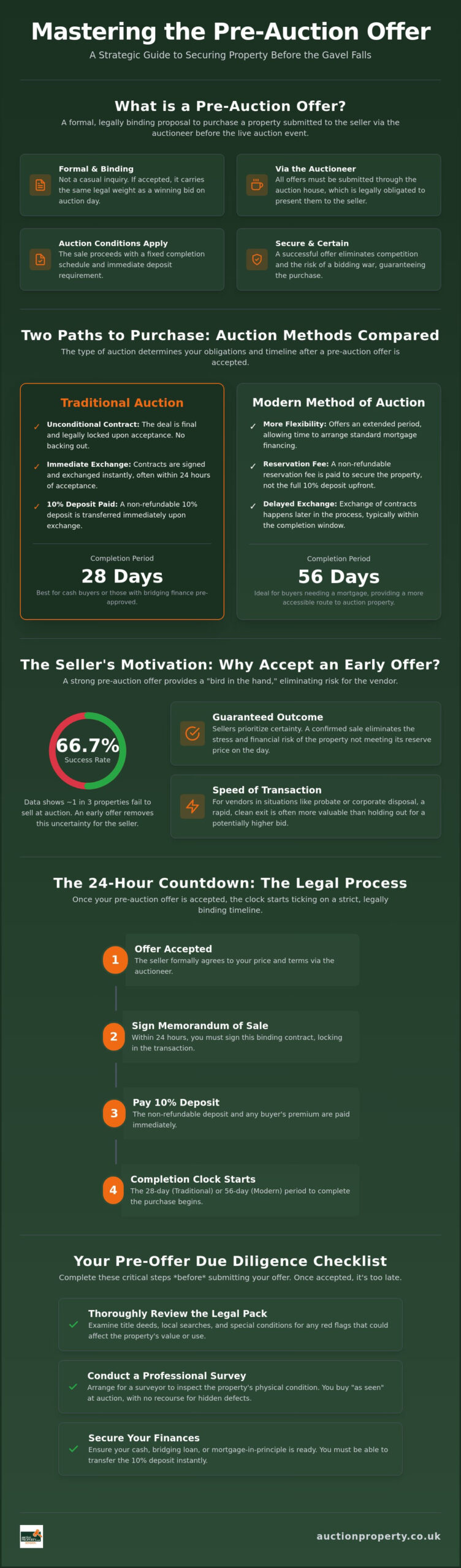
A pre-auction offer is a formal proposal to purchase a property after the official catalogue has been released but before the scheduled auction date. When you’re investigating what is a pre-auction offer, you’ll find it’s a strategic tool designed to bypass the competitive environment of the bidding floor. This isn’t a casual inquiry. It’s a professional commitment that, if accepted, binds you to the same rigorous terms as a successful bid on the day.
The auctioneer serves as the mandatory intermediary in this process. You must submit all bids through the auction house rather than contacting the seller directly. Auctioneers have a legal obligation to present every bona fide offer to the vendor for consideration. Even when a sale is agreed upon early, it typically proceeds under “Auction Conditions.” This means you must be ready to exchange contracts immediately, pay a 10% deposit, and adhere to a fixed completion schedule. Accessing the legal pack provision early is essential to ensure you aren’t blindsided by hidden covenants or title issues.
Traditional vs. Modern Method Pre-Auction Offers
The contractual obligations of your offer depend heavily on the auction method being used. Traditional auctions are unconditional. If the seller accepts your pre-auction bid, you exchange contracts immediately and usually have 28 days to complete. There’s no room for negotiation after acceptance; the deal is locked. This method demands that you have cash or bridging finance ready to move at pace. It’s the most final way to secure a property before the hammer falls.
The Modern Method of Auction offers more flexibility, which explains its rising popularity in 2026 for residential buyers. Instead of an immediate exchange, you pay a non-refundable reservation fee to secure the property. You then have a 56-day completion period. This extended timeframe allows enough room to finalize a mortgage, making it a viable route for buyers who don’t have significant cash reserves. Understanding these timing differences is critical before you sign any paperwork.
Why Sellers Consider Early Offers
Sellers often prioritize certainty over the potential for a slightly higher price on auction day. Data from May 2026 shows a residential auction success rate of 66.7%, meaning roughly one in three properties fails to sell under the hammer. For a vendor, a strong pre-auction offer is a “bird in the hand” that eliminates the risk of their lot failing to meet the reserve price. It provides a guaranteed outcome without the stress of a live event.
Speed is the other major driver. In cases of probate, distressed sales, or corporate disposals, the vendor may value a rapid exit above all else. If you can prove you have the funds and can facilitate a quick exchange, your offer becomes highly attractive. By moving early, you provide the seller with the administrative relief they need while securing the asset for your own portfolio without a bidding war.
The Legal Reality: How Pre-Auction Sales Are Executed
Accepting a pre-auction bid isn’t an invitation to start a lengthy negotiation process. It is an immediate, legally binding event. When the seller accepts your proposal, you typically enter a strict 24-hour window to exchange contracts. You must be prepared to sign the Memorandum of Sale and transfer the non-refundable 10% deposit instantly. This document serves as the final contract, locking both parties into the transaction with the same weight as a gavel fall in a live room. If you’re still wondering what is a pre-auction offer in a legal sense, it’s an unconditional commitment to buy.
The financial stakes are high. Beyond the 10% deposit, you are often responsible for a buyer’s premium or administration fee, which is also payable upon exchange. There is no cooling-off period. Once the Memorandum of Sale is signed, the property is effectively yours, and the 28-day completion clock begins. Failure to complete within this timeframe results in the forfeiture of your deposit and potential legal action for breach of contract. For those looking to secure a property before the crowd, you can explore our secure transaction platform to see how we facilitate these rapid exchanges.
The Critical Role of the Legal Pack
You must perform all due diligence before you even consider what is a pre-auction offer. This starts with a comprehensive review of the legal pack. This file contains the title deeds, local searches, and any special conditions that might affect the property’s value or your ability to develop it. In a traditional auction environment, you cannot make an offer “subject to survey” or “subject to finance.” Your solicitor needs to verify every document in the pack within hours, not weeks. Any issues with the title or restrictive covenants must be identified and accepted before you commit your funds.
Financial Readiness and Proof of Funds
Speed requires total financial transparency. Under 2026 Anti-Money Laundering (AML) regulations, auctioneers must verify your identity and the source of your funds before a sale can be finalized. You need to have your 10% deposit cleared in a UK bank account, ready for immediate transfer. Standard mortgages are rarely compatible with the 28-day completion requirement of a pre-auction sale. Most successful buyers utilize cash or pre-approved auction finance. To refine your approach, consider these 5 Tips for Making a Pre-auction Offer, which highlight the importance of having your capital and legal advice lined up before you strike a deal.
Strategic Analysis: Should You Buy or Sell Before Auction Day?
Deciding what is a pre-auction offer worth to your specific portfolio requires a cold, data-driven calculation of risk versus reward. For a buyer, the primary objective is to eliminate the “Auction Fever” that often grips a live room, where emotional bidding can drive prices far beyond rational valuations. If a property has generated high interest levels—evidenced by more than 15 or 20 scheduled viewings—the likelihood of a bidding war is significant. In this scenario, paying a strategic premium now is often cheaper than competing against five other motivated investors on the day.
From the seller’s side, an offer is only “too good to refuse” if it comfortably exceeds the secret reserve price and compensates for the lost potential of a runaway auction. Sellers must weigh the 100% certainty of a signed contract today against the 66.7% average success rate seen in May 2026. If the property is a niche asset or requires extensive renovation, the “Bird in the Hand” theory carries even more weight. A bird in the hand, in this context, is a buyer with cleared funds and a signed Memorandum of Sale.
Pros and Cons for the Professional Buyer
The most immediate advantage for a professional buyer is the total elimination of competition. You secure the asset, lock in your costs, and can begin project planning weeks earlier than your competitors. However, you must guard against the “winner’s curse.” There is always a risk that you’ve overpaid for a property that might not have reached your offer level in a live environment. To mitigate this, use the Guide Price as a floor for your negotiations, not a ceiling. If your offer isn’t at least 10% above the guide, it’s unlikely to trigger a cancellation of the auction.
- Pro: Stops emotional bidding fatigue and secures the asset immediately.
- Con: Risk of paying more than the market would have dictated under competition.
- Strategy: Analyze viewing numbers; high footfall justifies a higher pre-auction premium.
Pros and Cons for the Motivated Seller
For sellers, the appeal lies in speed and certainty. By accepting an early bid, you slash holding costs, insurance premiums, and marketing durations. This is particularly vital for probate executors or those managing distressed assets where time is the most expensive variable. The downside is the loss of the “ceiling-shattering” price that occurs when two bidders refuse to back down. Your decision metric should be simple: if the offer is significantly above your reserve and the buyer’s proof of funds is verified, the certainty of the exit usually outweighs the gamble of the gavel.
- Pro: Guarantees a sale and removes the risk of the lot failing to meet reserve.
- Con: Misses the opportunity for a competitive price surge in the room.
- Strategy: Only accept offers that provide a clear financial incentive over your target reserve.
Step-by-Step: How to Make a Winning Pre-Auction Offer
Executing a successful strategy requires more than just capital; it demands a disciplined, sequential approach. Once you understand what is a pre-auction offer, you must move with precision to beat the competition. The window between the catalogue release and the auction day is narrow. You don’t have time for hesitation or administrative delays. Follow these steps to position your bid as the most attractive option for the seller.
- Step 1: Immediate Due Diligence. Download the legal pack and arrange a viewing the day the catalogue goes live. If you need a survey, book it for the first available slot. You cannot make an informed offer without knowing exactly what you’re buying.
- Step 2: Solicitor Alignment. Confirm your legal representative can facilitate a 24-hour exchange of contracts. If they can’t meet this pace, find a firm that specializes in auction transactions.
- Step 3: Formal Submission. Submit your offer in writing to the auction house. Include your specific price, proof of funds, and your solicitor’s contact details. This signals you’re a serious, ready buyer.
- Step 4: Negotiation. The auctioneer will present your offer to the vendor. Be prepared for a “Best and Final” counter-offer. Know your limit before you enter this phase.
- Step 5: Immediate Execution. If accepted, sign the Memorandum of Sale and transfer the 10% deposit and any administration fees instantly. This removes the property from the auction and guarantees your purchase.
To start your journey, you can view our current residential and commercial auction listings and identify your next investment opportunity today.
Calculating Your Offer Price
Your offer must be high enough to tempt the seller away from the potential of the auction room. A common rule of thumb is to bid 10% to 15% above the guide price. Sellers rarely stop an auction for a bid that only meets their reserve. Use local sold prices from the last six months to justify your figure to the auctioneer. Remember to factor the buyer’s administration fee into your total budget calculation. This ensures your final “all-in” cost remains within your financial parameters.
Dealing with Rejection: What Happens Next?
A rejected offer isn’t a failure; it’s market intelligence. It often means the seller has a higher reserve or believes the room will generate more heat. This rejection doesn’t bar you from bidding on the day. In fact, it gives you a clear idea of the seller’s expectations. Maintain your pre-determined ceiling price. Don’t let the frustration of a failed pre-auction bid lead to overbidding during the live event. Stick to your data and wait for the gavel.
Maximising Results with Auction Property Ltd
Executing a successful strategy requires a partner that prioritizes speed without sacrificing security. Auction Property Ltd operates a transparent platform designed to facilitate rapid communication between buyers and sellers. We act as the expert intermediary, ensuring every proposal is bona fide and legally robust before it reaches the vendor. This proactive management removes the administrative friction that often stalls traditional property sales. If you’re still refining your understanding of what is a pre-auction offer, our team provides the clarity needed to move from curiosity to a committed exchange.
Our expert support specialists manage the legal pack provision to ensure all parties are protected. We handle the heavy lifting of administrative coordination, allowing you to focus on the financial viability of the asset. With a national reach that covers all property types, we provide diverse opportunities for commercial property investors and residential buyers alike. Every transaction we facilitate is built on a foundation of speed, security, and professional integrity.
Our Transparent Fee Structure
Trust is the most valuable currency in a high-stakes auction environment. We maintain total clarity regarding our buyer’s administration and premium fees from the moment a lot is listed. This transparency builds the necessary confidence for both sides to reach an agreement before the live event begins. When you know exactly what your outgoings are, you can calculate what is a pre-auction offer that fits your budget with precision. Review our fees guide to understand how our model supports a certain outcome.
Next Steps: Get Involved in Our Next Auction
Success in the 2026 market belongs to those who act with conviction. Browse our current catalogue today to identify assets that align with your investment goals. If you’re a seller looking for an efficient exit, request a professional property valuation to determine if your asset is ready for the auction room. Our seasoned consultants are ready to facilitate your transaction, providing the expertise required to navigate the market with confidence. Don’t wait for the gavel to fall; secure your next property on your own terms.
Secure Your Competitive Advantage in the 2026 Market
Mastering the mechanics of a pre-auction sale transforms you from a passive bidder into a proactive market leader. You now understand what is a pre-auction offer and how it serves as a high-speed alternative to the traditional gavel fall. By combining rigorous due diligence with a decisive financial strike, you eliminate the unpredictability of the auction room. This approach relies on total transparency and a commitment to the 24-hour exchange rule. It’s the most effective way to secure high-value assets without the risk of a bidding war.
Auction Property Ltd provides the infrastructure needed to execute these transactions with absolute confidence. Our platform offers professional marketing and property appraisal alongside comprehensive legal and administrative support. We ensure every exchange is underpinned by a transparent and efficient online bidding platform that removes friction for both buyers and sellers. Take the next step in your investment journey today. Don’t wait for the live event to start your strategy.
Browse our latest auction catalogue and identify your next investment and take control of your property acquisitions. Your next successful exit starts with a decisive move.
Frequently Asked Questions
Can a seller reject my pre-auction offer even if it is above the guide price?
Yes, a seller can reject your offer at any time before contracts are exchanged. Even if your bid exceeds the guide price, the vendor might decide that the momentum of a live room will achieve a better result. High interest levels or a large number of legal pack downloads often encourage sellers to wait for the auction day to maximize their return.
Do I still have to pay the buyer’s premium if I buy before the auction?
Yes, the standard buyer’s premium and administration fees apply to all transactions. Buying early doesn’t change the contractual framework of the auction. You must factor these costs into your total budget calculation when determining what is a pre-auction offer that you can realistically afford. These fees are typically payable immediately upon the exchange of contracts.
How quickly must I exchange contracts if my pre-auction offer is accepted?
You must typically exchange contracts within 24 hours of acceptance. This rapid timeframe ensures the property is officially removed from the auction and prevents other bidders from intervening. You’ll need to sign the Memorandum of Sale and transfer the 10% deposit immediately to finalize the agreement. Preparation is vital; your solicitor must be ready to move the moment the deal is agreed.
Can I make a pre-auction offer on a commercial property?
Yes, you can submit an offer for commercial properties, land, or development sites. The process mirrors residential sales; you submit your bid through the auctioneer and provide proof of funding. Investors often use this tactic to secure strategic commercial assets before they attract wider market competition. Ensure you’ve reviewed the commercial legal pack thoroughly, as these often contain complex VAT or leasehold implications.
Is a pre-auction offer legally binding in the UK?
A pre-auction offer becomes legally binding only when you sign the Memorandum of Sale and pay the non-refundable deposit. In the UK, verbal or written acceptance by the seller doesn’t lock in the deal until the exchange happens. The 24-hour exchange rule is the specific mechanism that creates the legal obligation, matching the finality of a gavel fall in a live room.
What happens if the seller accepts another offer after mine?
Until contracts are exchanged, the seller is free to accept a higher offer. This is known as gazumping and remains a risk if you delay your paperwork or deposit transfer. To protect your position, ensure your solicitor is ready to move the moment your bid is accepted. Once the Memorandum of Sale is signed and the deposit is paid, the contract is binding and the seller cannot legally switch to another buyer.
Should I offer the full guide price as a pre-auction bid?
Offering just the guide price is rarely successful. The guide price is usually an indication of the reserve; sellers expect a premium of 10% to 15% to justify cancelling the live auction event. Your bid must be strong enough to convince the vendor that they’ve already achieved a “best-case” scenario. If your offer doesn’t provide a significant incentive, the seller will likely take their chances on the auction floor.
Can I use a mortgage for a pre-auction purchase?
Traditional auctions move too fast for most standard mortgages, but the Modern Method of Auction allows 56 days for completion. If you’re using a mortgage for a traditional 28-day completion, you must have a mortgage in principle and a very efficient lender. Most buyers rely on cash, bridging loans, or specialized auction finance to meet the strict deadlines and avoid the risk of losing their deposit.