

A winning bid at a traditional UK property auction is a commitment, not a provisional offer. The hammer falling usually creates a legally binding contract, and the buyer must have a deposit of 10% of the purchase price ready on auction day. To establish who holds the deposit after an auction, start with the payment arrangements set out in the auction terms and legal pack.
It’s understandable to want clarity before committing a substantial sum, especially when completion follows quickly and missing a deadline can have serious consequences. This guide explains when the deposit is due, how traditional and modern auction processes differ, and what may happen if you can’t complete the purchase.
You’ll also learn how the deposit fits into the sale, from the hammer falling through to settlement, and which documents explain the payment terms for a particular lot. The aim is to clarify the commitment before you bid, so you understand the financial steps and the risks that follow a successful bid.
Key Takeaways
- For a traditional UK property auction, be ready to pay a deposit of 10% on auction day after the hammer falls.
- A successful bid usually creates a binding contract, so understand the commitment before bidding.
- The auction terms and legal pack set out payment requirements and help establish who holds the deposit.
- Traditional and modern auctions can follow different contract and completion timelines, so identify which method applies to the lot.
- Missing completion can put your deposit at risk and may leave you liable for auctioneer’s fees.
What Happens if You Can’t Complete After Winning an Auction?
A successful bid can create a binding commitment before you arrange the remaining funds. In a traditional UK property auction, the deposit is generally due on auction day, shortly after the hammer falls.
If you miss a payment or completion deadline, the consequences can extend beyond losing the property. The auction terms and legal pack set out the required payments, deadlines and consequences for that lot.
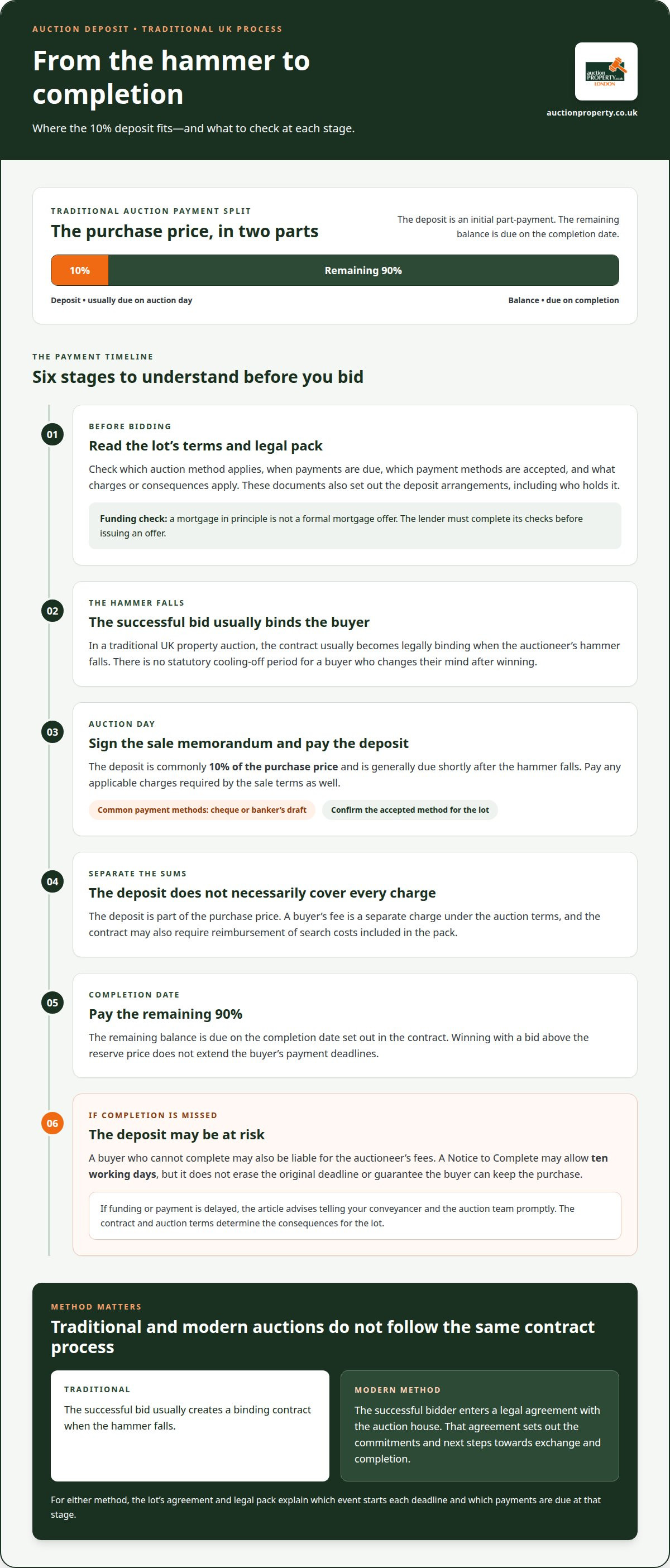
For a traditional auction, the deposit is commonly 10% of the purchase price and must be ready on auction day. After the hammer falls, the successful bidder signs the sale memorandum and pays the deposit, along with any applicable charges required by the sale terms. The remaining 90% is due on the completion date.
Payment arrangements are set out for each auction. Deposits are commonly paid by cheque or banker’s draft, so understand the accepted method before bidding. A payment that cannot be made in the required form or by the deadline can put the purchase at risk.
A mortgage in principle is not the same as a formal mortgage offer. The lender must complete its checks before issuing an offer, so relying on an in-principle decision alone can leave a funding gap when completion is due. The reserve price sets the seller’s minimum acceptable price, but winning with a bid above it does not extend the buyer’s payment deadlines.
Deposit and Buyer’s Fee
The auction deposit is an initial part-payment of the purchase price, while a buyer’s fee is a separate charge payable under the auction terms. Paying the deposit does not necessarily cover fees or other sums due. Before bidding, read the lot’s payment conditions to identify each amount, its purpose and its deadline.
If the buyer cannot complete, the deposit is usually at risk, and the buyer may also be liable for the auctioneer’s fees. A Notice to Complete may allow ten working days to complete, but it does not erase the original deadline or guarantee the buyer can keep the purchase. The contract and auction terms set out the consequences that apply.
Act immediately if funding or payment is delayed. Tell your conveyancer and the auction team, and establish what the contract requires next. Waiting until the completion date may leave you with fewer practical options, particularly if a mortgage offer or transfer of funds is still outstanding.
Deposit Refund if the Seller Cannot Complete
If the seller cannot complete, the buyer’s position differs from that of a buyer who defaults on payment. The contract governs the available steps and remedies, including whether the deposit can be recovered. The outcome depends on why completion failed and the terms agreed for the property, not simply on who paid the deposit.
Keep the signed contract, sale memorandum and payment records together. These documents show the agreed purchase price, deadlines and payment obligations, giving the conveyancers a clear basis for addressing a failed completion.
Contract formation when the auctioneer’s hammer falls
The contract process depends on the auction method. In a traditional UK property auction, the winning bid usually creates a legally binding contract when the auctioneer’s hammer falls.
That moment matters: the buyer’s commitment begins before later completion arrangements are finalised.
Contract Exchange and Binding Effect
At a traditional auction, the contract becomes binding when the hammer falls on the successful bid. The buyer then signs the contract and sale memorandum and pays the deposit required under the lot’s terms. Signing records the agreement, but the winning bid has already committed the buyer to proceed.
There’s no statutory cooling-off period for a buyer who changes their mind after winning at a UK property auction. Decide your maximum bid before bidding, and register as required by the auction house. A mortgage in principle is not a formal mortgage offer, so it does not remove the obligation to complete.
Auction Contract Conditions
Auction contract conditions define the buyer’s and seller’s obligations for a specific lot. They include payment deadlines and may require the buyer to reimburse the seller for searches included in the auction pack. These conditions can affect the total amount due and what happens if either party fails to meet its obligations.
Read the legal pack and contract conditions before bidding. Identify the completion date, deposit requirements, fees and any search-cost reimbursement. For example, if searches are included in the pack and the contract requires reimbursement, that cost is separate from the purchase price. The reserve price is the seller’s minimum acceptable price, not a change to the contract terms.
Modern auctions follow a different process. A successful bidder enters into a legal agreement with the auction house rather than exchanging contracts when the hammer falls. The agreement sets out the buyer’s commitments and the next steps towards exchange and completion. Because this affects when the sale contract is exchanged, don’t assume traditional auction timing applies to every method.
For a modern-method purchase, read the agreement alongside the lot’s legal pack before bidding. Confirm which event starts each deadline and which payments are due at that stage. Traditional and modern auctions can have different arrangements; the lot’s terms explain which process applies.
The hammer marks the point of commitment in a traditional auction, while a modern auction follows its own agreement process. Understanding the method before bidding helps you identify when you become bound and which conditions govern the purchase.
Deposit held in trust until settlement
In the UK, the auction terms and legal pack set out the buyer’s payment obligations and deadlines. Read them to identify the deposit recipient and how the money is handled before settlement.
Transfer of the Deposit to the Seller
The transfer point is when the deposit is released or applied towards the seller’s proceeds, as set out in the sale terms. Don’t assume it automatically stays in a trust account until settlement. The contract and payment arrangements determine how it is handled, which matters if you need to know whether the money remains separate before completion.
For a specific lot, read the payment and completion clauses together. They explain what the buyer pays, when payment is due and how the transaction proceeds towards settlement. If the wording does not clearly explain how the deposit is handled, ask your solicitor to clarify the clause before bidding.
Checking the Deposit Holder Before Bidding
To establish who holds the deposit, identify the named recipient and handling arrangements in the auction documents before bidding. The payment recipient and timing are not necessarily the same as the person who ultimately receives the sale proceeds.
Start with the property’s legal pack and auction conditions. Find the clauses covering the deposit, payment instructions and completion, then ask your solicitor to clarify anything unclear before bidding. The auction terms and legal pack specify what the buyer must pay and when, so use both to understand the lot’s requirements.
The highest bid does not, by itself, explain where the deposit is held. The reserve price is the seller’s minimum acceptable price, while the deposit arrangements are set out separately in the sale terms. Treat the reserve and payment clauses as distinct: one concerns the seller’s minimum, and the other explains the buyer’s obligations.
A private sale and an auction purchase can have different payment arrangements. For an auction lot, rely on its contract conditions rather than assuming private-sale practices apply. The legal pack may also include searches or other documents relevant to the purchase, so review its terms alongside the deposit clause.
After paying, keep the payment confirmation with the signed sale documents. This gives you and your solicitor a clear record of the amount, date and recipient if a question arises before settlement. Match the confirmation against the payment instructions in the auction terms, especially if the purchase involves several separate sums.
Before bidding, make sure the deposit clause answers three practical questions: who receives the payment, when it is due, and how the documents describe its handling before settlement. If anything remains unclear, resolve it with your solicitor before making a binding commitment. This is the practical way to establish who holds the deposit after an auction for a particular property.
How much is the typical property auction deposit in the UK?
For a traditional UK property auction, the typical deposit is 10% of the final purchase price. It is normally due on auction day, shortly after the hammer falls, so calculate it against the price you actually bid successfully.
The calculation is direct: multiply the winning purchase price by 10%. For example, if the final price changes from your planned bid, the deposit is calculated from the successful price, not your original estimate. Keep enough cleared funds available for that amount and any other sums required by the lot’s terms.
This 10% figure describes the traditional auction deposit, not every payment connected with buying at auction. The auction conditions identify the deposit amount, accepted payment method and deadline. They may also set out separate buyer charges or other sums. Read the full payment terms before bidding so you can distinguish the deposit from additional obligations.
Modern-method auctions can use a reservation fee rather than the traditional deposit arrangement. The buyer pays that fee on auction day, while the purchase follows a different agreement process. Don’t assume the traditional 10% rule applies to a modern auction. The auction method and the terms for the property determine which payment applies.
The distinction matters when planning your available funds. A reservation fee and a contract deposit are not interchangeable. Check whether the lot requires a deposit, a reservation fee or both, and note when each becomes payable. The auction terms and legal pack provide the payment details for the individual property.
Payment timing matters as much as the percentage. A traditional auction deposit is due promptly after a successful bid, so arrange the required payment method before auction day. Deposits are commonly paid by cheque or banker’s draft. Follow the instructions in the lot’s terms: having the right amount available is not enough if you cannot pay using the required method.
Do not base your budget only on the reserve price. The reserve is the minimum price the seller will accept, while the deposit is calculated from the final purchase price after bidding. If competitive bidding pushes the price higher, the deposit rises with it. Set a maximum bid that accounts for the resulting deposit and your other purchase commitments.
Before bidding, identify the auction method, calculate 10% of your maximum intended traditional-auction bid, and read the payment conditions. For a modern auction, use the stated reservation-fee terms instead. That simple distinction helps you prepare for the correct upfront payment without mistaking it for the full cost of completing the purchase.
When must the auction deposit be transferred to the seller?
The buyer’s payment date and the seller’s receipt date are separate points in an auction transaction. The auction terms and contract set out the payment obligations and explain how the deposit is handled before completion.
There is no single transfer date for every UK auction lot. The contract determines whether the deposit remains with the named holder until completion or is handled another way. Read the relevant clauses before bidding, rather than assuming that payment to an auction house means immediate payment to the seller.
Start with the auction conditions and legal pack. Identify the deposit recipient, payment deadline and any wording about holding, releasing or applying the money. These details matter because the successful buyer may pay on auction day while the sale completes later. The date the buyer pays does not, by itself, establish when the seller receives the funds.
Completion timing depends on the auction method and the lot’s terms. A traditional auction purchase usually completes within 28 days after the auction. Modern auction deadlines can range from 28 to 56 days after the auction. Those periods describe completion timing, not a universal deadline for transferring the deposit to the seller.
Check the contract for the event that triggers any transfer. It may refer to completion, settlement, exchange or another defined stage. Follow the exact wording in that lot’s documents, since these terms describe different parts of the sale. If a clause is unclear, ask your solicitor to explain how it affects the deposit before you bid.
This distinction matters if completion is delayed or either party cannot perform. The contract and auction conditions establish the agreed process, including how the deposit is treated when deadlines are missed. Keep the signed sale memorandum and payment record together: they help identify what was paid, to whom and under which terms.
Also distinguish a traditional deposit from a modern-method reservation fee. Under the modern method, the buyer pays the reservation fee on auction day. This payment follows the agreement’s terms and should not be treated as a traditional deposit unless the lot documents say so. Check the payment label and purpose before calculating the funds needed.
Before bidding, clarify three points: the named deposit holder, the buyer’s payment deadline, and the contract event that governs transfer to the seller. Ask your solicitor to review the legal pack and explain any release clause. This gives you a lot-specific answer to when the seller receives the deposit, rather than relying on a general assumption about UK auctions.
Auction Property
Auction Property Ltd helps buyers approach property auctions with a clearer understanding of the transaction and its documents. Its residential, commercial, and land and development site auctions are supported by legal pack provision, giving buyers access to lot information needed to understand the sale terms.
When assessing a property before bidding, Auction Property Ltd can help you understand how the auction process and legal pack relate to your purchase. Each lot’s terms set out the payment requirements, so reviewing them before you commit is an important part of preparing.
For support with buying or selling a property at auction, contact Auction Property Ltd.
Prepare for your next auction decision
Knowing who holds the deposit after an auction is one part of deciding whether you’re ready to bid. Next, turn the lot’s terms into a clear plan: understand your funding, be comfortable with the commitment, and know what happens after a successful bid.
Make that decision before the auction, not under the pressure of bidding. A considered plan helps you focus on the property and act with purpose when the right opportunity appears. Auction Property Ltd helps clients explore auction options for residential, commercial, and land and development properties.
Contact Auction Property Ltd for guidance and take the next step with a clearer view of your auction plans. With the right preparation, you can move forward confidently.
Frequently Asked Questions
What Does a Legally Binding Property Auction Purchase Mean?
It means the winning bidder and seller are committed to the sale under the auction contract. In a traditional auction, the contract usually becomes binding when the auctioneer’s hammer falls. The buyer cannot treat the bid as a provisional offer or wait until later to decide whether to proceed. The contract and lot conditions then govern payment, completion and the consequences of failing to meet the agreed terms.
Can I change my mind after placing a successful bid?
No. A successful bidder at a UK property auction generally cannot withdraw simply because they change their mind. A traditional auction purchase usually becomes binding when the hammer falls, and there’s no statutory cooling-off period for the buyer after winning. Before bidding, understand the contract conditions and have funding arrangements in place. If a problem arises afterwards, the relevant contract terms determine the consequences and available next steps.
When do I need my deposit?
For a traditional UK property auction, have the deposit ready for auction day. It’s generally due shortly after the successful bid, once the hammer falls, alongside any other payment required at that stage. The lot’s terms state the accepted payment method; deposits are commonly paid by cheque or banker’s draft. Modern-method auctions may instead require a reservation fee on auction day under a separate agreement.
When is the property ‘sold’?
In a traditional property auction, the property is sold when the auctioneer accepts the winning bid by bringing down the hammer. That event usually forms the binding contract, even though completion and transfer of ownership happen later. In a modern-method auction, the successful bidder enters into an agreement with the auction house rather than exchanging contracts when the hammer falls. Read the lot’s terms to identify the relevant sale process.
Who holds the buyer’s deposit after a property auction in the UK?
There isn’t one holder for every UK auction purchase. The auction terms and contract identify who receives the deposit and explain how it is handled before completion. To establish who holds the deposit after an auction, look for the named recipient and any clauses about holding, release or application of the funds. A solicitor can explain how those provisions work for the particular lot.
Is the auction deposit held by the auctioneer, seller’s solicitor, or a stakeholder?
The documents for the specific property determine whether payment goes to the auctioneer, a solicitor or another named party, and whether that party holds it as stakeholder. Don’t assume the seller’s solicitor automatically receives the money or that every auctioneer retains it. Look for the deposit instructions in the contract and auction conditions. Those terms explain the payment route and any arrangements for holding or releasing the funds.
What does the auction contract say about who holds the deposit?
The contract and auction conditions specify the deposit payment requirements, including the recipient, deadline and handling arrangements. They may also explain when the deposit can be released or applied towards the sale. Read those clauses alongside the legal pack rather than relying on a general description of auction practice. If the wording is unclear, ask your solicitor to explain it before bidding.
What happens to the deposit if the buyer fails to complete after the auction?
A buyer who fails to complete risks losing the deposit, which is usually 10% in a traditional auction, and may also be liable for the auctioneer’s fees. The contract sets out the applicable obligations and consequences, including any process after a missed completion deadline. A Notice to Complete may allow ten working days to complete, but it doesn’t automatically remove the buyer’s liability or guarantee the purchase can proceed.