

A fixed-term tenancy can end without the tenant moving out or signing a new agreement. In England, what a statutory periodic tenancy is comes down to what happens next: under section 5 of the Housing Act 1988, a tenancy can continue automatically on a rolling basis when its fixed term ends. The periods usually follow the rent schedule, such as monthly or weekly.
The distinction matters because a statutory periodic tenancy arises by law, while a contractual periodic tenancy continues under terms agreed between landlord and tenant. Both are periodic, but their terms and how they end can differ. Since 1 May 2026, assured tenancies in England have moved to a rolling-tenancy framework, so the rules also depend on when the tenancy began and which legal arrangement applies.
This guide explains what a statutory periodic tenancy is, how its terms are set and how it differs from fixed-term and contractual tenancies. You’ll learn what happens when a fixed term ends, what notice rules may apply and why identifying the tenancy type matters for landlords and tenants.
Key Takeaways
- Understand how a periodic tenancy rolls on and how its rental periods relate to rent frequency.
- See what can happen when a fixed-term assured shorthold tenancy ends and the tenant remains in the property.
- Compare statutory and contractual periodic tenancies to understand why the source of the terms matters.
- Learn how tenancy terms, including notice requirements, affect the way a periodic agreement can end.
- Discover how section 5 of the Housing Act 1988 relates to statutory periodic tenancies in England.
What is a Periodic Tenancy Agreement?
A periodic tenancy continues in recurring rental periods rather than ending on a set date. In England, an assured periodic tenancy rolls forward in periods of no more than one month.
Rolling periods and rent frequency
A periodic tenancy continues into another rental period when the current period ends, unless it is properly ended. Periods commonly follow the rent frequency: monthly rent may mean monthly periods, while other periodic arrangements can be weekly or quarterly. For assured periodic tenancies in England, each period cannot exceed one month. This distinction helps establish which tenancy rules apply.
Rent in advance and rent increases
Rent in advance is paid before the rental period it covers, rather than after it has passed. For a new tenancy in England agreed on or after 1 May 2026, a landlord may request no more than one advance rent payment before the tenant moves in, capped at one month’s rent. This affects the timing and amount requested at the start of a tenancy.
Rent increases under Section 13
In England, a landlord can increase rent for an assured periodic tenancy only after serving a Section 13 rent increase notice. A Section 13 increase is restricted to once in 12 months. The formal notice matters: a proposed change alone does not replace the required process. Tenants and landlords can use the notice to identify the proposed rent and when the change is intended to take effect.
Sharing one tenancy agreement can create a joint tenancy. When multiple tenants sign the same agreement, each is responsible for the rent, not just an assumed individual share. If one joint tenant does not pay their portion, for example, the others remain liable under the agreement. The written terms clarify who is named as a tenant and how rent is payable.
A periodic tenancy has no fixed end date. An assured periodic tenancy continues until the tenant and landlord agree to end it, the tenant gives notice to end it, or the landlord regains possession. Possession is a legal process, not simply a request from the landlord to leave. The applicable route depends on the tenancy and circumstances.
In England, rent repayment orders offer a remedy for certain landlord offences. For offences covered by the rules, they can recover up to two years’ rent. This is separate from the usual rent arrangements in a periodic tenancy. Tenants should distinguish a repayment order from a rent reduction or a change to future rent, as each has a different effect.
These points show why the tenancy type matters: the period sets the rental cycle, written terms clarify joint responsibility, and formal rules govern rent increases and possession. A periodic agreement is not automatically informal or short-term. It continues until it ends through the applicable legal route.
How assured periodic tenancies differ from fixed-term assured shorthold tenancies
A fixed-term assured shorthold tenancy (AST) has a defined end date, while an assured periodic tenancy continues on a rolling basis without one. In England, that distinction changed on 1 May 2026, when the new tenancy framework took effect.
Before the change, most ASTs began with a fixed term of six or 12 months. The agreement set a period during which the tenant could occupy the property under its terms. When that term ended, the parties could agree a further arrangement, or the tenancy could continue as a statutory periodic tenancy if the tenant remained and no replacement agreement was made.
From 1 May 2026, existing assured shorthold tenancies in England converted to assured periodic tenancies, unless a possession claim was already ongoing. New assured tenancies also operate periodically under the framework. The change means a fixed end date no longer defines the tenancy’s duration in these cases. Instead, it continues until ended through the applicable process.
What changes for tenants and landlords
Under a fixed-term agreement, the agreed end date provides a clear point for reviewing whether the tenancy will continue. A periodic tenancy has no end date, so both parties need to understand the rules for ending it. According to the Ministry of Housing, Communities and Local Government, a tenant in an assured periodic tenancy can give two months’ notice at any time, unless a shorter period is agreed in writing.
This distinction affects planning. A tenant who expects to leave when a fixed term expires may instead need to give notice under the periodic rules. A landlord cannot treat the old fixed-term end date as an automatic move-out date after the tenancy converts. It remains in place until it ends by agreement, tenant notice or the landlord regaining possession through the relevant legal route.
The possession rules changed too. Section 21 notices were abolished in England from 1 May 2026. Landlords must rely on the applicable possession grounds and process rather than using a Section 21 notice to end an assured tenancy. The legal basis and notice requirements depend on the ground being used.
For a landlord weighing whether to retain or sell a rental property, these tenancy changes may affect the decision and its timing. The Renters’ Rights Act introduced ground 1a for a landlord seeking possession to sell. If sale is the chosen route, residential property auctions offer a way to bring a property to market.
Start by identifying the tenancy’s current status and whether there is an ongoing possession claim. Then distinguish the old fixed-term end date from the legal route now required to end the tenancy. This helps tenants plan a move and landlords assess their next steps under England’s current framework.
Periodic tenancy agreement terms
A periodic tenancy’s terms come from its agreement and the rules that apply to that tenancy. In England, the distinction affects written terms, notice and the documents the landlord must provide.
Terms of the agreement
A periodic tenancy agreement sets out the terms that govern the landlord and tenant while the tenancy continues. It can be written or oral, but the landlord must provide the key terms of an oral agreement in writing. That record helps both parties identify the rent, payment arrangements and other agreed conditions.
When reviewing a written tenancy agreement, check who is named, when rent is due and what the agreement says about ending the tenancy. For an oral agreement, compare the landlord’s written statement of key terms with what both parties agreed. Keeping the documents together makes it easier to understand the arrangement if a rent or notice issue arises.
Tenant notice to end the tenancy
For a monthly statutory periodic tenancy, a tenant must give at least one month’s notice; for a weekly statutory periodic tenancy, the minimum is four weeks. The notice must end on the first or last day of the tenancy period.
For assured periodic tenancies in England under the framework effective from 1 May 2026, the Ministry of Housing, Communities and Local Government says tenants can give two months’ notice at any time, unless a shorter period is agreed in writing. The applicable rule depends on the tenancy type and framework. For example, a tenant should identify the rental period and governing agreement before choosing a notice end date.
Rights and responsibilities during the tenancy
During a statutory periodic tenancy, the tenant must meet the agreement’s terms, including paying rent as agreed. The landlord must also meet the applicable tenancy requirements. If several tenants signed one agreement, they are joint tenants and all remain responsible for the rent, not just their individual share.
For a statutory periodic tenancy, the landlord must provide documents including the How to rent guide, EPC, gas safety certificate, EICR and prescribed deposit-protection information. These documents give tenants key information about the property and deposit arrangements. Keep them with the tenancy agreement so you can find the relevant details if questions arise.
The tenancy continues until the tenant ends it, both parties agree to end it, or the landlord regains possession. Where an assured periodic tenancy has no applicable end date, a landlord cannot treat an intended end date as sufficient. The notice period, written terms and required documents help clarify the parties’ position while the agreement remains in force.
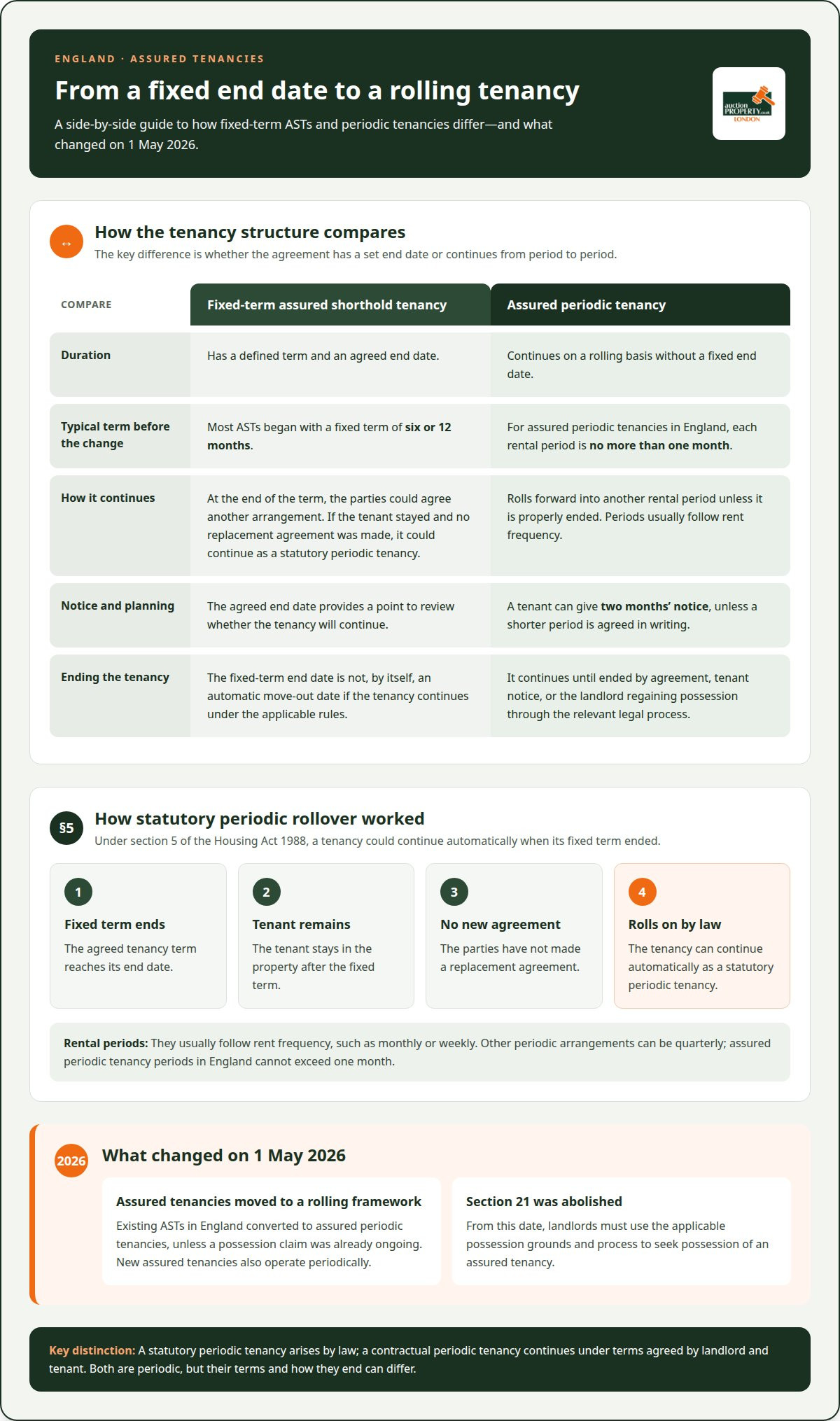
Statutory and contractual periodic tenancy differences
Both arrangements continue in rental periods, but they begin differently. A statutory periodic tenancy can arise automatically when a fixed-term tenancy ends without an agreed plan for what follows. A contractual periodic tenancy is created by the contract, which sets out the periodic arrangement between landlord and tenant.
That difference helps explain where to look for the tenancy’s terms. For a contractual tenancy, the agreement is the starting point for the rent period and other conditions. A statutory tenancy follows when the legal conditions apply after a fixed term; its continuation does not depend on signing a new periodic contract. In England, section 5 of the Housing Act 1988 provides for a statutory periodic tenancy when a fixed term ends without a specified plan for what happens next.
Rent frequency can help identify the period in either arrangement, but it does not show whether a tenancy is statutory or contractual. Check how the periodic arrangement began: did the contract create it, or did it arise after a fixed term ended? This distinction can affect which terms govern and which notice rules apply.
A tenancy agreement might set out a periodic arrangement from the outset, which points to a contractual tenancy. If a fixed term expires and the tenant stays without a new agreed arrangement, a statutory periodic tenancy may arise under the applicable rules. The original contract remains useful for understanding the relationship, but the tenancy’s legal basis has changed.
Do statutory periodic tenancy rules differ in England, Wales, Scotland and Northern Ireland? The rules described here concern England. Scotland, Wales and Northern Ireland have separate tenancy frameworks, so England’s statutory periodic tenancy rules do not apply across all four nations.
How can a landlord end a statutory periodic tenancy, and what notice is required? In England, a landlord must use an applicable possession ground; Section 21 notices were abolished from 1 May 2026. For the mandatory rent-arrears ground, the tenant must owe three months’ rent and receive four weeks’ notice; ground 1a allows possession where the landlord intends to sell.
These routes differ from a tenant giving notice to leave. A landlord’s intention to end the tenancy does not, by itself, bring it to an end. The relevant possession ground and its requirements determine the process; the tenancy remains in place until the tenant leaves or the landlord regains possession.
Before acting, identify the nation where the property sits, then establish how the periodic tenancy began. In England, distinguish a contract that created periodic renting from a tenancy that followed a fixed term under section 5. That gives both parties a clearer basis for understanding the agreement and the applicable route to end it.
What law governs statutory periodic tenancies in the UK?
For England, the key provision is section 5 of the Housing Act 1988. It can create a statutory periodic tenancy when a fixed-term tenancy ends without a specified plan for what happens next. The tenancy then continues on a periodic basis under the law, rather than because the parties signed a new periodic contract. The property’s location and tenancy timeline help identify which framework applies.
Section 5 is not a single rule for every rental home across the UK. England, Wales, Scotland and Northern Ireland have separate tenancy frameworks, so the Housing Act 1988 should not be treated as the governing law throughout all four nations. Start by locating the property, then identify the tenancy type and relevant dates. That prevents an England-specific provision being applied to a tenancy elsewhere.
The date matters in England. From 1 May 2026, assured tenancies, including assured shorthold tenancies, became rolling tenancies under the Renters’ Rights Act framework. Existing assured shorthold tenancies converted on that date unless a possession claim was ongoing. This means the older section 5 route remains relevant to understanding how a statutory periodic tenancy arose, but the tenancy’s start date affects which current rules apply.
To assess an individual arrangement, first read the original agreement and note its fixed-term end date. Next, establish whether it set out a plan for what would follow. If it did not, section 5 may be relevant to the tenancy’s transition after the fixed term. Then check whether the property is in England and whether the tenancy was affected by the 1 May 2026 changes. These facts frame the legal question; the label used in an agreement alone does not settle it.
The distinction between statutory and contractual periodic tenancies matters here, too. A contractual periodic tenancy is created by the contract’s terms. A statutory periodic tenancy arises through the legal mechanism that applies when the fixed term ends without a specified next step. Comparing the contract with what happened at the end of the term helps clarify which route applies.
Keep the agreement, any written changes, and records relating to the tenancy’s end date together. For example, a document setting out a renewal may affect whether there was a specified plan, while a possession claim ongoing on 1 May 2026 is relevant to the conversion rule. Use the property’s nation and these timeline details to understand the governing framework before considering notice or possession.
Auction Property Ltd: Residential Property Auctions
Auction Property Ltd offers Residential Property Auctions for owners considering a sale rather than continuing to rent. Once you understand the tenancy position and possession requirements, an auction may provide a route to market for a residential property. Review the legal position and tenancy information as part of preparing for a sale. Legal Pack Provision is also available. Commercial Property Auctions and Land and Development Site Auctions cover other property types.
If selling is your next step, explore the auction process and decide whether it suits your property and circumstances. Contact Auction Property Ltd or visit auctionproperty.co.uk to discuss the next step.
Turn clarity into your next property decision
Knowing what a statutory periodic tenancy means is most useful when it guides your next decision. Start with the outcome you want for the property: retain it as an investment, prepare it for sale or reconsider its place in your wider plans. A clear objective helps focus the decisions that follow.
If you are considering a sale, gather the property information and documents you already hold, and clarify who needs to be involved in the decision. This gives you a practical starting point for discussing the sale route and preparation. Keep your intended timing and the property’s current occupancy in view as you assess your options.
If an auction sale fits your plans, take the next step and contact Auction Property Ltd today to discuss your property. You can move forward with a clearer objective and a focused conversation about what comes next.
Frequently Asked Questions
What happens when a fixed term tenancy ends?
In England, the tenancy may continue as a periodic tenancy if the tenant stays and no new arrangement takes effect. Since 1 May 2026, existing assured shorthold tenancies generally converted to assured periodic tenancies, unless a possession claim was ongoing. For example, a tenant remaining after the old end date should identify whether the tenancy converted or a new agreement was made, rather than treating the date alone as requiring them to leave.
What is a statutory periodic tenancy in England and Wales?
In England, a statutory periodic tenancy is a rolling tenancy that can arise by law after a fixed term ends without a specified plan for what happens next. The Housing Act 1988 provides for this under section 5. Wales has a separate tenancy framework, so don’t assume England’s section 5 rules apply there. First identify where the property is, then use the rules for that nation.
When does a fixed-term tenancy become a statutory periodic tenancy?
In England, it can arise when the fixed term ends, the tenant remains, and the agreement does not specify what happens next. Section 5 of the Housing Act 1988 governs that transition. Since 1 May 2026, assured tenancies operate on a rolling basis, and existing assured shorthold tenancies converted unless a possession claim was ongoing. The date and any agreed next arrangement help determine which situation applies.
How often is rent due under a statutory periodic tenancy?
Rent periods can be weekly, monthly or quarterly, and commonly correspond with the rent schedule. For assured periodic tenancies in England from 1 May 2026, each rolling period cannot exceed one month. Check the agreement and payment records to establish the due date. For example, a monthly rent arrangement should be assessed against its stated payment date, not assumed to follow a calendar month.
How does a statutory periodic tenancy differ from a contractual periodic tenancy?
A statutory periodic tenancy arises through law, while a contractual periodic tenancy is created by the parties’ contract. In England, section 5 of the Housing Act 1988 can apply when a fixed term ends without a specified next arrangement. By contrast, a contract may establish periodic renting from the outset. To distinguish them, consider how the periodic arrangement began and what the agreement says about continuation.
Can rent be increased during a statutory periodic tenancy, and what rules apply?
In England, rent for an assured periodic tenancy can be increased only after the landlord serves a Section 13 notice. A Section 13 increase is limited to once in 12 months. Keep the notice and compare its proposed rent and effective date with the current payment records. This helps identify the change being proposed and whether another increase has already been made within that period.
What happens to a deposit and tenancy terms when a tenancy becomes statutory periodic?
A change in tenancy type does not mean tenants should discard their original agreement or deposit records. Keep the existing paperwork and check which terms continue to apply alongside the periodic arrangement. In England, the landlord must provide prescribed deposit-protection information when a statutory periodic tenancy starts. Keeping that information with the agreement gives both parties a clear record of the deposit arrangements.