

Most buyers assume that buying a shared ownership property at auction is an impossible legal tangle that is best avoided. They are wrong. While the process demands a higher level of precision than a traditional sale, it offers a distinct tactical advantage for those who can move fast. You are likely worried about hidden leasehold clauses, the rigid involvement of housing associations, or whether you can even secure a mortgage for an auction lot. These are valid concerns in a market where the Bank of England base rate sits at 3.75 percent and lenders have tightened their criteria.
We understand that the speed of the auction room feels intimidating when there are complex eligibility rules to satisfy. This 2026 guide strips away that uncertainty and provides the expert clarity you need to act. You will learn exactly how to navigate the 80,000 pound household income threshold, or 90,000 pounds in London, while managing the housing association’s right of first refusal. We provide a clear roadmap for financing your purchase and conducting the legal due diligence necessary to protect your investment. From understanding the 1 percent staircasing rules to reviewing the mandatory RICS valuation, this guide ensures you are ready to bid with total confidence.
Key Takeaways
- Understand why resale and repossession lots are increasing in the 2026 market and how to identify high-potential shared ownership opportunities.
- Secure Housing Association pre-approval before the auction begins to satisfy strict eligibility criteria and protect your deposit from forfeiture.
- Navigate the specific financial complexities of buying a shared ownership property at auction by coordinating with specialist lenders and RICS-qualified surveyors.
- Evaluate the trade-off between lower initial capital requirements and the long-term impact of leasehold clauses found within auction legal packs.
- Utilize Auction Property Ltd’s transparent online platform to access expert administrative support and streamline the high-speed bidding process.
Understanding Shared Ownership in the 2026 Auction Market
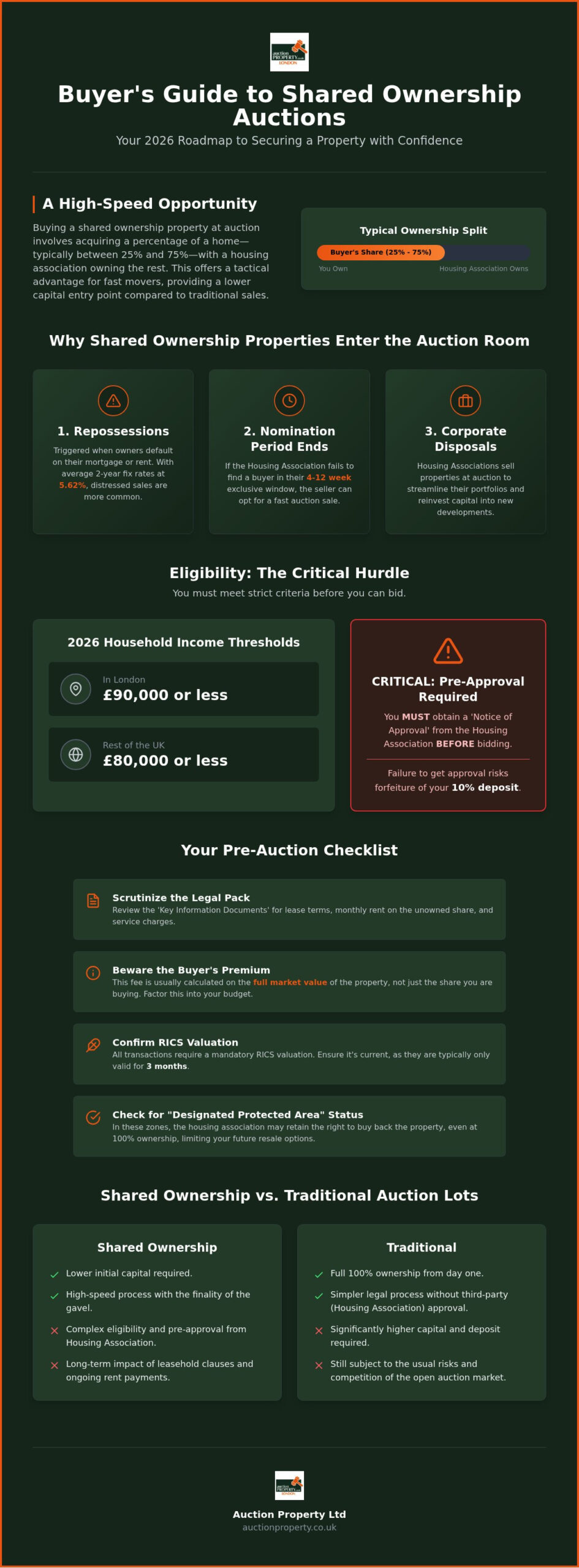
Buying a shared ownership property at auction involves acquiring a specific percentage of a home, typically between 25% and 75%, while the remainder stays with a housing association. In the 2026 market, these lots are no longer rare. They represent a high-speed alternative to the traditional, often sluggish, resale process. For investors and first-time buyers, the primary advantage is the lower capital entry point and the finality of the gavel. You aren’t just buying a home; you’re securing a stake in a property that has often bypassed the standard market due to specific legal or financial triggers. Understanding Shared Ownership is the first step in recognizing why these lots appear in auction catalogues rather than on estate agency windows.
Why Shared Ownership Properties Enter the Auction Room
Properties typically arrive at auction for three reasons. First, repossessions occur when previous owners default on their mortgage or the rent portion of their lease. With average mortgage rates holding at 5.62% for two-year fixes as of July 2026, financial pressure has increased the volume of distressed sales. Second, the nomination period is a critical factor. If a housing association fails to find a qualifying buyer within their mandatory 4 to 12 week window, the seller may gain the right to sell on the open market, often choosing the speed of an auction. Finally, housing associations use auctions for corporate disposals to streamline their portfolios and exit specific geographic areas quickly. This allows them to reinvest capital into new developments under the Affordable Homes Programme.
The 2026 Regulatory Landscape for Affordable Housing
Current UK housing standards in 2026 demand higher energy efficiency and structural integrity for all affordable housing lots. Buyers must check the legal pack for “Designated Protected Area” status. In these zones, even if you staircase to 100% ownership, the housing association may retain a right to buy the property back. This restriction limits your future resale potential on the open market. The nomination period in 2026 leases is defined as the exclusive timeframe during which the landlord has the right to find a buyer before the property can be auctioned. Additionally, all shared ownership transactions in 2026 require a mandatory RICS valuation. This valuation determines the price and is typically valid for only three months. When buying a shared ownership property at auction, you must ensure the RICS valuation is current to avoid financing delays and ensure the bid remains within market value.
Navigating the Legalities: Housing Associations and Bidding Eligibility
The Housing Association acts as the ultimate gatekeeper in any shared ownership transaction. When buying a shared ownership property at auction, you aren’t just competing against other bidders; you’re seeking formal approval from a landlord with strict regulatory mandates. Bidding without pre-approval is a high-risk strategy that often leads to disaster. If the gavel falls and you fail to meet the Housing Association’s specific eligibility criteria, you’ll likely forfeit your auction deposit. This financial penalty is severe, typically representing 10% of the purchase price, and there is rarely any legal recourse for an unapproved bidder.
Always scrutinize the ‘Key Information Documents’ contained within the auction legal pack. These files outline the specific lease terms, including the monthly rent on the unowned share and projected service charges. A common point of confusion for new bidders is the calculation of the buyer’s premium. In most auction contracts, this fee is calculated based on the full market value of the property, as determined by the RICS valuation, rather than just the value of the share you’re purchasing. You must factor this into your maximum bid to avoid a significant capital shortfall on completion day.
Pre-Auction Eligibility Checks
Eligibility is strictly governed by the official government shared ownership scheme guidelines. As of 2026, your combined household income must be £80,000 or less, or £90,000 or less if the property is located in London. You must also demonstrate that you’re unable to afford a suitable home on the open market. Before the auction date, you must obtain a ‘Notice of Approval’ from the housing provider. This document confirms you’ve passed their initial assessment and are a qualified purchaser. To streamline this process, you can review comprehensive legal packs through our platform to identify specific landlord requirements before you commit to a viewing.
The Leasehold Structure: What You Are Actually Buying
Your winning bid secures the leasehold interest in a specific share, plus the legal obligation to pay rent on the remainder. Most 2026 leases allow for ‘staircasing’, the process of purchasing additional shares until you own 100% of the property. Under the current model, the minimum staircasing transaction is 5%, and you have the option to buy an additional 1% share each year for the first 15 years. However, you must check for ‘Mandatory Buyback’ clauses. These are frequent in designated protected areas and require you to sell the property back to the Housing Association rather than on the open market, even if you’ve staircased to full ownership. This restriction limits your pool of future buyers and should be reflected in your initial bid price.
Evaluating Risks and Rewards: Shared Ownership vs. Traditional Lots
Buying a shared ownership property at auction requires a different risk-assessment framework than a traditional residential lot. You’re essentially bidding on a fraction of the property’s total equity, which dramatically lowers the capital hurdle for entry. This is a significant advantage for buyers who’ve been priced out of the open market. However, this lower entry price is balanced against the complexities of a leasehold structure. You must analyze the auction premium carefully. Since this fee is frequently based on the full RICS market value rather than the share you’re buying, it can represent a much higher percentage of your actual cash outlay than expected.
The most compelling reward is the combination of speed and certainty. In a market where traditional chains often collapse, the auction gavel creates a binding contract instantly. To navigate this successfully, professional legal pack provision is your most vital tool. It provides the transparency needed to bid without the fear of hidden clauses or administrative delays.
The Hidden Costs of Shared Ownership Auctions
The hammer price isn’t your only financial commitment. You’ll owe monthly rent on the unowned portion, and in 2026, these figures are subject to annual reviews that can impact long-term affordability. Service charges and sinking fund contributions are also mandatory. These are often overlooked by novice bidders but can add hundreds of pounds to your monthly outgoings. Unlike traditional sales where a 5% reservation fee might suffice, auctions require a 10% deposit the moment the hammer falls. You also need to account for the Housing Association’s administrative fees for the lease assignment, which are separate from the auctioneer’s costs.
Red Flags in the Auction Legal Pack
When you’re buying a shared ownership property at auction, the speed of the transaction leaves no room for post-bid discovery. You must identify red flags in the legal pack before the event. A lease with fewer than 80 years remaining is a critical warning sign, as it complicates future remortgaging and staircasing. Check for any existing arrears; some auction contracts stipulate that the buyer inherits the seller’s unpaid rent or service charges. Additionally, the Building Safety Act 2022 has introduced strict requirements for high-rise blocks. Ensure the pack includes a valid EWS1 form if applicable. Reviewing the Right to Shared Ownership scheme documentation can provide further insight into the specific regulatory protections or limitations tied to the lot.
The Bidding Process: Preparation and Financing Requirements
Successfully buying a shared ownership property at auction depends on your preparation in the weeks leading up to the event. Unlike a traditional purchase where you have months to arrange surveys and financing, the auction timeline is compressed into a 28-day completion window. Follow this precise five-step sequence to ensure you’re ready to bid when the gavel rises:
- Register and Review: Sign up with the auction house immediately and download the legal pack. This contains the lease details and the Housing Association’s specific requirements.
- Secure Financing: Obtain a ‘Decision in Principle’ from a lender that specializes in auction transactions. Standard high-street lenders are often too slow for the 28-day deadline.
- Inspect the Lot: Conduct a physical viewing. Since a RICS valuation is mandatory for shared ownership resales, ensure the valuation in the legal pack is less than three months old.
- Final Verification: Confirm your eligibility with the Housing Association at least 72 hours before the auction. They must verify your income and ‘Notice of Approval’ before you can legally commit.
- Calculate Your Ceiling: Set a strict maximum bid. This must include the buyer’s premium, which is often calculated on the full market value, plus any applicable stamp duty.
To begin your preparation, you can view our latest residential auction listings and access the essential legal documentation required for your due diligence.
Can You Get a Mortgage for a Shared Ownership Auction Property?
Securing a mortgage for these lots is challenging but possible. Traditional lenders typically require 8 to 12 weeks to process an application, which is incompatible with the auction’s 28-day completion requirement. The solution lies in bridging finance or specialist auction mortgages. These products are designed for speed, often allowing for completion in as little as 14 days. You must ensure your lender is comfortable with the specific Housing Association’s lease terms and the shared ownership structure. If the lender identifies a restrictive clause too late, you risk losing your deposit and the property.
Winning the Bid: What Happens When the Gavel Falls
The moment the gavel falls, you’ve entered into a legally binding contract. You don’t have a cooling-off period. You’re required to pay a 10% deposit immediately and sign the memorandum of sale. At this stage, you must provide your solicitor’s details and your pre-obtained Housing Association approval letter. The remaining 90% of the purchase price is typically due within 20 to 28 working days. For a deeper look at the general mechanics of the auction room, read our guide on How to Buy a House at Auction. Missing the completion deadline results in the forfeiture of your deposit and potential legal action for breach of contract, so your solicitor must be ready to move the moment the auction ends.
Executing Your Strategy with Auction Property Ltd
Auction Property Ltd provides the high-speed infrastructure necessary for buying a shared ownership property at auction with total confidence. Our platform simplifies the search for residential lots across the UK, allowing you to filter for properties that meet your specific investment criteria. We recognize that shared ownership lots involve layers of complexity that traditional auction houses often overlook. Our expert team provides dedicated administrative support to help you navigate these hurdles. This ensures your bid is backed by full legal transparency. By focusing on digitized legal packs and verified documentation, we position our clients for speed and certainty in a competitive 2026 market.
A Modern Approach to Property Transactions
Our online bidding infrastructure is designed to remove the friction associated with traditional property sales. You gain 24/7 access to our bidding portal and digitized legal packs. This allows you to conduct your due diligence on your own schedule. Our model eliminates the risk of gazumping and the protracted delays typical of estate agency chains. When you work with Auction Property Ltd, you’re partnering with a no-nonsense consultancy team. We prioritize results and clarity. Our consultants act as tech-forward facilitators who have digitized the auction experience without losing the gravitas of a high-stakes transaction. We focus on the critical data points you need to make an informed decision before the gavel falls. This practical approach is why we successfully transacted over £2,494,000 worth of property across our auctions in the last 12 months.
Next Steps: Register for Our Upcoming Auction
Don’t wait for the right property to appear on the open market. You can sign up for our automated alerts to receive immediate notifications when new shared ownership and residential lots enter our catalogue. This ensures you have the maximum amount of time to review the legal pack and satisfy the Housing Association’s eligibility requirements. If you have questions about a specific lot or the bidding process, our support team is available for a pre-auction consultation. We provide the practical guidance you need to transition from a curious observer to a successful bidder. Browse our current auction catalogue today to find your next opportunity and secure a property below market value with the efficiency of a modern auction platform.
Secure Your Strategic Advantage in the 2026 Auction Market
Buying a shared ownership property at auction is a sophisticated move that bypasses the friction of the traditional housing market. Success requires you to balance the speed of the gavel with rigorous pre-auction preparation. You must secure your Housing Association approval and verify the current RICS valuation before the bidding begins. By managing these legal and financial hurdles early, you position yourself to acquire a high-quality asset at a competitive price point. The 28-day completion window is a tight deadline; however, it offers a level of finality that traditional estate agency chains can’t match.
Auction Property Ltd is your partner in this high-speed environment. We provide national reach across all property types and a transparent, secure online bidding platform. Our team offers professional legal administrative assistance to ensure your transaction moves from bid to completion without unnecessary friction. Take the first step toward securing your new home or investment by joining our modern auction community. Register to Bid on UK Residential Auction Properties and gain access to the clarity and opportunity you need to succeed in today’s market. Your next successful transaction is only one bid away.
Frequently Asked Questions
Can I use a standard mortgage to buy a shared ownership property at auction?
No, standard high-street lenders cannot meet the 28-day completion deadline required when buying a shared ownership property at auction. Their valuation and underwriting processes typically take 8 to 12 weeks. You must use bridging finance or a specialist auction mortgage designed for rapid execution. Ensure your lender is comfortable with the specific Housing Association lease before you place a bid to avoid a financial shortfall.
Do I pay Stamp Duty on the full property value or just the share I buy?
You have two choices for paying Stamp Duty Land Tax (SDLT). You can make a “market value election” to pay on the full value upfront or pay only on the share you purchase. As of 2026, first-time buyers in England pay 0% stamp duty on the first £300,000 of the property’s value. This threshold is a vital consideration when calculating your maximum bid for an auction lot.
What happens if the Housing Association rejects my application after I win the bid?
A post-auction rejection usually results in the total loss of your 10% deposit. You have entered a legally binding contract the moment the gavel falls. If you fail to meet the eligibility criteria, the Housing Association will block the lease assignment. This leaves you in breach of the auction contract. You must obtain a formal “Notice of Approval” at least 72 hours before the auction begins.
Is the 10% deposit calculated on the share price or the full market value?
The 10% auction deposit is calculated on the winning hammer price, which represents the value of the share you are purchasing. However, be aware that the auctioneer’s administration fee or buyer’s premium is often calculated on the full RICS market value. You must read the “Special Conditions of Sale” in the legal pack to confirm which figure applies to each specific fee before bidding.
Can I staircase to 100% ownership on a property bought at auction?
Most shared ownership auction lots allow for staircasing up to 100% ownership, but you must verify this in the lease. Under the 2026 model, the minimum staircasing transaction is 5%. You also have the option to purchase an additional 1% share annually for the first 15 years. Check the legal pack for “Designated Protected Area” status, which might prevent you from ever owning the property outright.
What is the ‘nomination period’ and how does it affect auction buyers?
The nomination period is a 4 to 12 week exclusive window during which the Housing Association attempts to find a qualifying buyer. Shared ownership properties typically only enter the auction room after this period has expired or if the property is a repossession. For auction buyers, this means the landlord has already failed to find a buyer through traditional channels, potentially offering you a tactical advantage.
Are there any specific income limits for buying shared ownership at auction in 2026?
Yes, the 2026 income thresholds are strictly capped at £80,000 for households outside London and £90,000 within the capital. These are government-mandated limits that apply to all shared ownership purchases, including those made via the gavel. You must prove your household income falls below these figures during your pre-auction eligibility check. Failure to meet these limits will result in the Housing Association rejecting your application.
What are the common ‘red flags’ to look for in a shared ownership legal pack?
Critical red flags include leases with fewer than 80 years remaining and missing EWS1 safety certificates for high-rise blocks. You should also look for high service charge arrears or “cladding” clauses that could lead to significant future costs. When buying a shared ownership property at auction, ensure the RICS valuation is less than three months old. An expired valuation will cause your lender to reject your finance application immediately.